

Boxing has been around for thousands of years, and evolved from raw, bare-knuckle fights into the structured sport we see today.
Its origins trace back to ancient civilizations like Egypt, Greece, and Rome. Where people used fist fighting as a form of combat training and entertainment.
Over time, boxing evolved. Especially in 18th-century England, where bare-knuckle prizefights were popular. The first formal rules were introduced by Jack Broughton in 1743 to protect fighters in the ring.
The Marquess of Queensberry Rules in 1867, introduced gloves, timed rounds, and banned certain tactics like wrestling and hitting opponents while they were down. They laid the foundation for modern boxing as we know it today.
This page will explore the boxing rich history, evolution, and the rules that have shaped it into the sport we enjoy today. Let’s get started!
Ancient Greece and the Olympics
Boxing’s roots trace back to ancient civilizations. In the 3rd millennium BCE, the Sumerians of Iraq depicted boxing on artifacts. The early form involved two men punching each other with wrapped fists, and it shows the first use of boxing as a sport.
The Greeks later adopted and developed boxing. It became an official Olympic sport in 688 B.C. At this time, boxers wrapped their hands in leather thongs for protection.
Greek boxing matches were quite different from modern contests. There were no rounds. Boxers fought until one conceded or could no longer continue.
Weight divisions didn’t exist either, and large fighters often dominated the smaller ones. The traditional boxing stance: lead leg forward and the dominant hand drawn back, was introduced during this period. And formed the basis for the stance we still use today.
The Prizefighters of London
Boxing resurfaced in 16th-century England. Bare-knuckle boxing, known as “prizefighting,” became popular. The first documented match occurred in London in 1681. It was organized by Christopher Monck, 2nd Duke of Albemarle, between his butler and butcher.
By 1719, James Figg became the first English bare-knuckle boxing champion, and the term “boxing” was officially used.
In 1743, Jack Broughton, a famous bare-knuckle champion, introduced the first formal ruleset to protect fighters. These rules included a 30-second knockout count and prohibited tactics like hitting an opponent while down.
Many of Broughton’s rules are still part of modern boxing, like the bans on head-butting, eye-gouging, and biting.
The Marquess of Queensberry Rules
The late 1800s brought the rules that essentially define modern boxing. The Marquess of Queensberry rules, established by John Chambers and sponsored by the Marquess of Queensberry, set out clear guidelines for the sport.
They required boxing to take place in a square ring, typically 24 feet across. They introduced three-minute rounds with one-minute rest periods between them. The rules also mandated a ten-count for knockdowns and banned grappling or wrestling.
A major shift came with the introduction of boxing gloves. It increased safety and changed the nature of the sport. With gloves in play, boxing bouts became longer, and strategy took on a bigger role.
New defensive techniques like bobbing and weaving and counterpunching began to emerge. These innovations shaped boxing into the structured and strategic sport it is today.
Also Read: Venum Boxing Gloves Review

The Queensberry Rules
- Boxing matches should take place in a 24ft ring or as close to that size as possible.
- No wrestling or hugging allowed.
- Each round lasts 3 minutes with a 1-minute break in between.
- A fighter who falls must get up unaided within 10 seconds. If not, the referee may award the win to the other fighter.
- A fighter hanging on the ropes with his toes off the ground is considered down.
- No one is allowed in the ring during rounds except the fighters.
- The gloves must be of good quality and replaced if damaged.
- A fighter on one knee is down and entitled to the stakes if struck.
- No shoes or boots with springs allowed.
- Fights are governed by the Revised Rules of the London Prize Ring.
Boxing in America
Boxing arrived in the U.S. from England in the late 1700s and grew popular in urban areas like Boston and New York. Initially illegal, the sport gained acceptance in the 19th century with figures like Theodore Roosevelt advocating for it. John L.
Sullivan became America’s first heavyweight champion in 1882. He marked the start of a century-long reign of American champions. By the 20th century, boxing was a major economic force, and draw in minorities despite ongoing racism.
The sport hit a golden age in the 1960s and 70s, with stars like Muhammad Ali and Joe Frazier dominating the ring. Ali also used his platform to speak out on social and political issues. He’s a cultural icon beyond the ring.
Sonny Liston, who had great strength and power became world heavyweight champion in 1962, despite his criminal past and racist media treatment.
Jack Johnson, the first black heavyweight champion, faced racial discrimination throughout his career but remains one of boxing’s greatest champions. These icons left a lasting legacy on American boxing.

Modern Professional Boxing
Professional boxing today is governed by major organizations like the WBC, WBA, IBF, and WBO. Each one has set standards for safety and fairness.
The components include:
- The Boxing Ring: Typically square, from 16 to 24 feet on each side, and padded canvas over foam padding. Ropes are held by turnbuckles and should be taut for safety. The floor elevates up to 4 feet and must be well-lit.
- Gloves and Hand Wraps: Gloves vary by weight class, generally between 8 to 10 ounces for professionals. Hand wraps are used to stabilize the wrist and knuckles, to reduce injury risk.
- Protective Gear:
- Mouthguards: Protect teeth and reduce jaw injuries.
- Groin Protectors: Mandatory for male boxers to prevent low blow injuries.
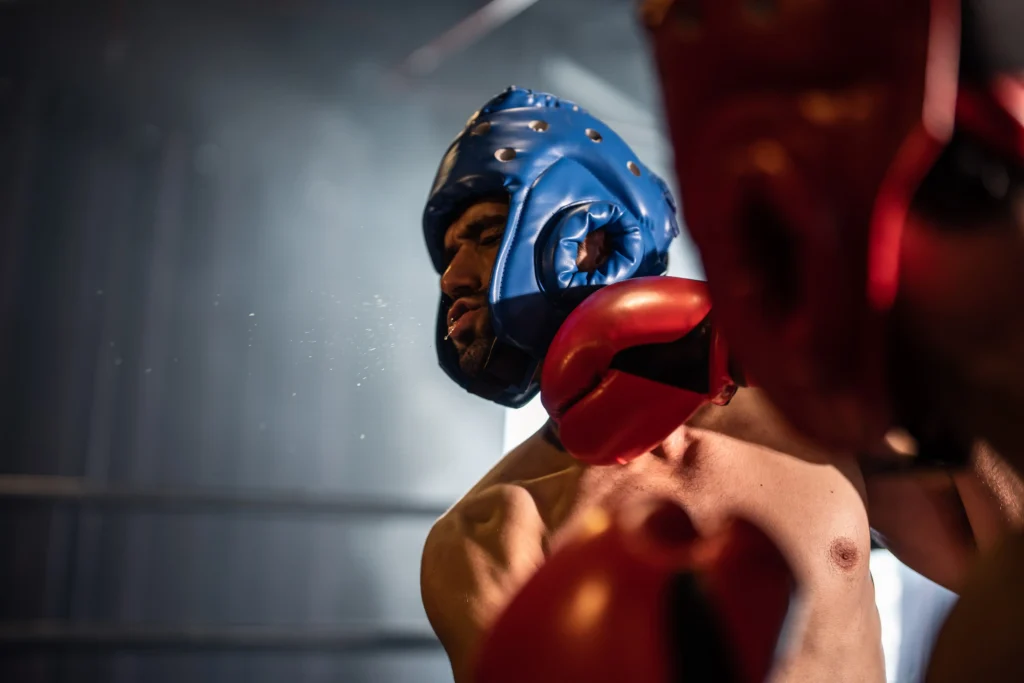
- Headgear: Required in amateur boxing to protect against cuts and bruises. Not used in professional bouts.
- The Officials and Their Roles:
- Referee: Enforces rules, for fighter safety, and has the authority to stop the fight if necessary
- Judges: Score the fight round-by-round, typically three judges are present.
- Timekeeper: Manages round durations and rest periods.
- Corner Team: Includes coaches and cutmen who advise and treat fighters between rounds.
Each component plays a part to maintain the integrity and safety of the sport.
The Unified Rules of Boxing
The rules areestablished by the Association of Boxing Commissions (ABC) for consistency and safety across professional boxing.
- Fight Duration: Championship bouts consist of 12 three-minute rounds with one-minute rest periods. Non-title fights typically have 4 to 8 rounds.
Knockdowns and Counts:
- A knockdown occurs when any part of a boxer’s body, other than the soles of their feet, touches the canvas.
- After a knockdown, the referee administers a mandatory 8-count.
- There is no standing 8-count. The referee must determine if a fighter can continue.
- The three-knockdown rule is not applied.
Knockout (KO) and Technical Knockout (TKO):
- KO: When a boxer is unable to continue after a 10-count.
- TKO: When the referee stops the fight due to a boxer’s inability to defend themselves, or a corner or doctor stops the bout.
Mouthpieces: Mandatory for all fighters. If dislodged, the referee calls time to replace it without interrupting the action.
Fouls:
- Intentional Fouls: Result in point deductions or disqualification, depending on severity.
- Accidental Fouls: If the bout is stopped before four rounds, it’s a no decision. After four rounds, the bout is a technical decision if the injured boxer is ahead on the scorecards.
Fouls and Infractions: What’s Not Allowed in the Ring
Prohibited Actions:
- Hitting below the belt (low blows)
- Hitting behind the head (rabbit punch) or back of the neck
- Hitting a downed opponent
- Holding, wrestling, or clinching excessively without punching
- Hitting with the open glove, wrist, or elbow
- Headbutts (accidental vs. intentional)
- Pushing, tripping, or kicking
- Biting or spitting
Penalties and Their Impact:
- Warnings from the referee
- Point deductions
- Disqualification (DQ) for repeated or egregious fouls
- Accidental fouls leading to no-contests or technical decisions
The rules ensure fighter safety, fair competition, and clear scoring. Intentional fouls can lead to severe penalties. Accidental fouls are handled based on severity and timing.
Scoring a Boxing Match: The 10-Point Must System
- Each round is scored independently
- The winner of the round receives 10 points. The loser receives 9 points (or less for knockdowns/fouls)
Criteria for Judging a Round:
- Effective Aggression: Forcing the action, landing meaningful punches
- Ring Generalship: Controlling the pace, dictating location, imposing will
- Defense: Avoiding punches, blocking, slipping, parrying
- Clean Punching: Landing punches legally and effectively
Scoring Scenarios (Examples):
- 10-9: Close round, one fighter clearly wins
- 10-8: With a knockdown for the winning fighter
- 10-7: With two knockdowns for the winning fighter
- 10-9: With a point deduction for the losing fighter, even if they won the action
- 10-8: With a point deduction for the losing fighter AND a knockdown for the winning fighter
The judges have a structured approach to evaluate each round, and promote consistency and fairness in scoring.
Professional boxers also undergo medical evaluations, like blood tests for HIV, Hepatitis B, and Hepatitis C, and physical and eye exams, for competition fitness.
Also, they are subject to drug testing to detect the presence of prohibited substances. Some boxing commissions have implemented instant replay systems to review potential fouls for fair outcomes in matches.
Summing Up
Boxing has come a long way! The ancient Sumerian carvings showing fistfights to today’s highly regulated global sport. Its evolution reflects a journey from raw combat to a refined contest of skill and strategy.
Boxing also holds cultural and historical significance. It has served as a platform for social change. The figures like Muhammad Ali used their prominence to challenge societal norms.
The sport’s impact extends into the arts, and inspire countless works in literature, film, and visual media.
Boxing embodies a unique blend of art, athleticism, and controlled aggression. Its enduring appeal lies in the timeless human fascination with competition and resilience.
As you watch a match, consider the centuries of tradition and the evolution of the “Sweet Science” that have shaped it into the spectacle we appreciate today!