

A boxing jump rope has one job: keep up with your rounds.
That sounds simple until you are training on concrete, your hands are wrapped, your grip is soaked, and the rope gets tossed into a packed gym bag after every session.
A cheap rope can feel fine at first. But after a few weeks of hard use, the cable kinks, the handles slip and the coating wears down. One bad catch on the floor, and your rhythm is gone.
A jumping rope is warm up tool but it affects your timing, footwork, breathing, and focus. If it fails, it breaks the round and pulls your mind away from training.
The real cost is not just the money you spent. It is the lost rounds and the broken rhythm. Most general fitness rope guides focus on home workouts, clean floors, and short sessions. Boxing training is rougher than that. You need a rope that can handle sweat, fast turns, repeated impact, and the wear that comes from real gym use.
Stay with me and you’ll find a jump rope that feels steady in your hands, holds up under pressure, and lets you focus on your rounds instead of your gear.
Let’s start!
Key Takeaways
- On a speed rope, bearing quality and grip matter more than max RPM. Smooth bearings and grippy handles help keep your timing steady when sweat and concrete are in the mix.
- Weighted ropes help build the shoulder endurance that keeps your guard from dropping late. With the Crossrope system, you can move from 1 lb warm-up rounds to heavy 2 lb power rounds as your session gets harder.
- The cheaper rope is not always cheaper. A $65 rope with $10 to $15 replacement cables can cost less over a year than a $20 rope you keep replacing every other month.
- Rope length matters most when measured in your boxing stance. Too short makes you hunch and too long makes you trip. Start a little long, then trim it down.
- Sound is important too. A clean, steady click gives you a rhythm you can match to footwork, breathing, and combinations.
Table of Contents
Best Boxing Jump Ropes at a Glance
If you need a rope right now, here is a quick table, and each pick below is matched to a specific boxing training need.
| Best For | Rope Name | Key Feature | Price |
|---|---|---|---|
| Best Overall Speed Rope | RPM Training Session 4 | Knurled aluminum handles, dual-bearing spin, replaceable coated cable | Check Here |
| Best Weighted System for Shoulder Endurance | Crossrope Get Strong Set | Power Handles, 1 lb and 2 lb ropes, fast clip changes | Check Here |
| Best Lower-Cost Speed Rope for Beginners | EliteSRS Surge 3.0 | Dual ball-bearing rotation, aluminum handles, foam grip | Check Here |
| Best Classic Leather Rope for Warm-Ups and Timing | TITLE Classic Leather Speed Rope 2.0 | Genuine leather rope, ball-bearing swivels, foam grip handles | Check Here |
| Best Customizable System for Fine Tuning | Rx Smart Gear EVO G2 | Diamond-knurled aluminum handles, cable length and cable type options | Check Here |
| Best Entry-Level Rope with Reliable Grip | Everlast Speed Rope | Comfortable grip, adjustable rope length, beginner-friendly feel | Check Here |
| Best Adjustable Freestyle Rope for Versatility | Honor Athletics Speed Rope | Adjustable length, PVC rope, lock-style length system | Check Here |
The RPM Session 4 is the safest starting point for most boxers. The knurled aluminum handles stay steady in wrapped hands, the spin is fast without feeling wild, and the cable can be replaced when it starts to wear down.
If you are not sure where to start, buy this.
My In-Depth and Honest Boxing Jump Ropes Reviews
Here is how each rope held up in boxing training setup.
I looked at the things like grip with wrapped hands, cable wear on concrete and rubber floors, spin consistency when sweat gets involved, and how easy it is to keep the rope going once parts start to wear.
I also judged each rope by the job it is best at. Some ropes are built for speed work. Some are better for shoulder conditioning and some make more sense as warm-up ropes. That’s why the right pick depends on how you train.
1. RPM Training Session 4
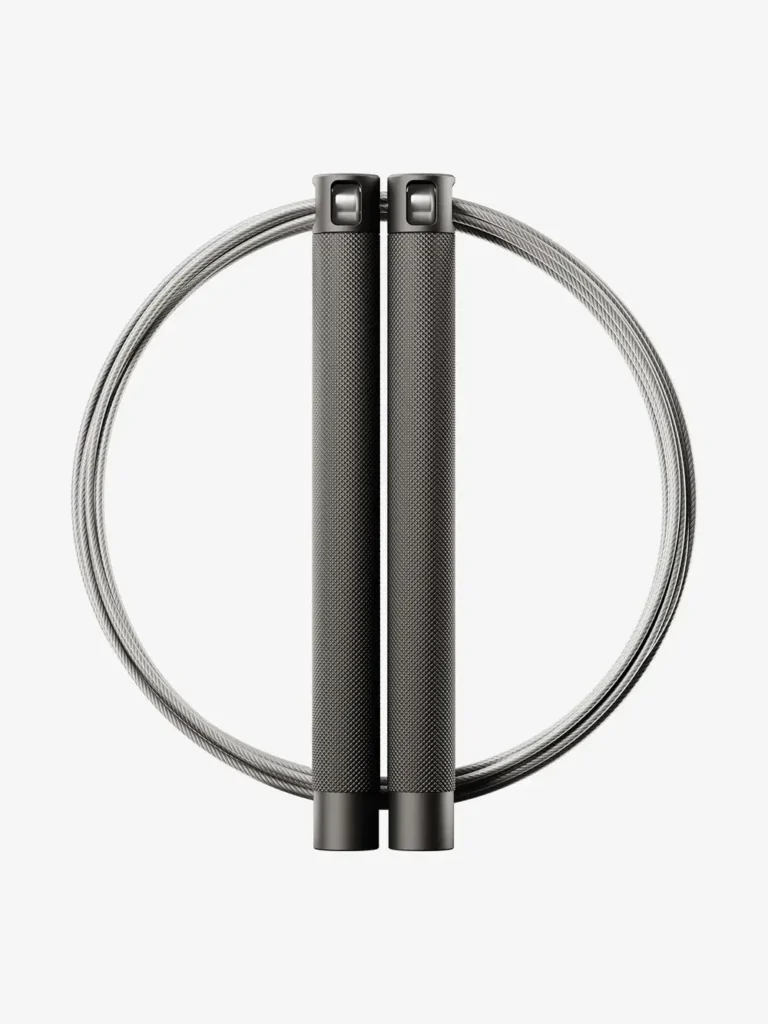
The RPM Training Session 4 is the rope I would trust most for speed rounds and double-under finishers after bag work.
It feels fast, but not loose. The spin stays clean, and the cable does not feel like it is fighting your hands. RPM uses a dual-axis rotation system and an anti-friction dual-bearing setup, which is a big reason the rope turns so smoothly without twisting up during hard rounds.
The handle feel is the main win for boxers. The aluminum handles feel secure with wraps, even when your hands are sweaty and your grip starts getting lazy late in the session. They give you enough texture to stay locked in without feeling rough or distracting.
On concrete, the coated cable showed normal surface scuffing, but it held up better than cheaper cables in this test. I would still use a mat if you can, because concrete wears down any cable over time. The good part is that RPM cables are replaceable and easy to find, so you are not replacing the whole rope once the cable wears out.
The Session 4 is not the cheapest rope here. But it is the one that feels the most dependable when the pace gets high and your form starts getting tested.
The only real downside is the price of entry. Still, if you train often and care about rhythm, speed, and grip, this is the safest speed rope pick.
2. Crossrope Get Strong Set
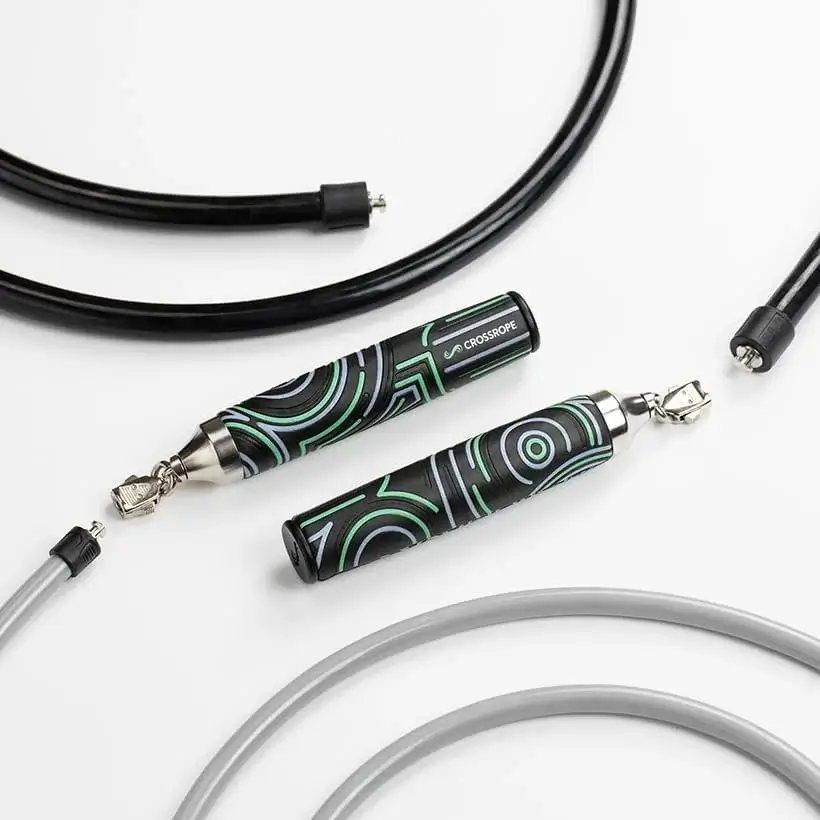
The Crossrope Get Strong Set is more of a conditioning tool.
This set includes Power Handles, a 1 lb rope, and a 2 lb rope. The fast clip system lets you change rope weights quickly, which makes it easy to move from a hard shoulder round into lighter footwork work without wasting time.
I used the 1 lb rope for full 3-minute rounds and the 2 lb rope for shorter, harder intervals. The spin is heavy and deliberate. You cannot rush it, and that is the point. If your shoulders get lazy, this rope tells on you fast.
The handles are thicker than a normal speed rope handle. They do not bite into wraps the way knurled aluminum does, but the grip feels secure enough for power rounds. With wet wraps, I still felt in control, especially because the heavier rope naturally slows your turn rate.
The quick connection stayed locked in during testing. That matters, because the last thing you want is a heavy rope shifting or coming loose mid-round.
The trade-off is cost. The set is pricey, and replacement weighted ropes cost much more than standard speed rope cables.
It is not the rope I would pick for daily double-unders or fast footwork. But for shoulder endurance, high-guard conditioning, and hard finishers, it does a job that a normal speed rope cannot.
3. EliteSRS Surge 4.0
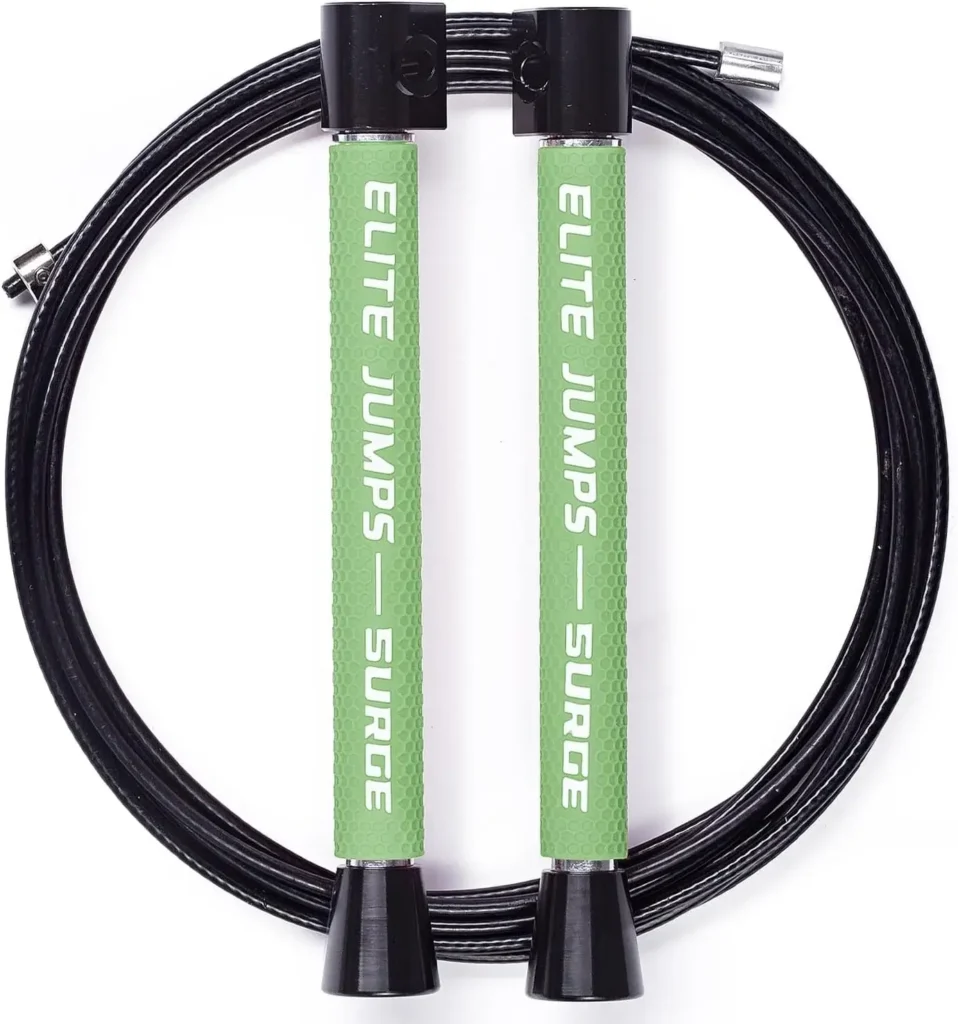
The EliteSRS Surge 4.0 is the value speed rope in my lineup.
It fixes one of the biggest issues with cheaper speed ropes: grip. Instead of the old foam-style feel that can get slick or peel, the Surge 4.0 uses a silicone-textured sleeve over lightweight aluminum handles. It is not as secure as aggressive knurling, but it is much better than basic foam when your hands are sweaty.
The spin is fast right away. The 5-inch aluminum handles are light, the dual-bearing system turns smoothly, and the standard 2.4 mm nylon-coated steel cable feels quick enough for double-unders and fast boxing footwork.
On rubber flooring, the Surge 4.0 felt like a strong value. On concrete, the cable still needs care. The coating will wear if you use it on rough surfaces often.
About pricing, it sits in a nice middle lane. It is cheaper than the RPM and far cheaper than the Rx Smart Gear EVO G2, but it still gives you real speed rope performance.
For beginners and intermediate boxers, this is one of the better low-risk speed rope buys. If you are already doing hard double-under sets every week, the RPM or EVO G2 will feel more locked in, but the Surge 4.0 gives you plenty for the price.
4. TITLE Classic Leather Speed Rope 2.0
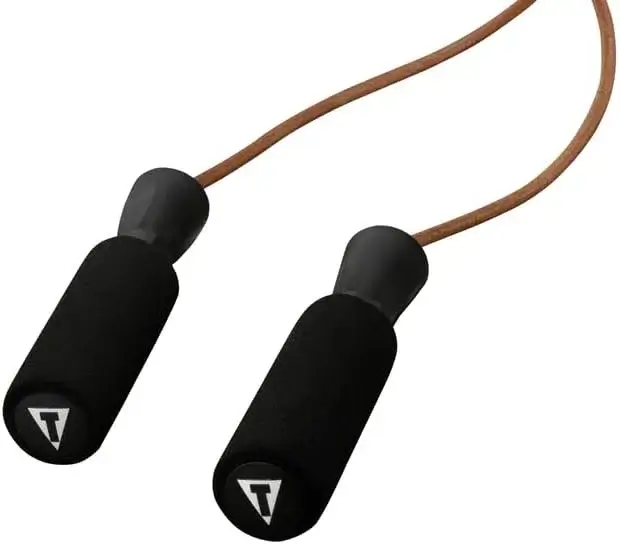
The TITLE Classic Leather Speed Rope 2.0 is a warm-up rope, not a max-speed rope.
The genuine leather rope gives it a slower, heavier feel than a cable speed rope. That makes it useful before sparring, bag work, or mitt rounds, because it forces you to relax and find a steady rhythm instead of rushing every turn.
The sound is part of the appeal. The leather gives a clear slap against the floor, and that sound helps you settle into timing. It is not fast like the RPM or Surge 4.0, but it gives you feedback you can actually feel and hear.
There are ball-bearing swivels and foam grip handles. The foam handles are comfortable, but with wet wraps they can get slick. A simple layer of athletic tape fixes that fast.
On concrete, the leather showed wear at the contact point. That is expected. Leather can take some abuse, but it still needs more care than a coated steel cable. If you use this rope mostly for warm-up rounds, it should last longer.
It is not the rope for double-under goals. It is the rope for getting your feet under you, finding your breathing, and starting the session with cleaner timing.
5. Rx Smart Gear EVO G2
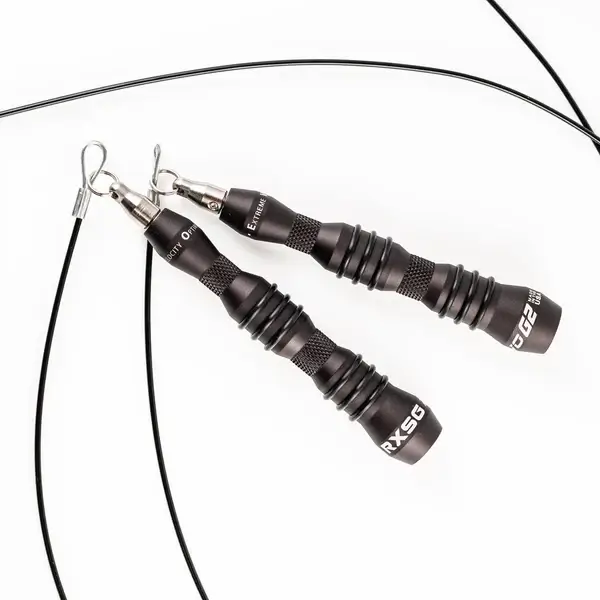
The Rx Smart Gear EVO G2 is the a serious speed rope, and it comes with a high price.
The handles are the first thing you notice. They use diamond knurling and traction bands, so your fingers have clear grip points even when your wraps are damp. The aluminum handle body feels solid, and the bearing system is extremely fast.
The EVO G2 is also a fixed-length rope, so sizing matters more here than it does with adjustable ropes.
In use, the rope feels sharp, light, and very direct. It rewards clean technique. If your hands drift wide or your timing gets sloppy, the rope will not hide it from you.
On concrete, the cable showed normal wear, but the handles and head assembly felt solid throughout testing. Still, with a rope this expensive, I would not make concrete your main surface unless you are using a mat.
For experienced fighters who want a fast rope with excellent grip and a very clean turn, the EVO G2 is a strong pick. For beginners, it is probably more rope than you need.
6. Everlast Socket Speed Rope
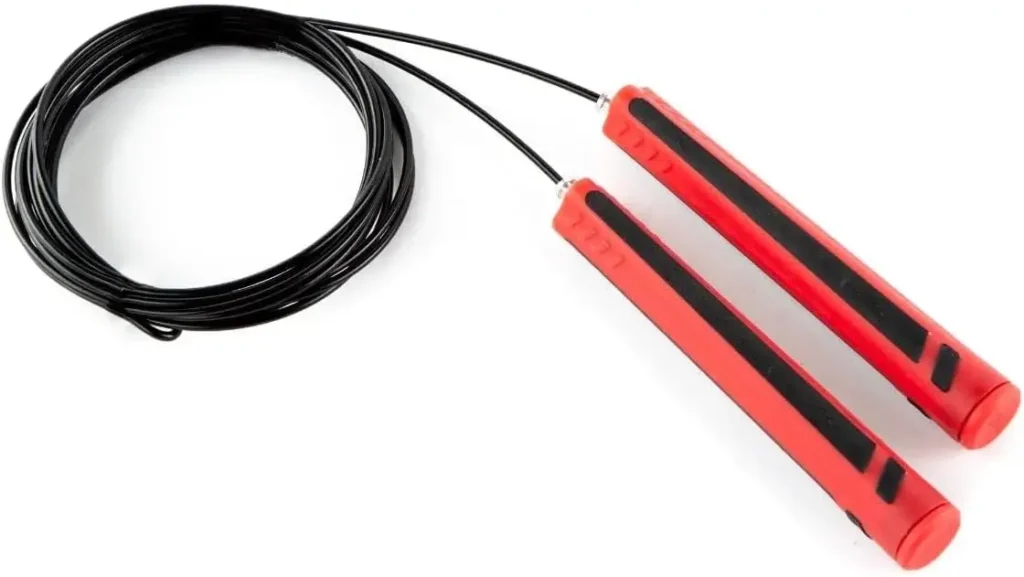
The Everlast Socket Speed Rope is the entry-level pick with a few useful features.
It is an 11-foot rope with a durable cable, steel ball joint rotation, adjustable length, and removable handle weights. That makes it more useful than a basic plastic rope, especially for someone who is new to boxing conditioning and wants a simple way to start.
The spin is smooth enough for beginner rounds. It will not feel as quick or clean as the RPM, Surge 4.0, or EVO G2, but it does the job for basic footwork, warm-ups, and light conditioning.
The grip is basic. With dry hands, it is fine. With soaked wraps, I would add athletic tape to get more control. That small fix makes the rope much easier to use in a boxing gym.
Use the Everlast Socket on rubber flooring or a mat, especially if you are new and still working on timing. Once you are training consistently, upgrade to a rope with better grip and easier cable replacement.
For the price, it is a good starter rope. It is a gateway rope, not your final option.
7. Honor Athletics Speed Rope
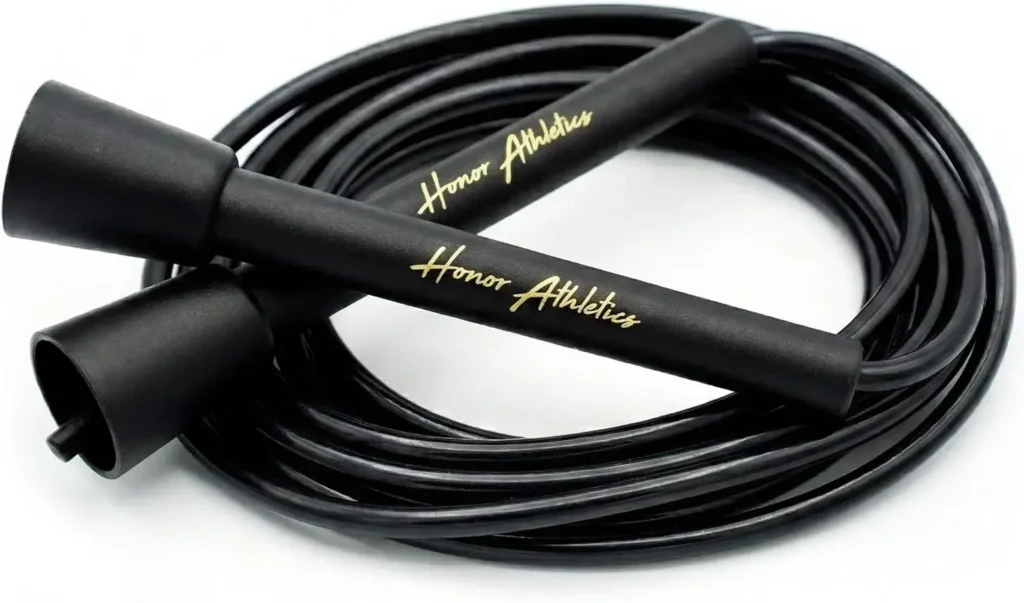
The Honor Athletics Speed Rope is a good baseline rope.
It works for casual skipping, beginner cardio, and light footwork. The 10-foot adjustable rope and 5 mm PVC cord make it easy to pick up and use without much setup. The handles are light and simple, and the rope has enough weight to give beginners a clear feel for the turn.
For boxing, though, the limits show up fast.
The PVC cord is thicker and slower than a cable speed rope. That can help beginners learn rhythm, but it does not feel sharp enough for serious speed work. On concrete, the rope started to hold bends and wear at the contact point. That is the trade-off with low-cost PVC ropes.
Grip is also a concern. The handles are fine for dry hands, but once wraps get wet, they do not feel as secure as knurled aluminum, silicone texture, or taped handles.
It is a general fitness rope being used in a boxing setting, and it feels that way.
If you already own the Honor Athletics rope, use it for light warm-ups or basic footwork on a mat. Do not rely on it for hard fight-camp rounds on concrete.
If you train once in a while, it can get you moving. If you train like a boxer, you will outgrow it quickly.
Compare the Specifications Here
The reviews give you the feel of each rope. Here are the specs side-by-side.
Remember, specs only matter if they match your training. For boxing, the key things are grip with wrapped hands, smooth rotation, cable life, and whether you can replace parts when the rope wears down.
Not every rope here is built for the same job.
Also, adjustability is not the same across the board. Some ropes can be trimmed or adjusted at the handle. Crossrope is chosen by size. Rx Smart Gear EVO G2 is custom-cut, so you need to get the length right before you buy.
| Rope Name | Weight Category | Cable Or Rope Material | Handle Grip Type | Adjustable? | Best For Boxing Use | Pricing |
|---|---|---|---|---|---|---|
| RPM Training Session 4 | Speed | Coated cable | Aluminum handle with textured grip | Yes, adjustable and replaceable cable | Speed work, double-unders, fight-camp conditioning | Check price |
| Crossrope Get Strong Set | Weighted | 1 lb and 2 lb weighted ropes | Power Handles with textured grip | No, choose size at purchase | Shoulder endurance and power conditioning | Check price |
| EliteSRS Surge 4.0 | Speed | 2.4 mm nylon-coated steel cable | Aluminum handles with silicone-textured sleeve | Yes, adjustable cable | Budget-friendly speed work and beginner to intermediate footwork | Check price |
| TITLE Classic Leather Speed Rope 2.0 | Leather | Genuine leather rope | Foam grip handles | No, sold in fixed sizes | Warm-ups, rhythm, coordination, and old-school timing | Check price |
| Rx Smart Gear EVO G2 | Speed | Fixed-length cable options | Diamond-knurled aluminum handles with traction bands | No, custom-cut fixed length | Advanced speed work and precise rope setup | Check price |
| Everlast Socket Speed Rope | Speed | Durable cable rope | Weighted handles with removable weights | Yes, adjustable rope | Basic boxing conditioning and entry-level speed work | Check price |
| Honor Athletics Speed Rope | Freestyle / fitness | 5 mm PVC cord | Lightweight handles | Yes, snap-lock adjustment | Light warm-ups, basic skipping, and casual boxing cardio | Check price |
What To Check Before You Buy a Boxing Jump Rope
You have seen the rope picks. Now let’s talk about why one rope holds up while others don’t.
For boxing, a jump rope has to deal with sweat, wrapped hands, rough floors, fast rounds, and gym-bag abuse. The difference usually comes down to three things: how smoothly it spins, how secure the handles feel, and how well the cable survives your training surface.
Before you buy, know what makes a rope perform or fail under boxing conditions.
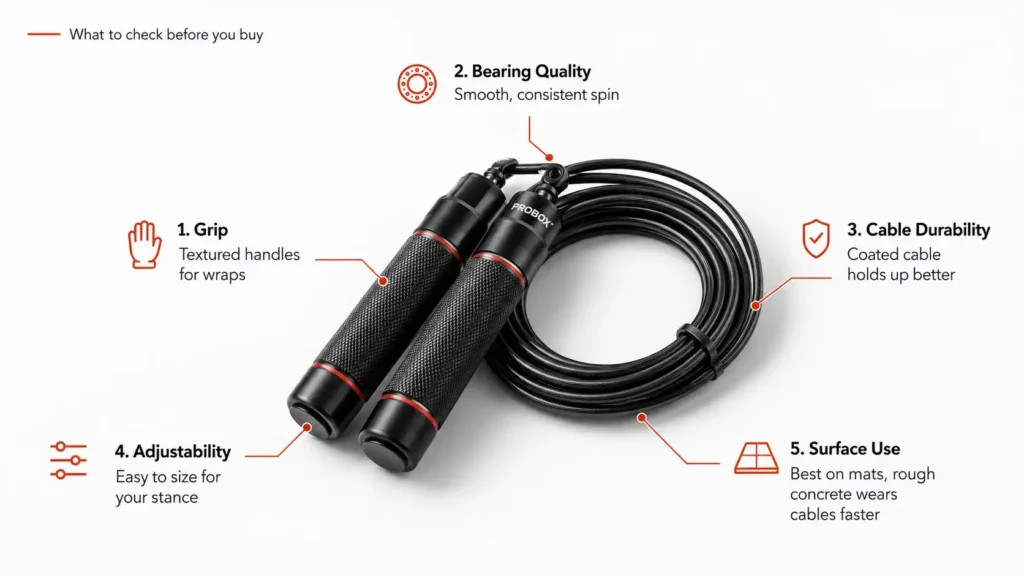
1. Bearing Systems
A rope’s sound becomes your beat. When the spin is smooth, your feet can stay relaxed and on time. When the bearings drag, click unevenly, or feel rough, your timing starts to slip.
That small delay can ruin a double-under set or break your rhythm during a three-minute round.
Ball bearings use small metal balls to reduce friction inside the handle. That gives the rope a smoother, more predictable turn. Bushings are simpler sleeves. They can still work on basic ropes, but they usually create more drag and can feel rough after heavy use.
Sealed or well-protected bearings are a real plus in a boxing gym. Sweat, chalk dust, and floor grit get everywhere. In my testing, sealed bearing units stayed cleaner, while open assemblies showed grit and early rust.
The RPM Session 4 uses a dual-bearing anti-friction system with dual-axis rotation and replaceable coated cables. That is the kind of speed rope build that makes sense for boxers who care about timing.
The EliteSRS Surge 4.0 also uses dual ball bearings, which is strong for its price range. Still, if you train in a hot, sweat-heavy boxing gym, the bearing feel and handle grip matter more.
2. Handle Design and Grip Security with Hand Wraps
Hand wraps change the grip completely.
A handle that feels secure bare-handed can start moving around once your 180-inch Mexican-style wraps are soaked. I tested each rope with dry wraps and wet wraps, and texture wins.
Knurled aluminum handles, like the ones on the RPM Session 4 and Rx Smart Gear EVO G2, bite into the fabric instead of sliding over it. The EVO G2 also adds traction bands, which help your fingers land in the same place each round.
Crossrope takes a softer route with its Power Handles. The grip is not as sharp as knurling, but it gives you enough control for weighted rope work, where shoulder load matters more than pure speed.
Foam grips are more hit or miss. They can feel comfortable at first, and some brands use them well, but once sweat builds up, they can get slick or spongy. For a quick warm-up, that may be fine. For a full fight-camp conditioning block, I would rather have knurling, rubber texture, or grip tape.
Handle length matters too. If a handle is too short, your wrists can feel cramped during crossovers and side swings. To test, close your wrapped hand around the handle. You should still have at least an inch past your fist.
3. Weight Changes and Training Flow
This is where Crossrope makes sense for boxers who want shoulder endurance work.
The Get Lean set uses 1/4 lb and 1/2 lb ropes, while the Get Strong set uses 1 lb and 2 lb ropes with Power Handles. That gives you room to warm up light, then switch into heavier rope rounds when you want your shoulders and grip to work harder.
For boxing, that kind of weight change matters. A heavy rope exposes lazy shoulders fast. If your guard starts dropping late in rounds, weighted rope work can show you the problem before sparring does.
Just do not treat a weighted rope as a speed rope. It has a different job. Use lighter ropes for rhythm, footwork, and double-unders. Use heavier ropes for shoulder burn, grip pressure, and conditioning.
Boxing-Specific Priorities
Most general fitness guides talk about speed, calories, and beginner comfort. Those things matter, but boxers should look harder at three less obvious details: sound, bag survival, and long-term cost.
Sound matters because rhythm matters. A rope that makes the same sound every turn helps you stay on tempo. The click or whir becomes feedback. When the sound changes, your timing often changes too.
Bag survival is next. Some ropes need careful coiling and a case. That is fine if you train in controlled conditions, but boxing gear gets tossed around. PVC-coated steel cables usually handle that better than bare steel or leather. Bare steel is fast, but it can fray and wear quickly on rough floors. Leather has great feel for warm-ups, but it needs more care.
Long-term cost is also important. A higher-priced rope with cheap replacement cables can be the better buy if you train three times a week on rough flooring. A cheap rope that dies every few months is not really cheap.
Sizing and Adjustment Guide: Get the Length Right Before You Train
A rope that does not fit will make you blame your footwork when the real problem is the cable length.
Most boxers cut their rope too short because they measure standing tall, feet even, shoulders square. But that is not how you jump in training. You jump in a boxing stance, with your feet slightly staggered, knees soft, and weight on the balls of your feet.
That stance changes how the rope moves around your body. Even a small length mistake can make you clip your toes, lift your hands too high, or hunch forward without noticing.
If the rope is too long, your hands start drifting up to control the slack. Your shoulders tighten, your elbows rise, and the rope slaps the floor too hard.
If the rope is too short, you start folding forward, cutting your stride, and catching your toes. Both problems build bad habits into your rhythm.
Step 1: Measure In Your Boxing Stance
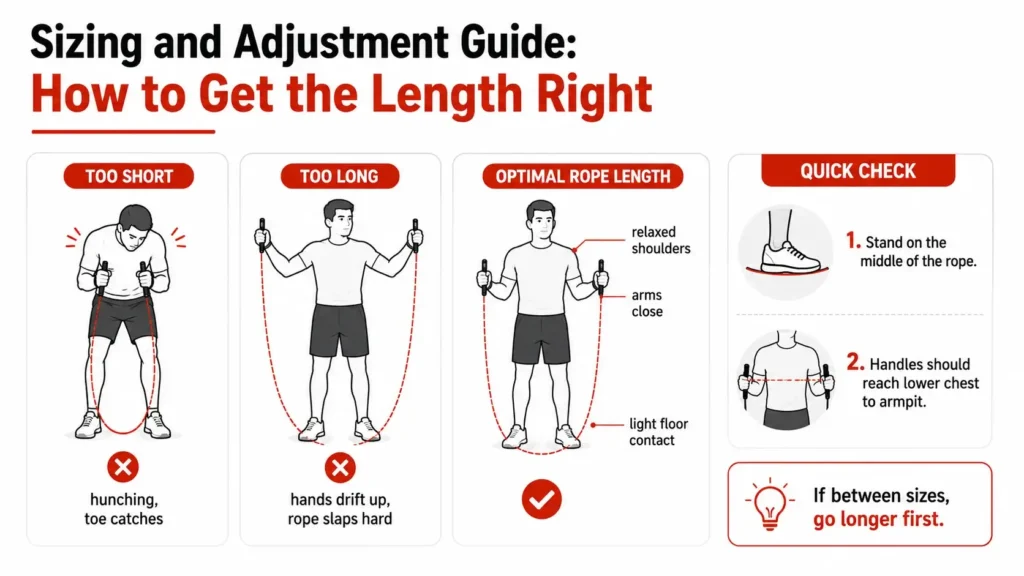
Stand on the middle of the rope with one foot in your natural boxing stance. Use the same stance you would use during a skipping round.
Pull both handles straight up along your sides.
For most beginners, the handle tops should land around the lower chest to armpit range. It gives you enough clearance while you learn your rhythm.
For more advanced boxers, you can go slightly shorter, closer to lower chest height, because a shorter rope turns faster and keeps your hands tighter. Just do not cut it so short that you start hunching or clipping your feet.
Step 2: Adjusting a Trim-Style Rope
Use this for ropes like the RPM Training Session 4, EliteSRS Surge 4.0, Everlast Socket Speed Rope, and most adjustable fitness ropes.
Loosen the handle cap or locking piece, then slide the cable to your measured length. Before you cut anything, test the rope for 30 seconds.
Once the length feels right, leave a small tail inside the handle before tightening it down. That gives the screw or lock something to hold onto.
Do not cut it flush right away. If you cut too close and the rope slips, you have no room to fix it.
After your first round, check the screws again. Fast turns and floor impact can loosen a cable that felt tight in your hand.
Step 3: Adjusting The Honor Athletics Speed Rope
The Honor Athletics Speed Rope uses a snap-lock style adjustment, so the process is simple.
Set the rope to your length, lock it down, then tug both sides before you jump. If the lock shifts by hand, it will shift faster once you start turning the rope.
The rope is fine for light warm-ups and basic skipping, but I would not treat the lock system like a long-term fight-camp setup. Check it often.
Step 4: Sizing A Crossrope Get Strong Set
Crossrope is different because you do not trim it like a normal speed rope. You choose your rope size when you buy it.
That means you should check the brand size guide before ordering and match it to your height. If you are between sizes, think about how you jump. A newer boxer usually needs a little more clearance. A more experienced jumper may prefer a tighter turn.
Since this is a weighted rope set, do not size it too short. The 1 lb and 2 lb ropes need space to move. If the rope is too short, it will punish your shoulders and timing fast.
Step 5: Sizing The Rx Smart Gear EVO G2
The Rx Smart Gear EVO G2 is a custom-cut rope, not a normal adjustable rope.
You choose the cable length before you buy, and the rope is built around that length. Do not guess here. Measure a rope you already like, or use Rx Smart Gear’s sizing guide before ordering.
If you are still learning your preferred length, the EVO G2 may not be the best first speed rope. Start with an adjustable rope, find your length, then move to a fixed-length rope once you know what works.
Step 6: Sizing A Fixed-Length Leather Rope
The TITLE Classic Leather Speed Rope 2.0 comes in fixed sizes, so choose based on your height and the brand’s size options.
Do not tie knots in a leather rope to shorten it. A knot changes the weight balance and makes the rope wobble. That ruins the smooth rhythm you bought the leather rope for in the first place.
If you want it mainly for warm-ups, it is better to be slightly long than too short. A little extra length gives you time to relax into the turn.
Step 7: Test The Rope Before You Commit
Once the rope is set, jump for 30 seconds at your normal pace.
The rope should tap the floor lightly with each turn. Your hands should stay around waist level, your elbows should stay close, and your shoulders should feel relaxed.
If your arms lift and the rope slams the floor, it is too long. Trim a tiny bit and test again.
If you keep catching your toes or leaning forward, it is too short.
A good rope length should feel quiet in your mind. You should be thinking about your rhythm, breathing, and footwork, not the rope.
Speed vs. Weighted vs. Beaded: Which Rope Type Matches Your Boxing Goal?
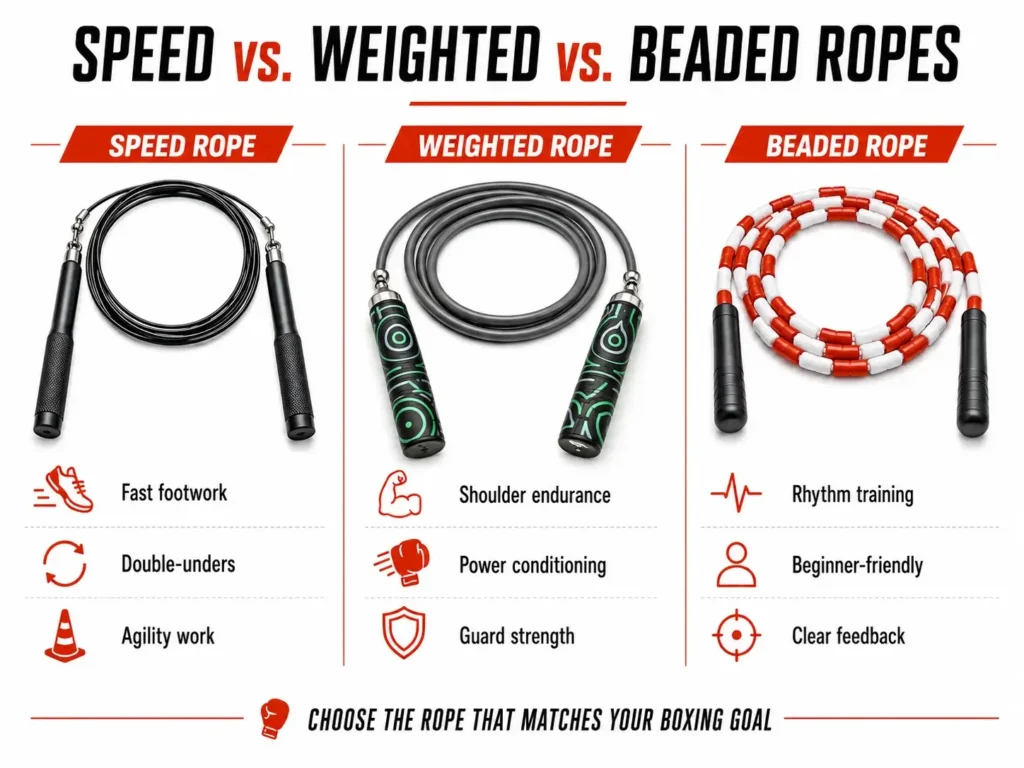
In a boxing gym, three rope types matter most: speed ropes, weighted ropes, and beaded ropes.
Speed Ropes
A speed rope is built for fast turns.
Most use a thin coated steel cable, smooth bearings, and light handles. That setup lets the rope move faster than your feet want to move, which is exactly the point. It pushes you to stay light, shorten ground contact, and keep your footwork sharp.
For boxing, a good speed rope should feel quick but controlled. If the rope spins fast but keeps twisting, skipping, or slipping in your hands, it is not helping you.
Look for smooth bearing rotation and handles that stay secure with wraps. Knurled aluminum, silicone texture, or strong rubber grip all work better than slick plastic or worn foam when sweat builds up.
Try this drill:
30 seconds fast basic bounce
30 seconds double-unders
30 seconds boxer shuffle, shifting weight foot to foot like you are cutting an angle
30 seconds rest
Repeat for three rounds.
That last boxer shuffle section is important. It connects rope speed to ring movement, so the drill does not feel like random cardio.
Weighted Ropes
A weighted rope changes the whole feel of the round.
Once the rope has real weight, your shoulders, upper back, grip, and forearms have to work harder. That is why a 1 lb rope can make your guard feel heavy fast, even if your legs still feel fine.
The Crossrope Get Strong Set fits this role well because it includes 1 lb and 2 lb ropes with Power Handles. The 1 lb rope works better for longer conditioning rounds. The 2 lb rope is better for short, hard intervals where the goal is shoulder burn, not speed.
Just do not treat a weighted rope like a speed rope. You are not chasing the fastest turn rate here. You are building control while tired.
Try this drill:
2 minutes weighted rope at a steady pace
Focus on elbows tucked and wrists turning the rope
Drop the rope and go straight into 2 minutes on the heavy bag
No rest between the rope and bag work
Your shoulders will already be tired when you start punching. That is the point. You learn to throw clean shots when your arms want to drop.
Beaded Ropes
Beaded ropes are not about speed records, but timing.
The plastic beads hit the floor with a clear, steady sound, so you can hear your rhythm. If your timing is off, the sound tells you right away. That feedback is useful for beginners, warm-ups, and anyone trying to clean up their basic bounce.
Beaded ropes also handle gym-bag life better than most cable ropes. They do not kink the same way, and they are easy to pull out and use without fussing over the cable.
Use a beaded rope for the first few warm-up rounds. Let the sound set your timing. Then switch to a speed rope or weighted rope once your feet are moving cleanly.
Maintenance And Longevity of Jump Ropes
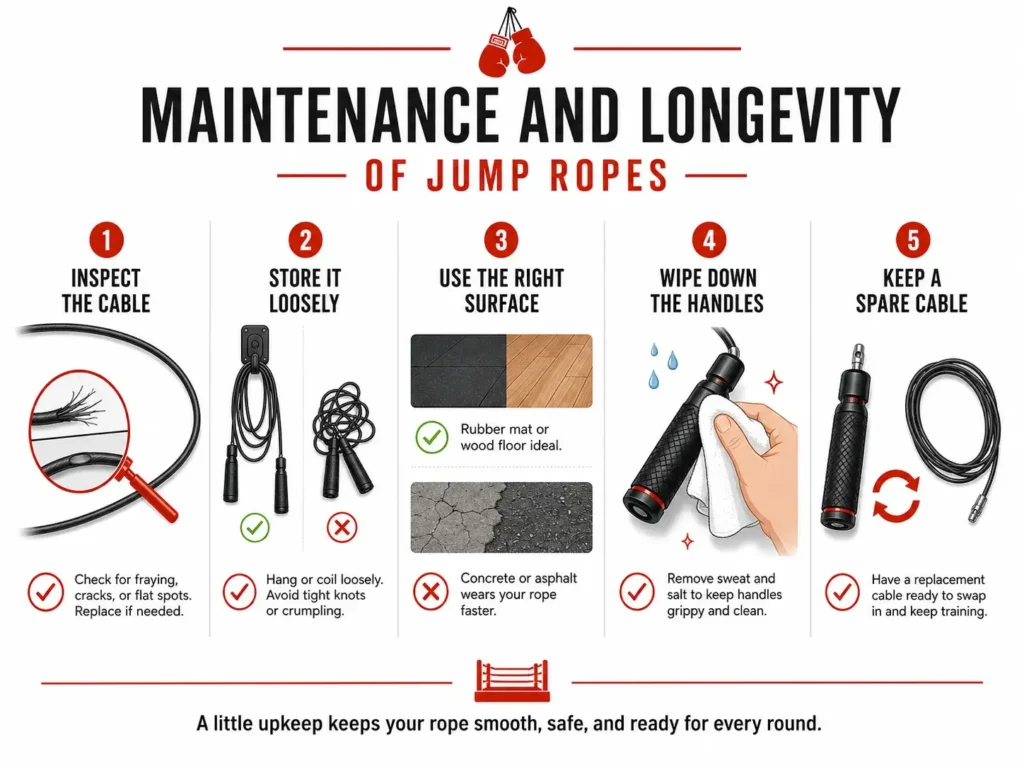
A rope can feel perfect at first and still fail early if you drag it over rough concrete, leave it twisted in a bag, or never check the cable. Most rope problems show up slowly, then fail fast.
Here is how to keep your rope ready.
1. Cable Replacement
Coated steel cables wear out, especially on concrete.
If you train on rough concrete several times a week, check the cable every week and expect to replace it every few months. Look for flat spots, exposed steel, fraying, or spots where the coating feels thin.
On rubber flooring or smooth gym mats, cables usually last longer, but you should still inspect them often.
Leather ropes need a different kind of care. Watch for fraying near the contact points and near the handles. They are great for rhythm, but they are not the best choice for daily concrete work.
Weighted ropes do not usually snap the same way thin cables do, but you should still check the handle connection points. Heavy ropes put more load on those parts.
2. Proper Storage
Do not crumple your rope into the bottom of your bag if you can avoid it.
Coil it loosely or hang it. A tight kink can become a weak spot, and that weak spot is where the cable starts to fail under fast turns.
Also, do not leave your rope in a hot car for long periods. Heat can soften coatings, affect grip materials, and make the cable hold bends.
If the rope comes with a pouch, use it. If not, a loose coil is still better than stuffing it under gloves, wraps, shoes, and water bottles.
3. Best Jumping Surfaces
Your jumping surface can make or break cable life. Here are best to worst surfaces.
- Sprung wood floor: smooth, joint-friendly, and gentle on the rope
- Rubber mat: one of the best choices for home or gym use
- Interlocking foam tiles: decent for light use, but make sure they do not shift under your feet
- Smooth concrete: usable, but it wears cable coating faster
- Rough concrete or asphalt: very hard on cables
- Carpet: too much friction and can make the rope hard to control
- Gravel: skip it completely
4. Handle Grip Maintenance
Grip matters most when your wraps are soaked.
Knurled aluminum handles are easy to care for. Wipe them down and use a dry brush if salt or chalk builds up in the texture.
Rubber or textured grips should be wiped after training. Sweat and dirt can make them feel slick over time.
Foam grips need the most attention. Once they start to feel spongy, slick, or torn, they are usually on borrowed time. You can tape them for a quick fix, but that is not the same as a better handle.
A simple layer of cloth athletic tape can save a slippery handle. Wrap from the base to the top, keep it smooth, and replace it when it gets dirty.
FAQs
What jump rope should I use for boxing?
The EliteSRS Surge 4.0 is a smart pick for most boxers who want speed without jumping straight into a high-priced rope. Its aluminum handles use a silicone-textured sleeve for better grip, the dual-bearing setup keeps the spin smooth, and the 2.4 mm nylon-coated steel cable is quick enough for footwork drills, fast singles, and double-under practice. It is also adjustable, which makes it easier to get the length right before you train hard.
How do I size a jump rope for boxing?
Measure in your boxing stance, not standing upright. Stand on the cable with one foot in your natural stance, pull handles up along your sides. For beginners, handle tops should reach lower chest, advanced boxers can size to armpit. If between sizes, go longer and trim later.
What is the difference between speed ropes and weighted ropes for boxing?
Speed ropes (thin PVC-coated steel, ball bearings) build footwork quickness and agility for double-unders and fast footwork. Weighted ropes (1-2 lb) load shoulders, upper back, and grip to build the endurance needed to keep a high guard in late rounds.
How often should I replace my jump rope cable?
PVC-coated steel cables on concrete should be replaced every 3-4 months. Inspect weekly for flat spots or exposed steel. On rubber mats or wood floors, you can stretch to 6-8 months.
Can I use a regular fitness jump rope for boxing?
No. General fitness ropes often lack sealed bearings, durable grips for wrapped hands, and concrete-resistant cables. They kink, slip, and fail quickly under boxing gym conditions.
Why do bearings matter in a boxing jump rope?
Sealed ball bearings keep the spin smooth and predictable, preventing sweat, chalk dust, and grit from causing stutter or seizure. Inconsistent bearings disrupt your footwork timing, which can ruin double-unders and rhythm during a round.
Summing Up
The best boxing jump rope is the one that survives your floor, your sweat, your pace, and your gym bag.
Your rope is either helping your training or giving you another excuse to stop.
Match the rope to the round. Use a speed rope for double-unders and fast footwork. Use a weighted rope for shoulder endurance. Use a leather or beaded rope when you want rhythm, timing, and a slower warm-up.
When your lungs are burning and your shoulders are tired, the last thing you need is a rope that slips, drags, or kinks. You want a steady spin, a secure handle, and a cable that keeps moving the same way every round.
A predictable rhythm under fatigue matters more than a big speed claim on a product page. If the rope binds 30 seconds into a round, the spec sheet does not matter. What matters is whether the rope lets you stay relaxed, stay light, and keep working.
And do not ignore the floor. Concrete and rough surfaces wear down cables fast. Use a mat when you can, keep a spare cable in your bag, and check your rope before it fails.
Pick the rope that fits your training, then take care of it!
Disclosure: This post contains affiliate links. As an Amazon Associate, I earn from qualifying purchases. It means that if you click on an Amazon link on this site and make a purchase, I may earn a small commission at no extra cost to you. Thank you for your support!