

Venum boxing gloves look sharp, feel firm, and cover different training needs. But their product range can feel confusing fast.
Venum Elite, Giant, Impact, Sharp, and Challenger all sit close together, with different weight options, padding claims, price points, and promises.
Some are built for beginners. Some are better for harder bag work. Some make more sense for Muay Thai and boxing.
The problem is that the product copy starts sounding the same after a while. Shock absorption, wrist support, comfortable fit, durable build, you see those lines on gloves that cost around $40 and gloves that cost more than $100.
My review cuts through that confusion with gym testing across heavy bags, Thai pads, focus mitts, and clinch work. You will see how each glove held up, where it makes sense, where it falls short, and more. Let’s discuss in detail!
Key Takeaways
- Budget synthetic gloves like Challenger can start losing padding shape in about 8–10 weeks under hard, repeated bag work.
- Higher priced models like Elite and Giant 3.0 are better long-term picks if you train often and rotate your gloves.
- Giant 3.0 is the better pick for fighters who want a leather glove with strong wrist coverage and a roomier training feel.
- Elite is the better pick if your main focus is boxing, wrist lock, and cleaner punch feedback.
- Impact is the safest middle-ground pick for bag work under $100, but it should not be treated like a do-everything glove forever.
- Sharp gives decent entry-level value, but the foam does not hold up like the higher priced Venum models.
- Be careful with very cheap listings online. Real pairs usually have clean logo work, proper tags, strong stitching, and branded Velcro details.
- Size your gloves with hand wraps on, close the strap with firm tension, and replace gloves when the foam flattens, not only when the outside starts tearing.
Table of Contents
How I Tested Venum Gloves
Each model went through at least 50 heavy bag rounds, 30 pad rounds, and 10 clinch-focused rounds over 60 days. Sessions ran 3-5 times per week. After each session, I logged round count, foam feel, wrist slip, lining wear, odor, and any knuckle pain.
I also rotated the gloves across different surfaces. The 100 lb heavy bag tested foam density and wrist support on straight punches. The banana bag tested how the cuff handled long hooks and angled shots. The double-end bag added fast, repeated contact, which showed how quickly the padding started to lose shape.
Pads and mitts gave us another layer. A good holder does not catch every shot the same way, so the gloves had to absorb impact from odd angles too.
I was not the only one testing the gloves. Three striking coaches gave feedback on wrist support, palm feel, clinch use, and lining wear. I also checked common complaints from fighters and gym owners, then compared those patterns with what happened in my own testing.
At-a-Glance: Venum Gloves Specifications
The table below shows what each glove is built around.
| Model | Outer Material | Padding Type | Closure Style | Weight Options | Best Training Use | Durability Rating |
|---|---|---|---|---|---|---|
| Venum Elite Boxing Gloves | Skintex synthetic leather | Triple-density foam | Velcro | 8–16 oz | All-around training, sparring, bag work, pads | High |
| Venum Giant 3.0 | Nappa leather | Quadruple-density foam | Velcro | 8–16 oz | Heavy bag, pads, sparring | High |
| Venum Impact Boxing Gloves | Skintex synthetic leather | Triple-density foam | Velcro | 10–16 oz | Bag work, pads, sparring | Medium |
| Venum Sharp Boxing Gloves | Nappa leather | Multi-layer foam | Velcro | 8–16 oz | Bag work, pads, sparring | High |
| Venum Challenger 3.0 | Synthetic leather | Triple-layer construction | Velcro | 8–16 oz | Light bag work, mitts, beginners | Low to medium |
Giant 3.0 is the strongest build on paper, with Nappa leather and thicker foam protection. Elite gives you the best mix of support, padding, and regular gym use without moving into full leather. Impact is the safer middle pick for bag work because its padding is stronger than most entry-level gloves, even if the outer material will usually age faster than leather.
Challenger 3.0 is better than a basic starter glove, but it still belongs in the beginner lane. Sharp looks stronger on paper because of the leather build, but availability and model details can vary by market.
Next, let’s get into the full model breakdown, starting with the Elite.
Venum Boxing Gloves Review: Detailed Breakdown
Here is what the specs felt like after real gym use. The five models I tested are Elite, Giant 3.0, Impact, Sharp, and Challenger 3.0.
1. Venum Elite Boxing Gloves
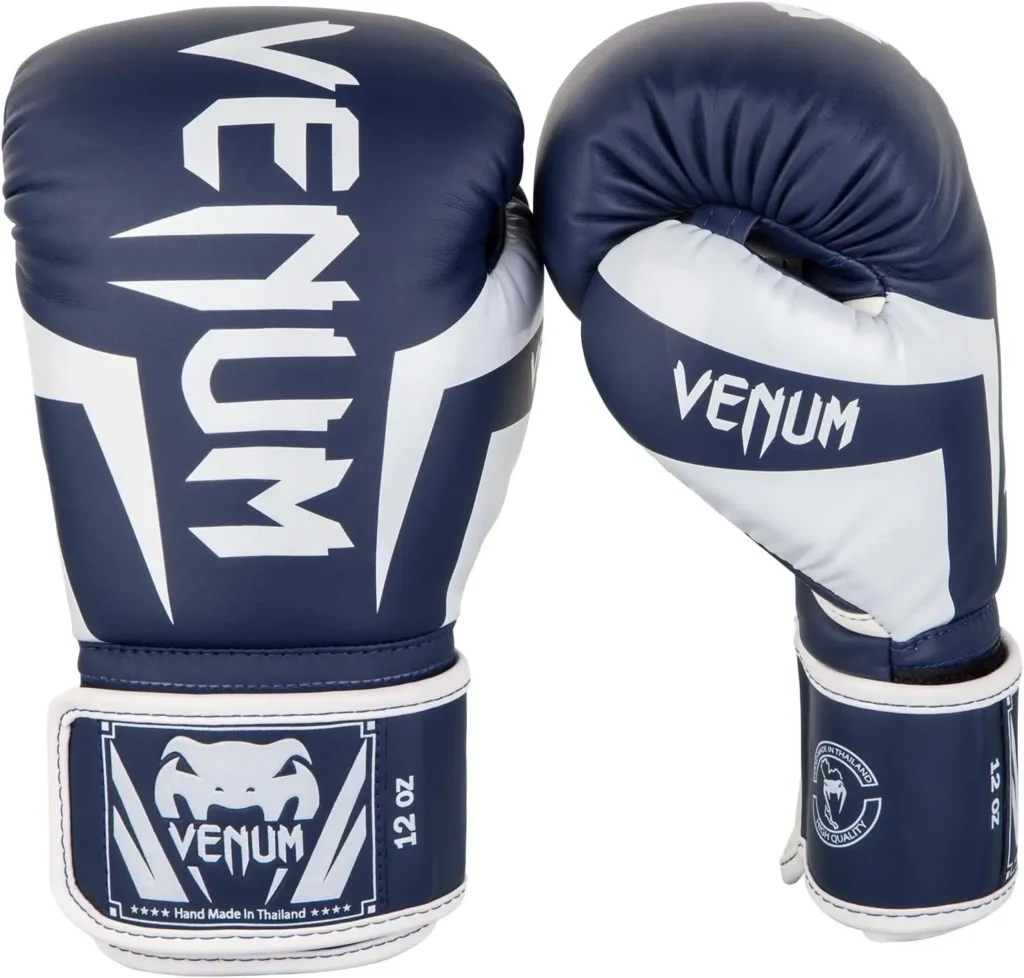
The Elite is the glove you buy when you are tired of replacing cheaper synthetic gloves every few months.
It is not leather, and that matters for accuracy. Venum lists the Elite with Skintex synthetic leather, triple-density foam, a reinforced palm, an attached thumb, and a wide hook-and-loop closure.
In use, that mix works better than expected. The outer material does not feel like real leather, but it holds shape well and did not show the same quick peeling I saw on cheaper gloves.
The foam is the main reason the Elite feels dependable. It spreads impact well across the knuckles, especially on straight shots and tight hooks. After 60 days, the padding had settled, but it was not dead. You could still hit the heavy bag without feeling the bag surface through the glove.
Wrist support is also strong. The wide strap and longer cuff give the hand a locked-in feel during boxing rounds. It is not a clinch glove, and the closed palm makes that clear. For boxing, that stiffness helps. For Muay Thai clinch work, it gets in the way.
2. Venum Giant 3.0
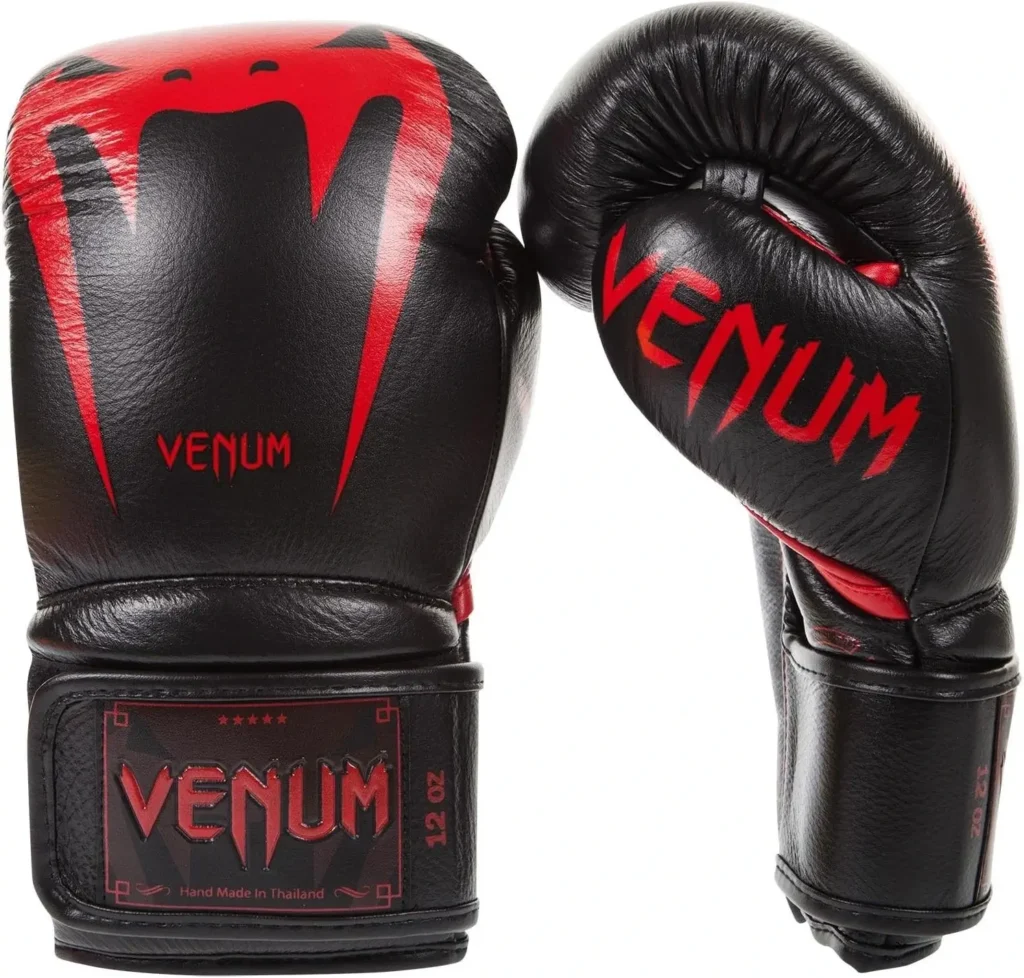
The Giant 3.0 is the most serious glove in my opinion.
It uses 100% Nappa leather, an attached thumb, long cuffs, and thick foam protection.
The leather is the first thing I noticed. After 60 days, it creased and softened, but it did not peel. That is the main difference between Giant 3.0 and the lower priced synthetic models. It ages like a training glove should.
The padding is dense and protective. It handles heavy bag rounds well and gives strong knuckle coverage on hard crosses and hooks. The glove feels more padded than the Elite, but also bulkier. That extra size can feel great when you are hitting hard, but a little much if you want fast, sharp mitt work.
3. Venum Impact Boxing Gloves
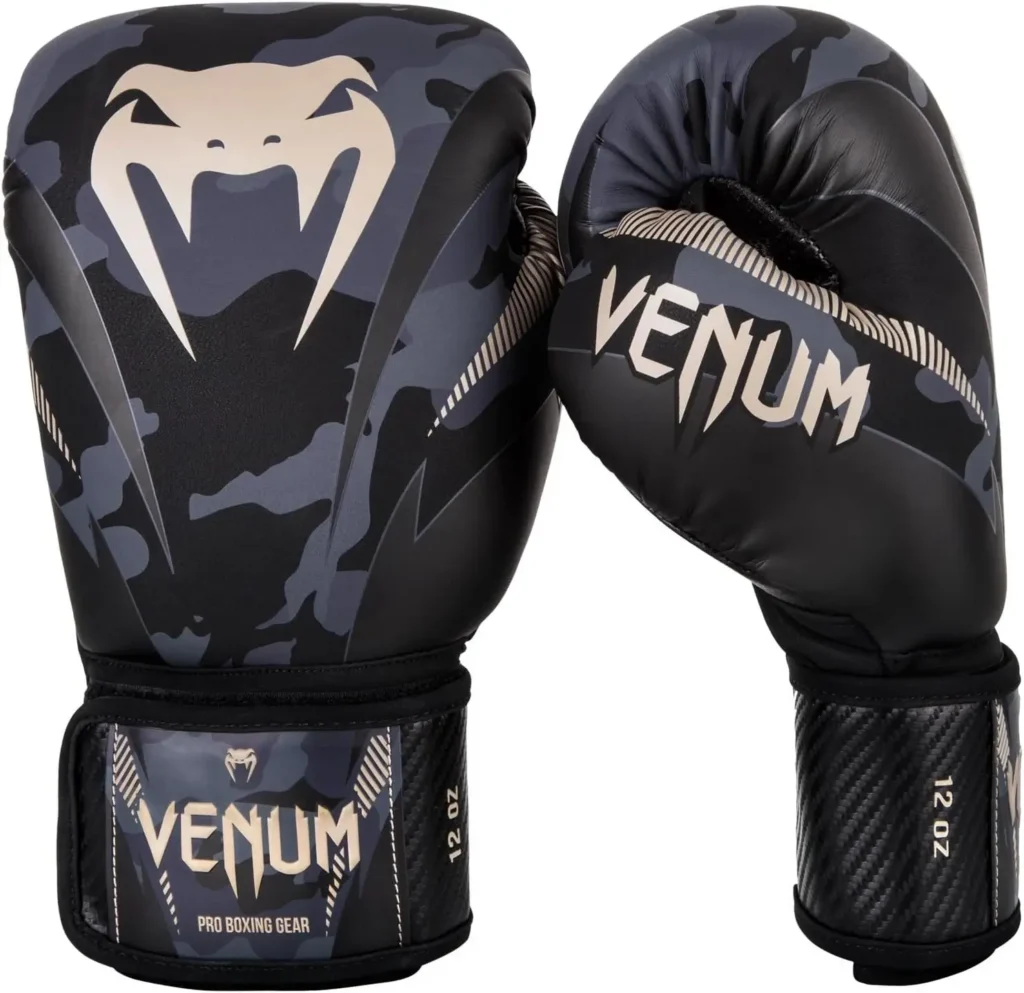
The Impact is the smart middle pick for bag work.
It uses Skintex synthetic leather and triple-density foam, which gives it better protection than most entry-level gloves. It does not feel as refined as the Elite, and it does not age like the Giant 3.0, but it does its job well.
The foam is the best part. After 60 days of heavy bag and pad rounds, the Impact still had decent rebound. It did not collapse as quickly as the Challenger, and it felt more protective than you would expect from a mid-range glove.
The outer material is where the trade-off shows. Skintex can hold up well, but it still does not age like Nappa leather. By the end of the test, the Impact had creasing around the stress points. It was still usable, but you could see where long-term wear would start.
Wrist support is fine for bag work and pads. The wide closure holds better than a basic narrow strap, but it does not feel as locked-in as the Elite or Giant 3.0. For straight punching and regular training, it works. For heavy hook rounds, wrap your wrists well.
4. Venum Sharp Boxing Gloves
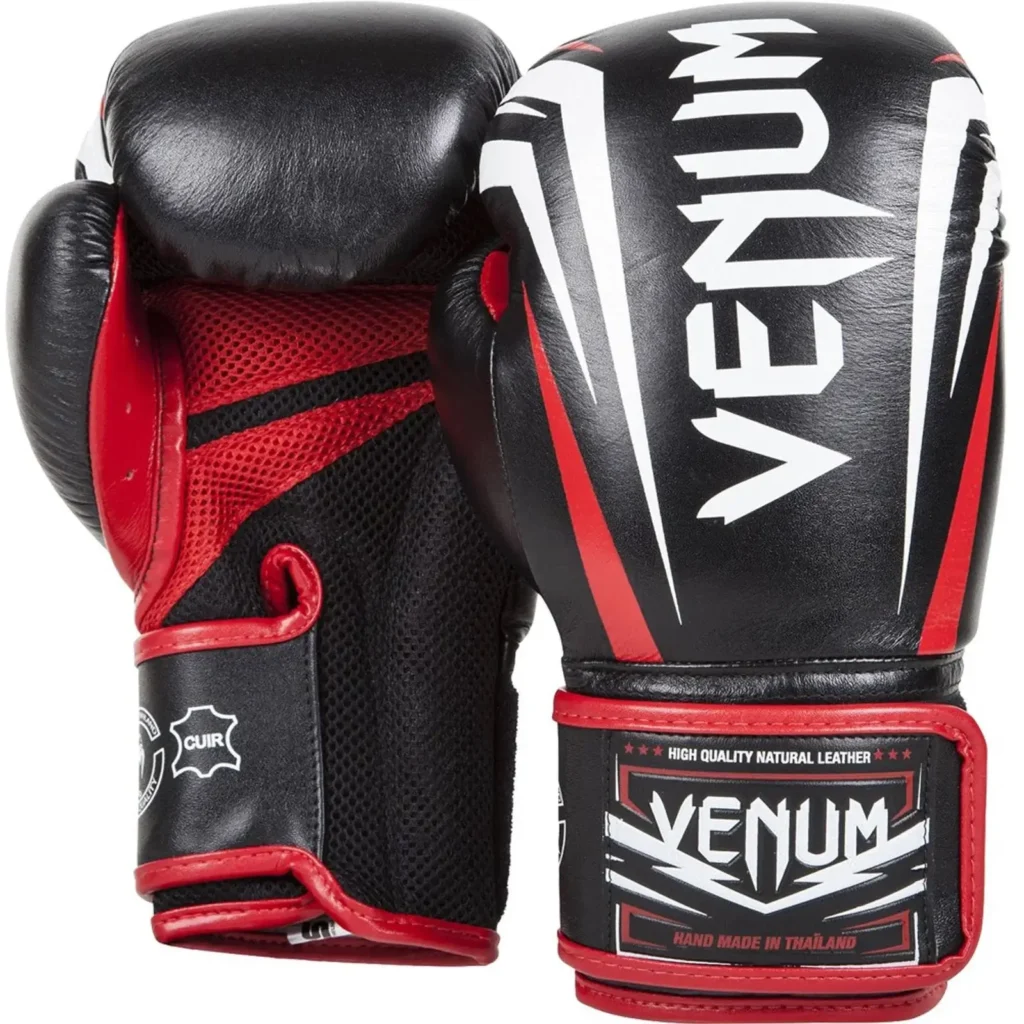
The Sharp is the glove you buy when you want Nappa leather but can’t stomach the Giant’s price. In the gym, the Sharp feels like a cleaner step up from the Challenger. The leather-style build gives it a better outer feel, and the glove stays more stable after weeks of use. Stitching and lining held up well during the test, and the glove still looked respectable after 60 days.
The padding was good, but it did not feel as strong under repeated heavy bag rounds as Giant 3.0. It worked well for pads, mixed training, and lighter sparring. On long heavy bag days, the knuckle area felt softer by the end of the test.
Wrist support is decent. The strap is better than Challenger, but it does not match the locked-in feel of Elite or the long-cuff support of Giant 3.0. If your wrists need extra help, use thicker wraps.
5. Venum Challenger 3.0
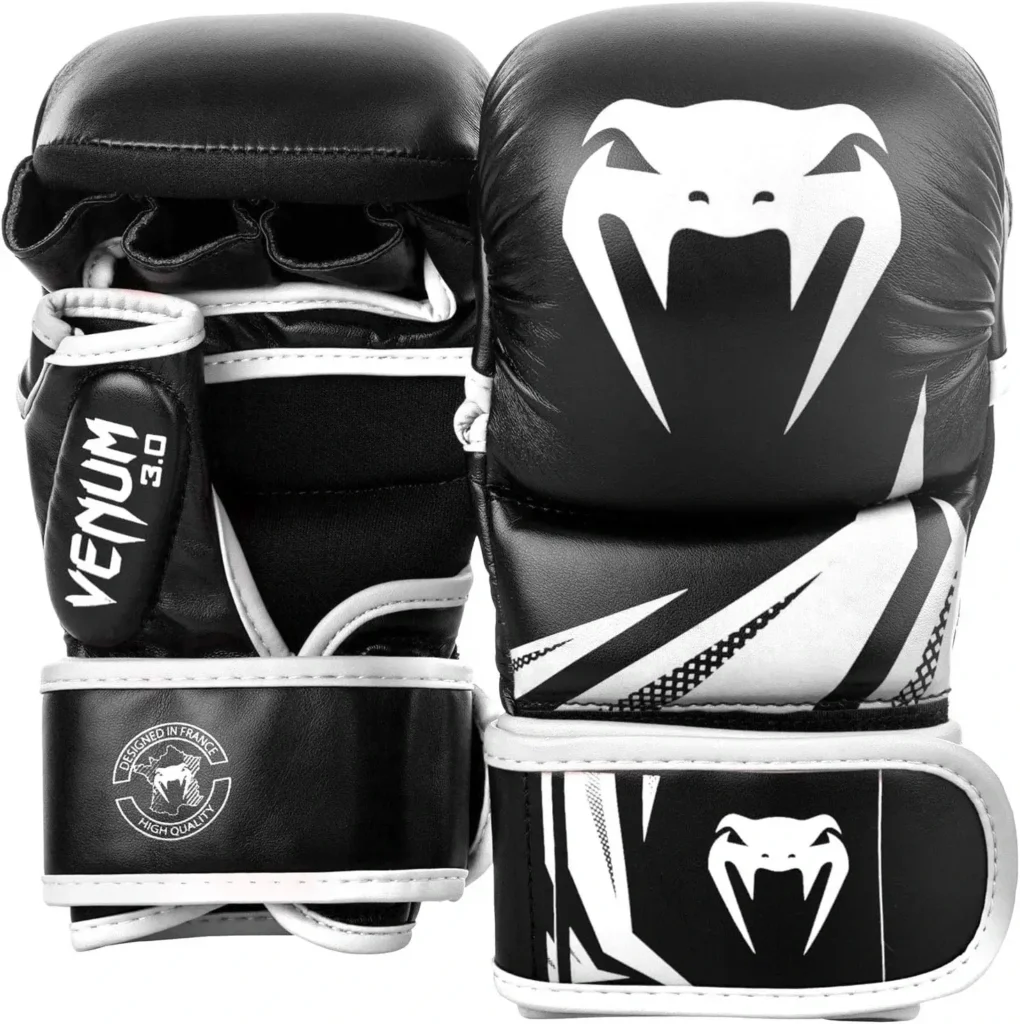
The Challenger 3.0 is the beginner glove for me.
It’s synthetic or semi-leather material, triple-layer construction, breathable neoprene inside, and a large Velcro closure. It sounds solid on paper but still feels like a starter glove in gym.
The Challenger feels soft and comfortable. But after repeated heavy bag rounds, the padding starts to lose shape faster than the other four gloves. By the middle of the test, it felt less protective on hard shots. By day 60, it needed careful wrapping to stay comfortable on the bag.
The outer material also showed wear sooner. It did not age like Sharp or Giant 3.0, and it did not feel as stable as Impact. The wrist support is basic. It is fine for light rounds, but it is not what you want for hard hook sessions or high-volume bag work.
Venum Cross Comparison and My Performance Review
A glove can protect your knuckles well and still fail at wrist support. It can feel great on pads and still fall apart on the heavy bag. So, I scored the tested models across four areas: padding, wrist support, airflow, and fit.
1. Padding and Knuckle Protection
Giant 3.0 sits at the top. The Nappa leather shell and quad-density foam held shape better than every other glove in the test. The break-in was slow, and the padding felt stiff for the first couple of weeks. After that, it formed around the hand without going flat. On hard bag rounds, it gave the steadiest knuckle protection.
Elite came next. Its Skintex outer is not leather, but the triple-density foam did its job well. It settled a little over 60 days, but it did not bottom out. Compared with Challenger 3.0, the difference was clear. The Elite kept more padding between your knuckles and the bag.
Impact was close behind. Its triple-density foam stayed springy longer than expected and held up well through bag and pad work. The outer material showed wear sooner than the foam did, so the padding was not the weak point.
Sharp was solid, but it softened faster under repeated heavy bag rounds. It still worked well for pads and mixed training, but it did not feel as dense as Giant 3.0 by the end.
Challenger 3.0 finished last. It feels comfortable early, but its padding lost shape fastest. For light training, it is fine. For hard bag work more than twice a week, it is not the glove I would trust.
2. Wrist Support Under Heavy Load
Giant 3.0 won this category too. The long cuff and firm Velcro closure kept the wrist steady on hard crosses, overhands, and hook rounds. Once the glove broke in, it felt secure without feeling loose between rounds.
Elite was second. The wide hook-and-loop strap gave strong support for boxing work. It does not lock the wrist as firmly as Giant 3.0, but it is stable enough for heavy bag, pads, and sparring.
Sharp came third. The strap holds well, and the cuff has enough structure for regular training. It is not as locked-in as Elite, but it is much better than a basic starter glove.
Impact was dependable, but it needed more re-tightening between rounds. Straight punches felt fine. During long hook sets, the wrist moved more than it did in Elite or Giant 3.0.
Challenger 3.0 was the weakest. The large Velcro strap helps, but the glove still shifts under harder shots. Beginners may not notice it right away. Anyone throwing with real power will.
3. Airflow and Odor Control
Airflow was more even than expected.
Elite did well because of the breathable mesh panels. It still needed proper drying, but it did not trap heat as badly as the heavier gloves.
Impact also performed well. The micro-perforation helped it dry faster than a fully closed synthetic glove. It still needed a full day after sweaty sessions, but odor did not build up as fast as Challenger.
Sharp sat in the middle. The palm mesh helped, but the thicker build still held sweat after long sessions. It needs glove deodorizers if you train often.
Giant 3.0 trapped the most heat among the higher-end gloves. That is the trade-off with dense padding and leather. If you do not dry it after training, the smell shows up fast.
Challenger 3.0 was the worst for odor. The inside felt damp longer, and after repeated sessions the lining picked up sweat quickly.
4. Fit, Comfort, and Break-In
Fit was the least consistent part of the Venum lineup.
Giant 3.0 runs large and takes the longest to break in. It feels bulky at first, but after a couple of weeks the leather softens and the glove starts to feel more natural. Average-to-large hands will like it more than small hands.
Elite also has a roomy fit. It breaks in faster than Giant 3.0, and the hand position feels clean for boxing. Smaller hands should use thicker wraps.
Impact fits closer and needs very little break-in. It is the easiest glove to put on and use right away.
Sharp runs slightly snug. The liner is basic but not rough, and one good pad session is usually enough to settle it.
Challenger 3.0 runs the smallest. It can feel cramped with wraps, and the comfort drops once the padding starts to lose shape.
Which Venum Glove Fits Your Training?
So, which glove fits the way you train?
1. Pure Boxing and Heavy Bag Work
For hard boxing rounds and heavy bag work, Giant 3.0 is the safest pick in this test. The leather build, long cuff, and thick foam protection held up best over 60 days. It is bulky, and the break-in takes patience, but it gives the most confidence when you are throwing full power.
Elite is the better pick if you want a lighter, cleaner boxing feel. It is not as tough as Giant 3.0, but it gives strong wrist support and good knuckle protection without feeling as large on the hand.
Impact is the value pick for bag work. The foam is good enough for regular training, but the outer material will show wear sooner than Giant 3.0 or Sharp.
2. Muay Thai, Clinch Work, and Pads
None of these five gloves is a true clinch-first glove. Giant 3.0 has an attached thumb and long cuff, so it protects well but can feel stiff when you try to grip.
For Thai pads and kickboxing rounds, Elite is the best balance. It gives enough wrist support, the padding handles strikes from different angles, and the fit is easier to work with than Giant 3.0.
Sharp is also a good mixed-training option if you want a leather glove and do not mind a snug fit. It works well on pads, but for long heavy bag days, Giant 3.0 still protects better.
3. MMA Hybrid and Cross-Training
If your session mixes boxing, kickboxing, and light clinch drills, Elite is the best compromise among these five. It is mobile enough for mixed striking work and protective enough for moderate bag rounds.
That said, no boxing glove is made for true MMA transitions. If you are adding takedowns or ground work, use the right MMA training gloves. For the striking part of a mixed session, Elite makes the most sense.
Impact is the backup pick if budget matters. It handles bags and pads well, but it does not have the same wrist feel or long-term build as Elite.
Skip Challenger 3.0 for serious cross-training. Its padding loses shape too fast, and the wrist support is not strong enough for hard, mixed sessions.
How to Spot Fake Venum Gloves
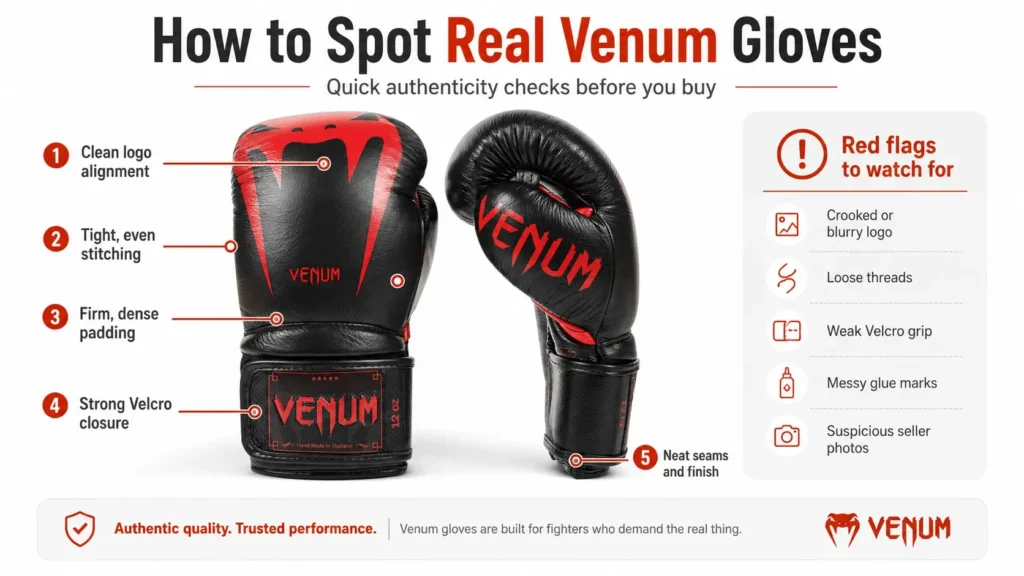
You need to buy real Venum gloves.
Fake gloves waste of money, and they can put your hands at risk because the padding, stitching, and wrist closure are usually the first things to fail.
Logo: Start with the logo. Real Venum gloves should have clean logo work, even placement, and tight stitching. If the snake logo looks thin, crooked, blurry, or raised in odd spots, that is a warning sign. Compare it with the same model on Venum’s official site before buying.
The Build: Next, check the build. The seams should be even, with no loose threads or messy glue marks. The glove should feel firm through the knuckle area, not soft like packing foam. A fake pair may feel comfortable at first, but that soft padding usually breaks down fast.
Tags: Look inside the cuff too. Tags should be clean, easy to read, and free of spelling mistakes. Be careful with labels, poor print quality, missing size details, or packaging that looks generic.
Velcro: The Velcro is another easy check. A real glove should close firmly and stay shut during rounds. Weak Velcro, thin straps, peeling logos, and cheap plastic smell are all bad signs.
Price matters, but do not use price alone. A very cheap new pair from an unknown seller should make you pause, but a low price does not prove it is fake. Check the seller, return policy, product photos, and reviews. The safest move is still simple: buy from Venum official sources and I’ve added their links, or a gym shop that orders from trusted suppliers.
Synthetic vs Leather: What Lasts Longer?
In this test, leather held up better under heavy use. Giant 3.0 uses 100 percent Nappa leather, and it aged the way a good training glove should. It creased, softened, and kept its shape. It did not peel like cheaper synthetic shells can.
Skintex is Venum’s better synthetic material, and it makes sense on models like Elite and Impact. It is lighter, costs less than leather, and can hold up well for regular training. But it still does not age like Nappa leather when sweat, friction, and heavy bag rounds pile up.
The real issue is not only the outer shell. Once a synthetic glove starts cracking near the palm, thumb, or knuckle crease, sweat gets deeper into the glove. That speeds up odor, lining wear, and foam breakdown. When the foam flattens, the glove may still look usable, but your knuckles start taking more impact.
Synthetic gloves make sense if you train once or twice a week, mostly on pads or light bags. A Skintex glove with good wrist support can be a smart buy there.
If you train three or more times a week, leather starts to make more sense. It usually costs more upfront, but it can last longer, keep its shape better, and need fewer early replacements.
Choose Skintex for lighter regular training, choose Nappa leather if you hit hard and train often.
How Venum Compares to Popular Gym Gloves
Venum’s own lineup is clear now. The next question is how its best gloves compare to the pairs you see in real gyms.
1. Venum Elite vs. Winning MS-500 / MS-500B
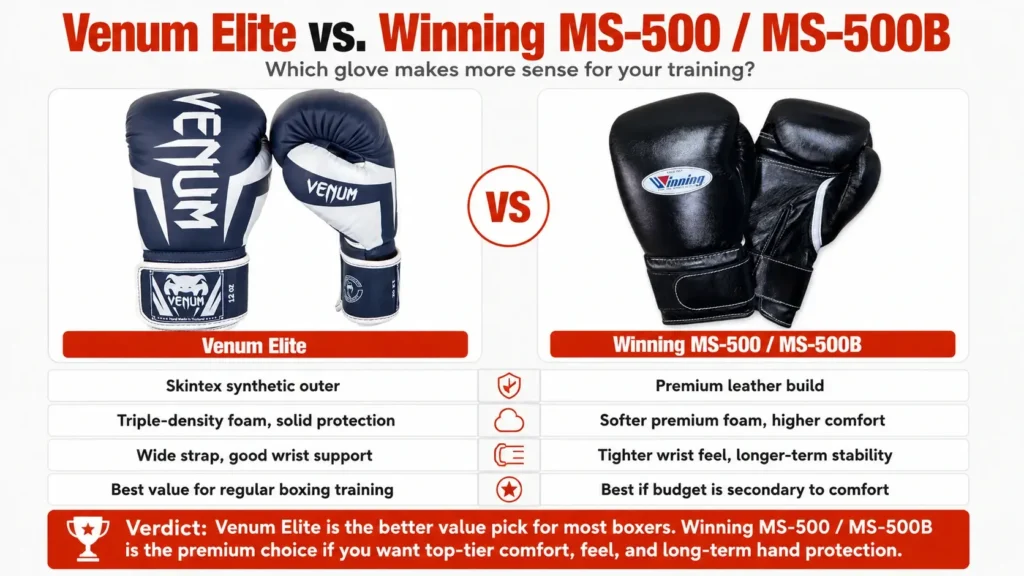
The Elite is Venum’s strong middle option. It fits roomy, uses Skintex synthetic leather, and has triple-density foam with a wide hook-and-loop closure. Compared with Challenger 3.0, the step up is easy to feel. The wrist support is better, the padding lasts longer, and the glove feels more stable on bag rounds.
Against Winning, the gap is still clear.
Winning MS-500 gloves sit in a higher class. They are handmade in Japan and built for fighters who care most about long-term comfort and hand protection. The MS-500B Velcro version also uses a wide double-width strap, which gives a tighter wrist feel than most standard Velcro gloves.
After 60 days, the Elite still felt like a good training glove. It handled bag work and pads well. But it did not feel as locked-in as Winning, and the padding softened sooner under heavy hook rounds.
For a boxer training three times a week, Elite is a smart buy. Winning makes sense if you want a glove that keeps its feel for years and you are willing to pay for that.
2. Venum Giant 3.0 vs. Fairtex BGV1
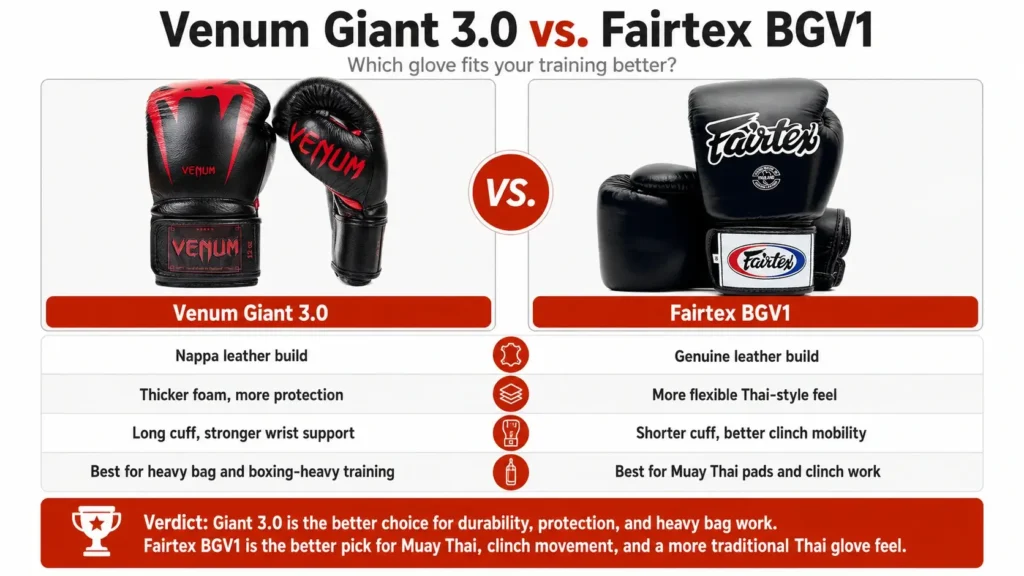
The Giant 3.0 is Venum’s most durable glove in this test. It uses 100 percent Nappa leather, quad-density foam, long cuffs, and a firm Velcro closure. It is made in Thailand and feels built for hard bag rounds, pads, and boxing-heavy training.
Fairtex BGV1 is the more natural Thai glove.
The BGV1 has a shorter cuff, premium leather, triple-layer foam, and a tight Thai fit. That shorter cuff makes it easier to work in clinch positions and move the wrist during Muay Thai rounds.
The Giant 3.0 protects better on heavy bag work. Its thicker foam and longer cuff give more support when you are throwing hard. But that same structure makes it stiffer. It is not as easy to use when you need hand control, wrist flex, or fast clinch entries.
So the split is simple. If your training is mostly boxing, bags, and pads, Giant 3.0 is the better Venum-style workhorse. If you spend a lot of time in Muay Thai clinch work, Fairtex BGV1 feels more natural.
3. Venum Challenger 3.0 vs. Entry-Level Thai Gloves
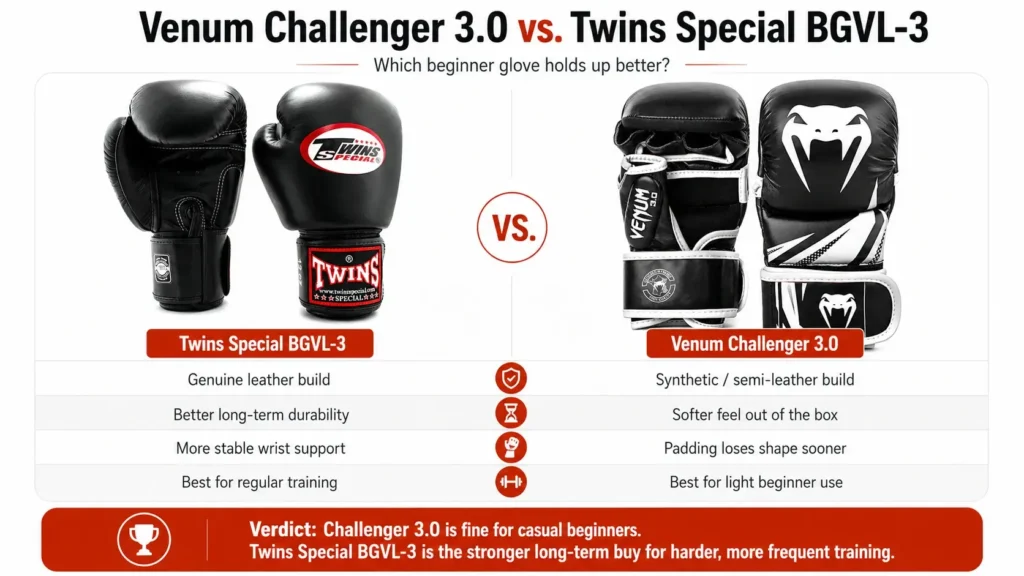
Challenger 3.0 looks good, costs less, and works fine for beginners or light sessions. Venum lists it with soft semi-leather, triple-layer construction, a large Velcro closure, and a breathable neoprene interior.
Compared with Thai entry staples like Twins Special BGVL-3, the material gap matters. Twins BGVL-3 uses genuine leather, multi-layer high-density padding, and a wide Velcro strap. It feels less flashy, but it is built for harder rounds.
Challenger 3.0 starts soft and comfortable. That is part of the appeal. The issue is that the padding loses shape faster under heavy bag work, and the outer material shows wear sooner than leather.
If you train once a week for fitness, Challenger 3.0 can work. If you train more than twice a week, a Thai leather glove like Twins Special will usually be the better long-term buy.
Total Cost of Ownership
Sticker price does not tell the full story.
A cheaper glove that needs replacing every few months can cost more over a year than one better glove that lasts longer and protects better. The real cost is not only the glove. It is also the hand pain, worn wraps, bad odor, and missed training from poor protection.
Nappa leather needs basic care, but it usually ages better. Skintex is useful and can be a smart buy, but it does not handle hard, frequent training like leather.
Final Verdict and Recommendations
After 60 days, Giant 3.0 is the best Venum glove overall. It costs more, but the Nappa leather, quad-density foam, long cuff, and firm closure make it the safest pick for hard training. If you train three or more times a week, this is the glove I would buy.
Impact Classic is the best value pick. It uses Skintex and triple-density foam, so it gives real protection without jumping to the top price range. It makes the most sense for casual to regular training, bag work, pads, and backup use.
Elite is the best upgrade from Challenger 3.0. It gives better wrist support, better padding, and a cleaner boxing feel. It is not as durable as Giant 3.0, but it is a clear step up for regular boxing sessions.
Challenger 3.0 is the beginner pick only. Use it for light training, fitness classes, and occasional bag work. Skip it if you hit hard or train more than twice a week.
FAQs
How long do Venum gloves actually last?
Light-use gloves can last months with proper care, but hard training shortens that fast. Impact Classic and Elite last longer than Challenger 3.0, while Giant 3.0 is the strongest long-term pick.
Can I use boxing gloves for Muay Thai clinch work?
You can for light drills, but boxing gloves are not ideal for serious clinch work. Use a Muay Thai glove if clinch training is a major part of your week.
Why do my Venum gloves smell bad?
They are holding sweat. Wipe them after training, dry them fully, use clean wraps every session, and do not leave them zipped inside your gym bag.
Are Venum gloves good for small hands?
Some models feel roomy. Smaller hands should use 180-inch wraps and check that the glove does not shift during hooks.
Is the Elite worth the upgrade from Challenger 3.0?
Yes for regular training. Elite gives better support, padding, and airflow. For hard, frequent training, Giant 3.0 is the better long-term jump.
Disclosure: This post contains affiliate links. As an Amazon Associate, I earn from qualifying purchases. It means that if you click on an Amazon link on this site and make a purchase, I may earn a small commission at no extra cost to you. Thank you for your support!