

Boxing can be good for kids when training is age-appropriate, well supervised, and focused on fitness, movement, technique, and self-control.
Bag work, pad work, footwork, shadowboxing, and conditioning can help children become fitter, more coordinated, more focused, and more confident.
The answer changes when regular sparring or competition is added. Repeated blows to the head can cause concussion and other brain injuries.
Major pediatric medical groups discourage children and teenagers from taking part in boxing where intentional head contact is part of the sport.
Parents should clearly separate non-contact boxing classes from training that puts a child in front of another boxer to exchange punches.
Table of Contents
What Does Boxing for Kids Usually Include?
A good beginner class should not look like an adult fight camp. Children normally start with basic stance, safe punching form, footwork, balance drills, jump rope, fitness games, shadowboxing, punch bags, and coach-held pads.
This type of training teaches boxing skills without requiring children to hit each other. It can provide many of the benefits parents want while removing much of the risk linked to blows to the head.
There are four main levels parents should understand:
- Non-contact fitness training includes running, skipping, bodyweight exercises, bag work, and movement drills.
- Technical training includes stance, guard, punches, defense, and footwork.
- Partner drills may include controlled movement and touch-based practice without hard punches.
- Sparring and competition involve contact with another boxer and carry a higher injury risk.
Before enrolling your child, ask the gym which level is included. Do not assume that a class called youth boxing is non-contact.
Benefits of Boxing for Kids
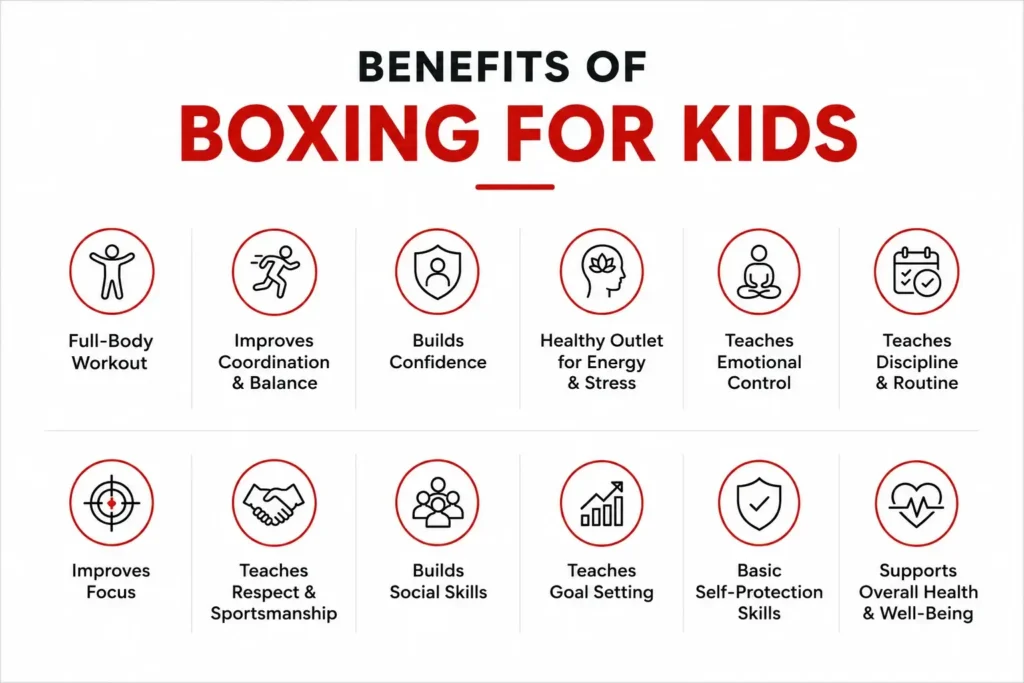
1. It Provides a Full-Body Workout
Boxing keeps the whole body moving. Children use their legs for footwork, their core for balance and rotation, and their arms and shoulders for punching drills. Jump rope, bag rounds, movement drills, and short bursts of exercise also raise the heart rate.
Regular physical activity supports heart and lung health, muscular fitness, bone strength, attention, memory, and healthy body weight.
Children ages 6 to 17 should get at least 60 minutes of moderate-to-vigorous physical activity each day, with a mix of aerobic, muscle-strengthening, and bone-strengthening activity across the week. Boxing can form part of that total, but it does not need to be the child’s only activity.
2. It Improves Coordination and Balance
A child cannot box well by moving only the arms. They need to keep their feet in the correct position, shift their weight, watch a target, protect their face, and move at the right time.
Pad work and bag drills train the eyes, hands, feet, and body to work together. Footwork drills can also support balance, agility, timing, and body control.
Research on structured martial arts programs for children has found improvements in several parts of physical fitness, including balance, speed, coordination, flexibility, and strength, though the results vary by program and activity.
3. It Builds Confidence Through Real Progress
Confidence grows when a child can see clear improvement. Learning a proper stance, landing a clean jab on a pad, completing a full round, or remembering a combination gives the child proof that practice works.
It matters because the praise is linked to effort and skill, not empty compliments. A child starts to think, “I could not do this before, but now I can.” That belief can carry into school, hobbies, and social situations.
Boxing should not be sold as a guaranteed fix for low confidence. The coach, class culture, and child’s experience matter. A calm coach who notices effort and corrects mistakes without embarrassment is far more helpful than a coach who uses fear or public criticism.
4. It Teaches Discipline and Routine
Boxing has clear rules. Children need to arrive on time, listen to instructions, repeat basic movements, care for their equipment, and control their effort.
Progress is hard to fake. A child who pays attention and practices usually improves. A child who rushes, ignores feedback, or skips sessions will often struggle. The direct link between actions and results can teach responsibility in a way children can feel and understand.
Discipline should not mean shouting, humiliation, or punishment exercises. A good youth class uses firm rules, calm correction, and consistent expectations.
5. It Can Improve Focus
Boxing drills require attention. A child may need to watch the coach, remember a punch sequence, move their feet, keep their guard up, and react to a target at the same time.
Physical activity can support attention, memory, and brain health in children. Boxing may be especially engaging for children who find repetitive exercise boring because each drill gives them a specific task.
Still, boxing is not a treatment for ADHD, anxiety, depression, or learning problems. Parents should not replace professional care with a sports class.
6. It Gives Kids a Healthy Outlet for Energy and Stress
Many children need a physical way to release tension after school. Hitting a bag, jumping rope, moving through drills, and finishing a hard workout can help them use extra energy in a controlled setting.
The lesson should be that feelings can be managed without hurting another person. A good coach teaches children to pause, listen, breathe, and use force only within the rules of training.
Regular physical activity is linked with lower depression risk and better mental health measures in children. The emotional benefit comes from movement, structure, progress, and social support, not simply from punching something.
7. It Teaches Emotional Control
Boxing requires control under pressure. Children learn that throwing harder is not always better. They need to stay balanced, follow instructions, and stop immediately when the coach calls time.
Mistakes are also part of every session. A child may forget a combination, lose balance, or become tired. With good coaching, these moments teach patience and the ability to try again without losing control.
This benefit depends heavily on the gym. A class that celebrates aggression, revenge, or hurting others sends the wrong message. A class that rewards calm technique, respect, and safe behavior can help children manage frustration more responsibly.
8. It Teaches Respect and Sportsmanship
Children in a good boxing gym learn to respect the coach, training partners, rules, equipment, and personal boundaries. They also learn that strength does not give them permission to intimidate someone else.
Partner drills can teach cooperation because each child is responsible for helping the other train safely. Children learn to take turns, control their speed, and listen when a partner feels uncomfortable.
Winning and losing can also teach useful lessons, but competition should never become the only measure of success. Better movement, improved fitness, steady attendance, and good behavior should count too.
9. It Can Build Social Skills
Youth classes give children a place to meet others outside school. They train beside children with different skill levels and personalities, share equipment, follow group rules, and encourage teammates.
This can help shy children feel part of a group, but the gym must actively protect them from teasing, hazing, and rough behavior. Parents should watch a class before signing up and pay attention to how coaches speak to beginners.
10. It Teaches Goal Setting
Boxing gives children small, clear targets. A beginner may work on keeping both hands up. Later, the goal may be completing three rounds, improving footwork, or learning a new combination.
These short goals make progress easier to understand. They also teach that improvement usually comes from repetition rather than instant success.
Keep goals suitable for the child’s age. Young children do not need pressure about fights, medals, body weight, or becoming champions. Their main goals should be movement, fun, listening, safety, and basic skill.
11. It Teaches Basic Self-Protection Skills
Boxing can teach children how to stand with balance, protect their face, keep distance, move away, and stay calm when someone enters their space.
Those skills may help a child feel less helpless, but boxing does not make a child bully-proof. It also does not teach every part of real-world safety. Children still need to learn how to leave a dangerous situation, call for help, stay near trusted adults, report threats, and avoid turning words into a physical fight.
Can Boxing Help a Child Deal with Bullying?
Boxing may improve posture, confidence, fitness, and calmness. These changes can help some children feel less afraid. However, teaching a child to punch should not be the main bullying plan.
Most bullying problems need adult action. The child should know how to speak clearly, move toward a safe area, stay with friends, report repeated behavior, and tell a parent, teacher, or school leader what happened.
Physical force should be a last option when there is an immediate threat and the child cannot safely get away. Even then, the goal should be to create space and reach safety, not to punish the other child.
Parents should also check school rules. A child may face discipline after a fight even when they believe they were defending themselves. Talk with the school before a problem occurs and make sure your child knows exactly what steps to take.
Is Boxing Safe for Kids?
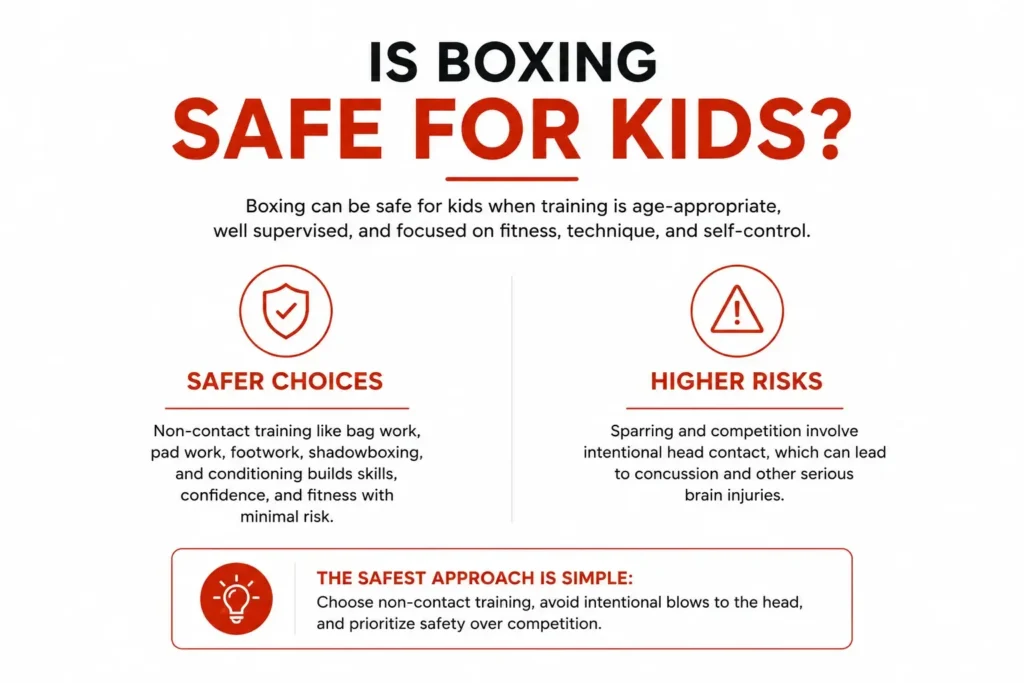
Non-contact boxing can be a useful fitness activity. Competitive boxing and regular sparring are different because direct punches to the head are part of the activity.
Concussion is one of the most common injuries linked to boxing, and repeated head impacts can have cumulative effects. Pediatric medical groups oppose boxing for children and adolescents because the sport rewards direct blows to the head and face.
It does not mean every boxing drill is equally dangerous. A child doing shadowboxing, footwork, pad work, and bag training is not facing the same head-impact risk as a child taking punches during sparring.
For many families, the best middle ground is simple: allow boxing-based fitness and technique training, but avoid head-contact sparring and competition.
Does Headgear Make Sparring Safe?
Headgear can reduce some cuts and facial injuries, but it should not be treated as concussion-proof equipment. The brain can still move inside the skull after a hit, even when padding covers the outside of the head.
Gloves also do not make repeated head punches harmless. They protect the hands and reduce some surface damage, but force can still reach the head.
A mouthguard protects the teeth and mouth. It is important for contact practice, but it is not a guarantee against brain injury.
The safest way to reduce boxing-related head injury is to reduce or remove intentional head contact.
What Is the Best Age for a Child to Start Boxing?
There is no single age that fits every child. Readiness depends on attention, coordination, emotional control, interest, and the type of class.
A practical age-based approach looks like this:
Ages 4 to 6
Keep the class short, playful, and fully non-contact. Focus on balance, listening, simple footwork, basic stance, safe pad taps, and fitness games.
At this age, the goal is not to create a fighter. The goal is to help the child enjoy movement and follow simple safety rules.
Ages 7 to 12
Children can usually handle more structured technique work, including stance, straight punches, basic defense, bag drills, pad combinations, jump rope, and bodyweight exercise.
Training should still focus on skill and fitness. There is no need to rush a child into sparring.
Ages 13 and Up
Teenagers may be able to handle harder conditioning and more detailed tactics. Contact should still be optional, closely supervised, and based on maturity and skill, not only age.
Before any sparring or competition, parents should understand the head-impact risk, the gym’s concussion process, the coach’s experience, and the medical support available.
How to Choose a Safe Youth Boxing Gym
The coach matters more than the logo on the wall. Visit the gym, watch a full class, and ask direct questions.
Look for these signs:
- The gym has a separate youth program.
- Coaches have experience teaching children.
- Beginners start with non-contact drills.
- Sparring is not forced or used as a reward.
- Children are matched by age, size, skill, and maturity.
- The coach stops unsafe behavior immediately.
- The class teaches respect and conflict avoidance.
- Equipment is clean, correctly fitted, and in good condition.
- Parents are allowed to watch.
- The gym has a written concussion and emergency process.
- Coaches do not tell children to hide pain, dizziness, or headaches.
- The gym does not pressure children to lose weight for a match.
- The class feels controlled, not chaotic.
Walk away if beginners are thrown into hard sparring, children are mocked for fear, larger students are allowed to dominate smaller ones, or coaches treat head punches as harmless.
Equipment Kids Need for Boxing
For non-contact beginner training, a child may need:
- Well-fitted youth boxing gloves
- Hand wraps
- Comfortable athletic clothes
- Supportive indoor training shoes
- A water bottle
For any contact drill, a properly fitted mouthguard is essential. Headgear may also be required by the gym or event rules, but it must not be used as a reason to allow harder head contact.
Do not choose gloves only by age. Fit depends on the child’s hand size, body size, training type, and the coach’s rules. Ask the coach to check the gloves and wraps before the first full session. Read more about youth boxing gloves sizing here.


Also read my Venum Challenger 2.0 Kids Gloves review here and about best boxing shoes for kids.
Should a Child Get a Medical Check Before Starting?
A routine sports physical is a good step before a child begins organized training, especially if the program includes hard conditioning, contact, or competition. A preparticipation check gives the doctor time to review medical history, past injuries, medicines, heart symptoms, breathing problems, and previous concussions.
Speak with a healthcare professional before training if your child has:
- A past concussion or repeated head injuries
- Frequent headaches, dizziness, or fainting
- A seizure disorder
- A heart condition or chest pain during exercise
- Poorly controlled asthma
- A bleeding disorder
- Vision problems
- A recent bone, joint, neck, or back injury
- Any condition that affects balance, coordination, or safe exercise
A child with a health condition may still be able to train, but the class may need changes.
Concussion Signs Parents Should Know
A concussion can happen after a blow to the head or after a hit to the body that causes the head and brain to move quickly. Symptoms may appear right away or later.
Watch for:
- Headache
- Dizziness or balance problems
- Nausea or vomiting
- Blurred or double vision
- Sensitivity to light or noise
- Confusion
- Slow answers
- Memory problems
- Trouble concentrating
- Unusual tiredness
- Irritability, sadness, or behavior changes
- Changes in sleep
Remove the child from training immediately if a concussion is suspected. Do not allow same-day return. The child should be assessed by a healthcare professional and should return to sport only through a medical step-by-step process.
Emergency care is needed for danger signs such as repeated vomiting, a worsening headache, seizure, slurred speech, weakness, increasing confusion, unusual behavior, one pupil larger than the other, double vision, or difficulty staying awake.
Can Parents Teach Boxing at Home?
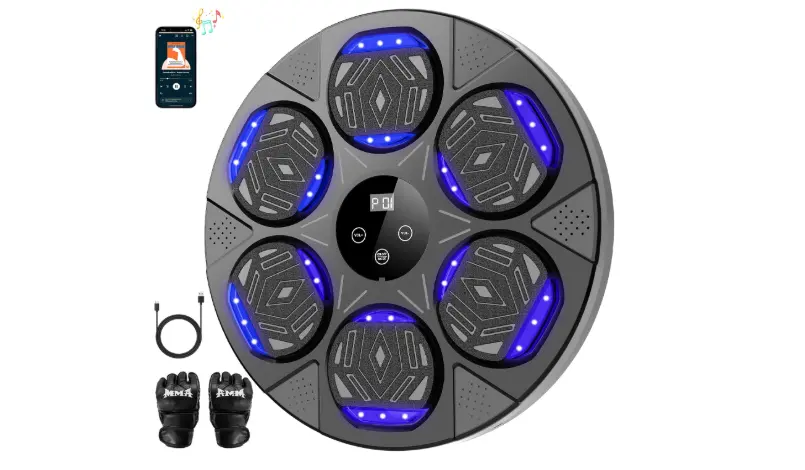
Parents can safely support basic non-contact practice at home. Good options include shadowboxing, simple footwork, jump rope, balance games, light pad work, short bag rounds, or music boxing machines.
Music boxing machines use lights, sounds, or moving targets to guide punching combinations. They can make exercise more enjoyable and help children practise timing, coordination, reaction speed, and rhythm.
Choose a machine that is suitable for the child’s height and age. Mount it securely, keep the surrounding area clear, and supervise every session.
Keep the area clear and make sure the child has enough space. Use proper wraps and gloves for bag work. Stop if the child reports hand, wrist, elbow, shoulder, neck, or head pain.
Do not copy advanced drills from random videos, allow siblings to punch each other, or turn home practice into unsupervised sparring. Technique errors repeated at home can cause injury and become harder to correct later.


Boxing or Another Martial Art?
Boxing is a good fit for children who enjoy fast movement, pad work, footwork, and structured fitness. Other children may prefer swimming, football, basketball, gymnastics, wrestling, judo, karate, taekwondo, or Brazilian jiu-jitsu.
No sport is risk-free. The right choice depends on the child, coach, rules, and training style.
Parents mainly interested in confidence, discipline, and general fitness do not need to choose a program with head contact. Many non-contact boxing, martial arts, and fitness classes can provide structure and skill practice without making blows to the head part of success.
Frequently Asked Questions
Is boxing good for a 5-year-old?
It can be good as a playful, non-contact activity. Classes should use short drills, simple movement, balance games, pads, and close supervision. A 5-year-old should not be treated like a small adult boxer.
Is boxing good for a 7-year-old?
A 7-year-old may be ready for structured lessons in stance, footwork, straight punches, bag work, and fitness. Choose a youth coach who does not rush beginners into contact.
Will boxing make my child aggressive?
A well-run class should teach control, respect, and rules. Boxing does not automatically make a child aggressive. A poor gym culture can still encourage bad behavior, so watch how the coach responds to anger, teasing, and roughness.
Can boxing help with confidence?
Yes, it can. Confidence often grows as children learn skills, improve fitness, and complete tasks that once felt difficult. Results depend on the child’s experience and the quality of coaching.
Can boxing improve focus at school?
Physical activity can support attention and memory, and boxing drills require concentration. Some parents may notice better focus, but boxing cannot guarantee higher grades or fix an attention disorder.
Is punching a bag safe for children?
It can be safe when the bag is suitable for the child’s size, the child uses wraps and gloves, and a coach has taught correct form. Children should not hit as hard as possible before they can control their wrist, elbow, shoulder, and stance.
Should children spar?
Parents should understand that sparring adds head-impact risk that is not present in normal bag, pad, and footwork training. Children can gain most fitness and skill benefits without sparring. Families who allow it should require strict supervision, careful matching, controlled intensity, proper equipment, and a clear concussion process.
Is boxing good for self-defense?
It can teach balance, distance, movement, guard, and punching skill. Real safety also requires awareness, verbal boundaries, leaving danger, calling for help, and knowing when not to fight.
Final Answer
Boxing can be good for kids when it means non-contact training, fitness, footwork, bag work, pad work, discipline, and safe coaching. It can help with physical fitness, coordination, confidence, focus, emotional control, respect, social interaction, and goal setting.
The main concern is not the basic training. It is repeated head contact. Sparring and competitive boxing expose children to concussion and other head injuries, and padding does not remove that risk.
Parents do not have to choose between banning every boxing drill and allowing full contact. A sensible option is to choose a good youth program, keep training age-appropriate, focus on non-contact skills, and avoid intentional blows to the head.