

Selecting a boxing glove size for a child is not about matching age to ounces. Age gives you a starting point. The final choice depends on hand circumference, body weight, hand wraps, training type, the exact glove model, and the coach’s rules.
Boxing glove ounces describe the weight of the glove, not the size of the hand compartment. Two 8 oz gloves can fit very differently inside. Everlast separates glove weight from hand circumference in its sizing guidance, while Rival uses both body weight and hand circumference for its youth sparring chart.
Table of Contents
Quick Youth Boxing Glove Size Chart
Use this chart as a starting point for normal youth training. It is not a sparring or competition rule.
| Age | Common starting range | Typical use |
|---|---|---|
| 3 to 5 | 4 oz | Non-contact drills, soft mitts, basic movement |
| 6 to 7 | 4 to 6 oz | Pads, technique work, light bag drills |
| 8 to 10 | 6 to 8 oz | General classes, pads, controlled bag work |
| 11 to 12 | 8 to 10 oz | General training, with coach approval for partner work |
| 13 to 15 | 10 to 14 oz | Based on body size, hand fit, and training type |
These ranges are broad on purpose. One age chart cannot work for every child. Venum sells youth gloves in 4 oz, 6 oz, and 8 oz. Hayabusa places its 6 oz T3 Kids glove around ages 6 to 10 and its 8 oz version around ages 11 to 14. Everlast sells an 8 oz youth glove aimed at ages 8 to 12. Rival pairs an 8 oz youth sparring glove with 70 to 90 lb and a 6.5-inch hand, then a 10 oz glove with 90 to 110 lb and a 7.5-inch hand.
That variation is normal. Use the chart to narrow the options, then check the exact glove.
What Do Boxing Glove Ounces Mean?
Boxing gloves are commonly sold as 4 oz, 6 oz, 8 oz, 10 oz, 12 oz, 14 oz, 16 oz, and above. The ounce number refers to glove weight. It does not tell you the internal width, finger length, or wrist opening.
More ounces usually means more material and padding, but it does not guarantee a roomier hand pocket or a better fit. A compact 10 oz youth glove may fit a child better than a loose 8 oz adult glove.
The ounce choice also changes with use. Lighter gloves are common for pads and bags. Sparring gloves are normally heavier and use padding intended for partner work. Competition glove weight is set by the governing body or event, not by a general shopping chart.
How to Size Boxing Gloves for a Child
Use five checks in this order.
1. Start With the Training Type
Ask what the gloves are for:
- General beginner classes
- Focus mitts and pads
- Punching bag work
- Sparring
- Competition
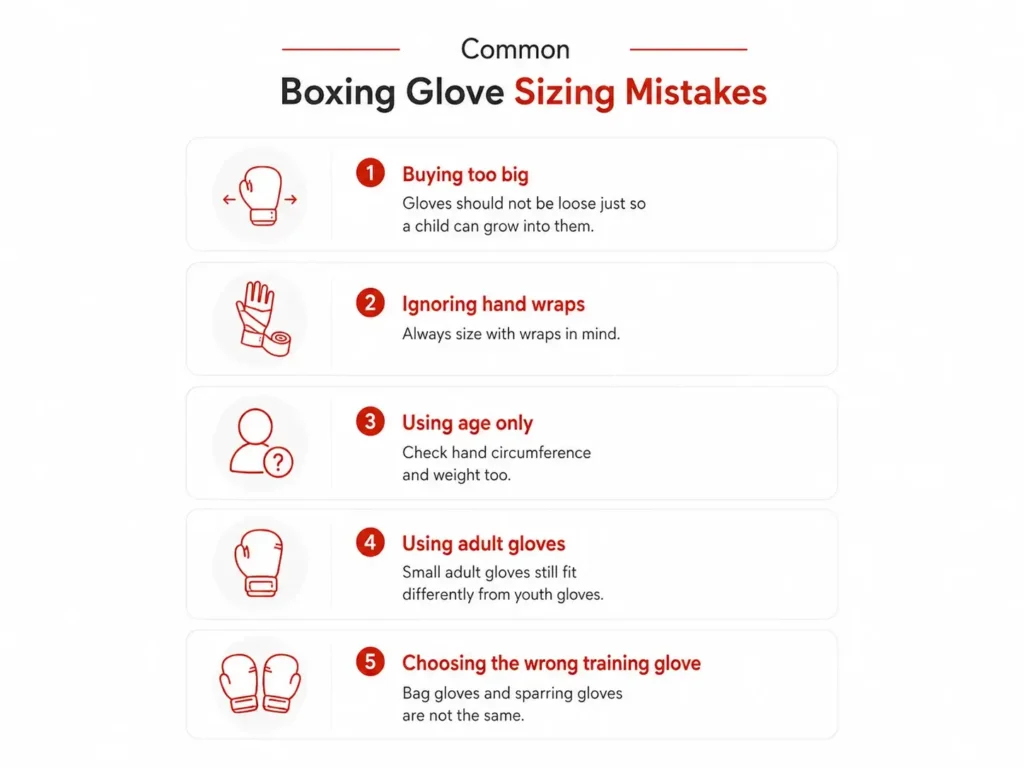
Do not choose a glove before answering that question. A bag glove and a sparring glove can carry the same ounce label but use different padding. For example, Rival youth bag gloves must not be used for sparring or for hitting another person.
For a beginner doing pads and light bag drills, a youth training glove is usually the simplest option. For sparring, use a glove approved by the coach. For competition, follow the current event rules.
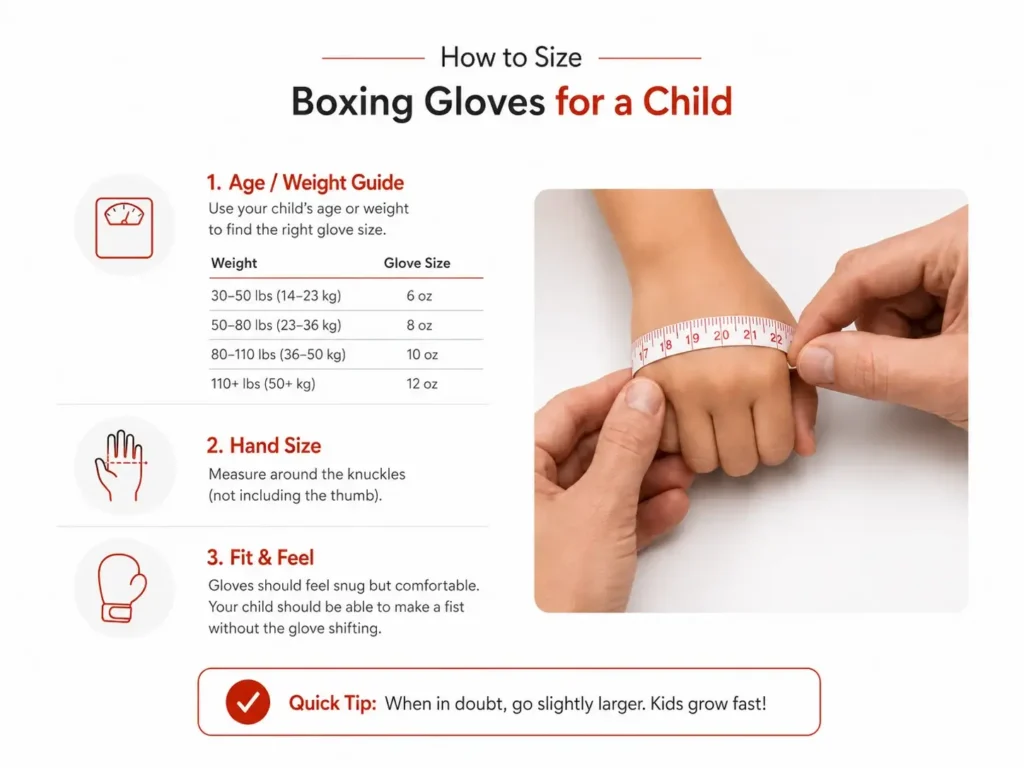
2. Measure Hand Circumference
Use a flexible sewing tape. Have the child hold the hand open and relaxed. Wrap the tape around the widest part of the palm, across the knuckles, without including the thumb.
Keep the tape snug without pressing into the skin. Record the result in inches and centimetres because brand charts may use either unit.
Everlast and Hayabusa both direct buyers to measure around the palm at the knuckles. Rival states that its hand circumference figures are taken without wraps.
Measure both hands when one appears larger. Use the larger result when comparing charts.
3. Check Body Weight
Body weight helps determine how much glove a child can control and how much padding may suit the activity. It should support the hand measurement, not replace it.
Rival’s youth sparring gloves combine body weight, hand circumference, and glove weight instead of relying on age alone.
4. Try the Gloves With Hand Wraps
A glove that fits without wraps may become too tight once the child is ready to train. Put on the same wraps the child will use in class, then test the glove.
Try ying gloves with wraps and check that the fingers reach the end without being crushed. The wrist strap should stay firm without slipping or pinching.
5. Let the Coach Check the Final Fit
The coach knows what the class uses for bags, drills, and sparring. A gym may also require a specific ounce weight for partner work.
Ask before removing tags or hitting a bag.
How Should Kids Boxing Gloves Fit?
A good glove feels snug, not cramped.
Check these points:
- The fingers reach near the end without curling or pressing hard.
- The child can close a natural fist.
- The knuckles sit behind the main padded area.
- The thumb sits naturally without being pulled outward.
- The wrist strap closes firmly.
- The glove does not rotate around the hand.
- The hand does not slide out while the strap is closed.
- There is no numbness, tingling, or finger colour change.
- The fit still works with wraps.
A little firmness in a new glove is normal. Pain, pinching, and lost circulation are not.
4 oz Boxing Gloves
Four-ounce gloves are among the smallest common kids boxing gloves. They are mainly for very young children with small hands doing non-contact drills, soft mitt work, and basic technique.
What Size Gloves for a 5-Year-Old?
Start by trying a proper youth 4 oz glove. A larger 5-year-old may fit 6 oz, but age cannot settle the choice. Check the inner hand space, wrist closure, and brand chart.
Under boxing rules, children under 10 may take part in classes but cannot spar, enter a skills bout, or compete. Technique work and non-contact training are therefore the correct focus for this age within that system.
6 oz Boxing Gloves
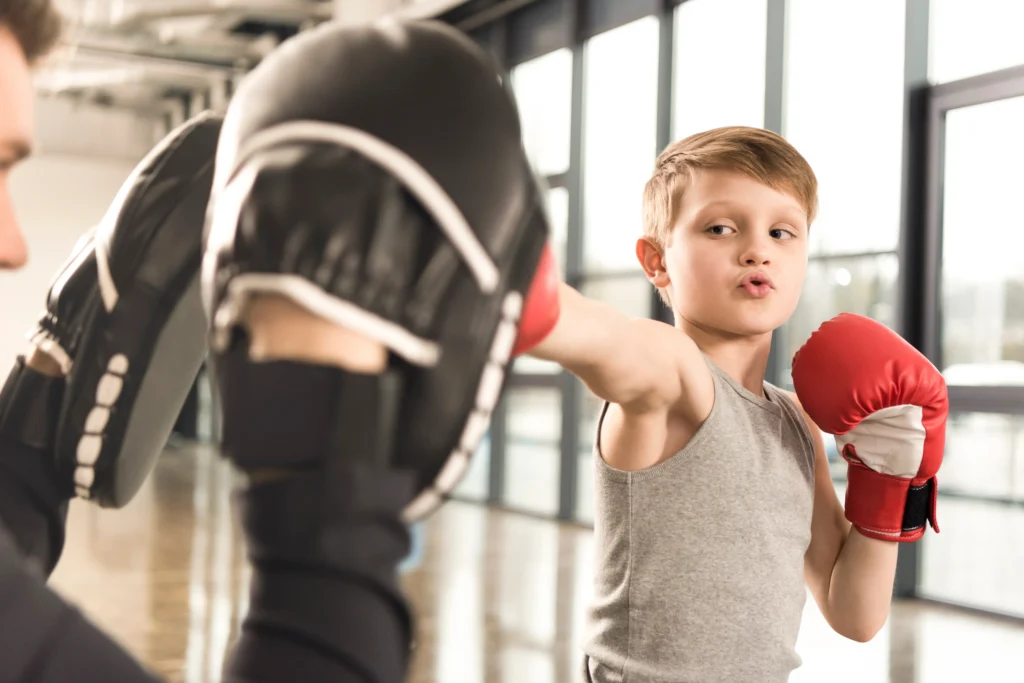
Six-ounce gloves are a common step for children in the early primary-school years. They can work for mitts, light bag training, and general beginner classes when the hand compartment fits correctly.
Hayabusa 6 oz T3 Kids glove are for ages 6 to 10, while several youth ranges offer 6 oz alongside 4 oz and 8 oz. That does not mean every child in that age group should wear 6 oz. It means 6 oz is worth trying.
What Size Glove for a 7-Year-Old?
A 6 oz youth glove is the normal first check. Try 4 oz when the child is very small and the 6 oz glove moves around. Try 8 oz only when the product chart, hand measurement, and coach support it.
The correct glove should not fall away from the wrist when the child holds a guard.
8 oz Boxing Gloves
Eight-ounce gloves cover a wide part of the youth market. They may suit an older child for general training, a larger child who has outgrown 6 oz, or a smaller youth boxer using a compact sparring model.
The label alone does not tell you the fit. Everlast’s Prospect 2 is an 8 oz youth glove aimed at ages 8 to 12. Hayabusa also sells 8 oz youth models, while Rival pairs its 8 oz youth sparring glove with 70 to 90 lb and a 6.5-inch hand circumference.
What Size Glove for an 8-Year-Old?
Try a 6 oz and an 8 oz youth glove. Choose the one that holds the hand securely with wraps and lets the child form a fist without pressure at the fingertips.
Do not choose 8 oz simply because the child is eight. The matching numbers are a coincidence.
10 oz Boxing Gloves
Ten-ounce gloves often suit older or larger children, but their use matters. A compact 10 oz youth glove can work for training or coach-approved sparring. A standard adult 10 oz glove may be too wide inside.
Rival’s youth sparring chart places 10 oz at 90 to 110 lb with a 7.5-inch hand circumference. Ten-ounce gloves can also be competition gloves.
What Size Gloves for a 12-Year-Old?
Start with 8 oz or 10 oz youth gloves for normal training, then follow the exact product chart. A smaller 12-year-old may fit an 8 oz youth glove. A larger child may need 10 oz or a compact adult model.
For sparring, ask the coach before buying. The gym may require more padding than the child’s bag glove provides.
12 oz Boxing Gloves
Twelve-ounce gloves may suit larger pre-teens and teenagers for general training. They may also be required for sparring or competition, depending on body weight and local rules.
Do not assume 12 oz is automatically safer. A loose 12 oz adult glove can give poor wrist control on a small hand. Internal fit still comes first.
When a child moves from a youth glove into an adult 12 oz model, compare finger length, palm width, and cuff position. The wrist strap should close around the wrist, not across the lower hand.
14 oz Boxing Gloves
Fourteen-ounce gloves are usually more relevant to larger teenagers and adults than to young children. They can be used for general training or sparring when the boxer’s body size, hand size, and gym rules support them.
A 14 oz glove is not a hand-size label. It may still come in different internal sizes. Everlast, for example, groups 12 to 14 oz gloves with a hand circumference range in its adult chart, while other brands use separate small, medium, or large hand compartments.
Do not buy Everlast 14 oz boxing gloves, or any other 14 oz model, for a teenager based only on age. Check the exact chart and intended use.

Boxing Gloves for Teenagers
Teenagers sit between youth and adult equipment. Some still fit an 8 oz or 10 oz youth hand pocket. Others need a 10 oz, 12 oz, or 14 oz adult glove.
Use this order:
- Measure the hand.
- Check body weight.
- Choose the training type.
- Compare the exact product chart.
- Test with wraps.
- Confirm sparring weight with the coach.
Girls do not need a separate boxing glove size chart. Use the same hand, body weight, and training checks. Color and product styling have no effect on fit.
What if My Child Is Between Sizes?
Do not automatically choose the larger glove for growing room. Start with the exact brand chart and give hand circumference more weight than age. Rival treats hand circumference as the main sizing guide and body weight as a secondary check.
Try both sizes with hand wraps on. Choose the smaller size when it feels snug, allows a natural fist, and stays fixed at the wrist. Move to the larger size when the smaller glove presses against the fingertips, restricts the fist, causes numbness, or becomes too tight once wraps are added.
The larger glove is not the right choice when the hand slides inside, the glove rotates during punches, or the wrist strap cannot hold it firmly. An oversized glove can shift during training, so a different model with a better-shaped hand pocket may work better than moving up in ounces.
For sparring, ask the coach before choosing. The required glove weight may depend on body weight, hand size, and gym rules, not just which pair feels most comfortable.
Bag Gloves, Training Gloves, and Sparring Gloves
Bag Gloves
Bag gloves are made for repeated contact with bags and pads. Their padding may feel firmer and more direct.
A bag glove should not be used on a training partner unless the coach and manufacturer approve it.
Training Gloves
Training gloves aim to cover pads, bags, and general drills. They are a sensible first pair for many children, but the word “training” does not always mean “sparring.”
Sparring Gloves
Sparring gloves are made for partner work and normally use more padding or softer contact foam. The coach should set the ounce weight.
Competition Gloves
Competition gloves follow the event rules. The boxer may not be allowed to use a personal training pair.
Always check the current rules for the child’s country, club, and event.
Youth Gloves vs. Small Adult Gloves
A small adult glove is not always a valid replacement for a youth glove.
Youth gloves usually have:
- A shorter finger section
- A smaller palm pocket
- A cuff shaped for a smaller wrist
- Lower ounce options
- Thumb placement suited to a smaller hand
An older or larger child may fit a compact adult glove. Test it rather than assuming.
When the hand moves inside, the wrist strap misses the wrist, or the child cannot close a natural fist, the glove is wrong.
What About S, M, and L Kids Gloves?
Some children’s gloves are sold as small, medium, and large instead of ounces. These letters describe that brand’s internal fit. They do not convert cleanly into 4 oz, 6 oz, or 8 oz across every company.
Use the chart attached to the exact model. A medium in one brand can have different hand measurements from a medium in another.
The same rule applies to adult gloves sold with both an ounce weight and a hand size. The ounce tells you glove weight. The letter describes the hand compartment.
Should You Size Up for Growth?
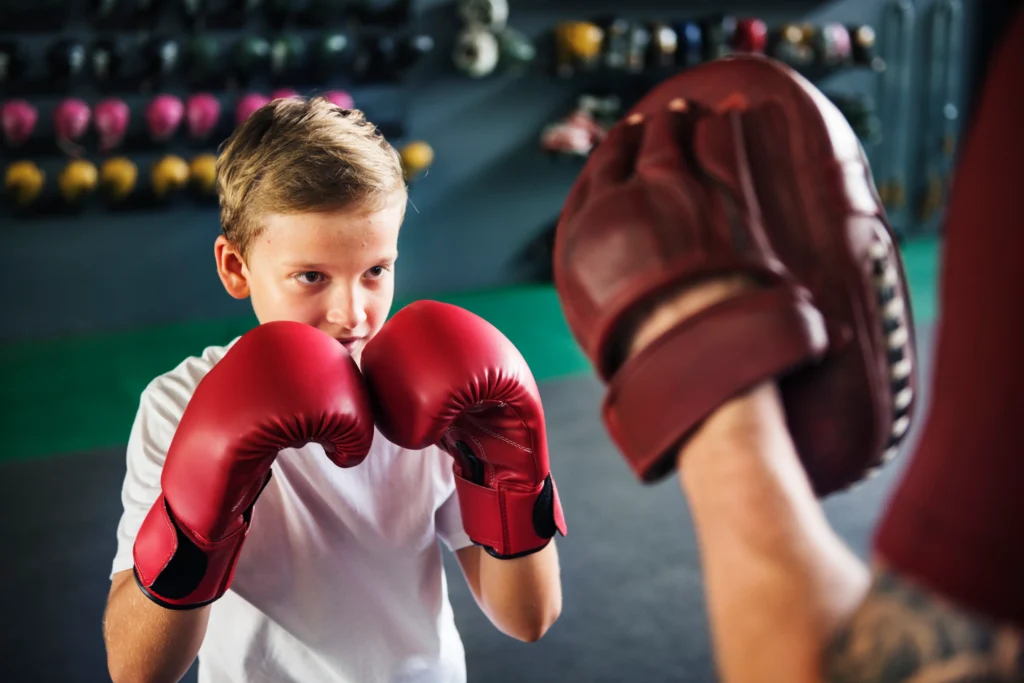
Do not buy a loose glove because the child may grow into it.
A small amount of space for wraps is necessary. Empty space that lets the hand slide or the glove rotate is not. Buy the glove that fits now, then replace it when the child’s hand no longer fits correctly.
Size up when:
- The fingers press hard against the end.
- The child cannot make a comfortable fist.
- Wraps make the glove painfully tight.
- The wrist strap no longer closes correctly.
- The thumb position pulls or pinches.
- The child has clearly outgrown the hand pocket.
Do not size up only because the next ounce number sounds more protective. Find best kids and youth boxing gloves here.
How to Buy Boxing Gloves Online
Before ordering, collect:
- Hand circumference
- Body weight
- Current age
- Intended training use
- The coach’s preferred glove weight
Then open the chart for the exact product. Do not rely on a general chart from another brand.
When the gloves arrive:
- Keep the tags attached.
- Put on the child’s wraps.
- Try both gloves.
- Check the fist, thumb, and wrist.
- Hold a guard for a minute.
- Confirm the fit with the coach.
- Do not hit a bag until the return decision is final.
Common Boxing Glove Sizing Mistakes
Read Further: Is Boxing Good for Kids?
What Boxing Glove Size Should My Child Get?
Start with a youth glove in the common range for the child’s age, but do not stop there.
Measure around the knuckles, check body weight, decide if the glove is for bags or sparring, compare the exact brand chart, and test the fit with wraps. The glove should feel snug, allow a natural fist, and stay fixed at the wrist.
For sparring or competition, the coach and current governing rules decide the final ounce weight. That answer matters more than any general boxing gloves sizing chart.