

A boxer can look sharp on the pads and still freeze when a sparring partner changes the rhythm.
That is not always a hand-speed problem. Often, the mitt session trained a fixed routine instead of a decision.
Good mitt work teaches clean punches, balance, range, guard recovery, defense, and quick choices. It should start simple and become less predictable as the boxer improves.
Padwork needs a clear purpose, realistic targets, boxer-like movement, and a level of difficulty that suits the athlete.
Let’s explore proper holding mechanics that force realistic targeting, a drill library organized by skill level, ready-to-use session templates, and a clear bridge from controlled pad work to live sparring.
Key Takeaways
- Mitt work is cognitive training: it sharpens reaction time, pattern recognition, and dual-task processing under pressure.
- Set combinations teach mechanics. Reaction drills teach the boxer to read and respond. A useful session needs both.
- The holder should present realistic targets, move like a boxer, and avoid swinging the pads into punches.
- Beginners should stay with short two or three-punch combinations until they can finish balanced and ready to defend.
- Structured round templates with timed progressions eliminate guesswork and maximize training efficiency.
Table of Contents
Do Boxers Memorize Combinations or React to the Mitts?
They do both.
New boxers usually start with named punches, number calls, and short set combinations. Repetition helps them learn the order, balance, and hand position.
As the boxer improves, the holder can reduce the verbal help. The boxer then reacts to pad position, body movement, distance, rhythm changes, feints, and light return shots.
That move from set work to less predictable work matters. As per research, experienced boxers processed the same cues differently from beginners and people with no boxing training. It does not prove that one mitt drill is best, but it supports using realistic cues instead of relying only on rehearsed sequences.
The Boxing Punch Number System
Many gyms use a number system because it is faster than calling each punch by name.
A common version is:
- Jab
- Cross
- Lead hook
- Rear hook
- Lead uppercut
- Rear uppercut
The system is not universal. Some coaches use 4 for an overhand right or change the uppercut numbers. Agree on the system before the round starts.
Set Up the Session Safely
Mitt work is cooperative, but poor setup can still hurt the puncher’s hands or the holder’s wrists.
The puncher should use clean hand wraps and suitable boxing gloves. There is no single wrap length that fits every hand. The wrap length should match hand size, since wraps that are too long can bunch up and wraps that are too short may not give enough support.
The holder should use mitts that fit securely, keep the wrists in a comfortable line, and stop if repeated catches cause pain.
Do not turn a technical drill into full-power work unless both people have the skill and equipment for it.
Sparring and contact work require qualified supervision and the rules of the gym or governing body.
How to Hold Focus Mitts Correctly
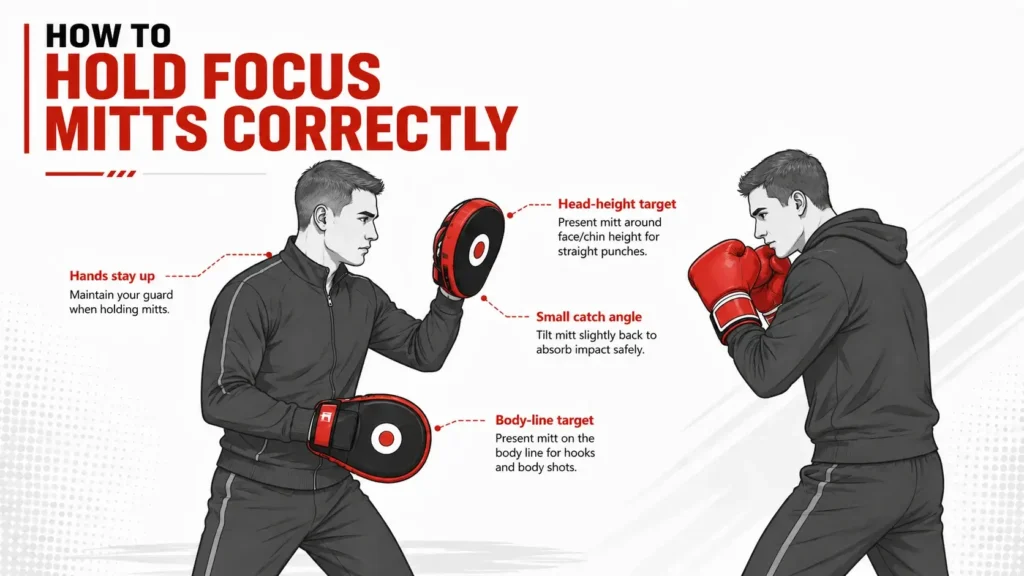
The target should look like a real opponent, not two pads floating far outside the holder’s body.
Here are the basic pad positions:
- Straight punches to the head: Hold the pad center around nose level with the palm facing the boxer.
- Straight punches to the body: Hold the pad around the solar plexus.
- Lead hook to the head: Hold the pad around nose level and turn it to receive the hook’s curved path.
- Uppercuts: Change the angle with range. A longer uppercut may meet a pad around a 45-degree angle, while a short uppercut may meet a pad facing the floor.
These are starting points. The correct angle depends on the punch, range, stance, and aim of the drill.
Keep the Pads Realistic
Start from a boxing stance and guard.
Keep the targets near your own head and body lines. Do not hold straight-punch targets at chest height when the boxer is meant to aim at a head.
Move your feet. A holder who stays planted teaches the boxer to punch a fixed object, not manage a moving opponent.
Most importantly, do not swing the pad forward to create a loud crack. Let the punch travel its full distance and warns against moving the target into the shot.
Hold a firm target with a small natural give. Do not reach into the punch or force the wrist backward.
Fundamentals for the Puncher
Clean mitt work starts with stance, guard, and distance.
A basic boxing stance uses a stable base, slightly bent knees, an offset rear foot, and a rear heel that can lift for movement. Place the feet a little wider than shoulder width and don’t go for a stance that is too wide or too narrow limits balance and movement.
Individual coaches may adjust the stance for body type and style.
Keep the chin down. Keep the hands near the cheekbones. The hand that is not punching stays home.
After every punch, return to guard.
The jab should reach the target without a forward fall. If the boxer must lean or stretch, the range is too long. If the arm stays heavily bent on contact, the boxer may be too close.
Use small steps to keep the gap. Do not cross the feet or jump after the pads.
10 Core Focus Mitt Drills
Each drill below has one main job. Keep the drill simple enough that the boxer can do that job well.
1. Jab-Only Range Drill
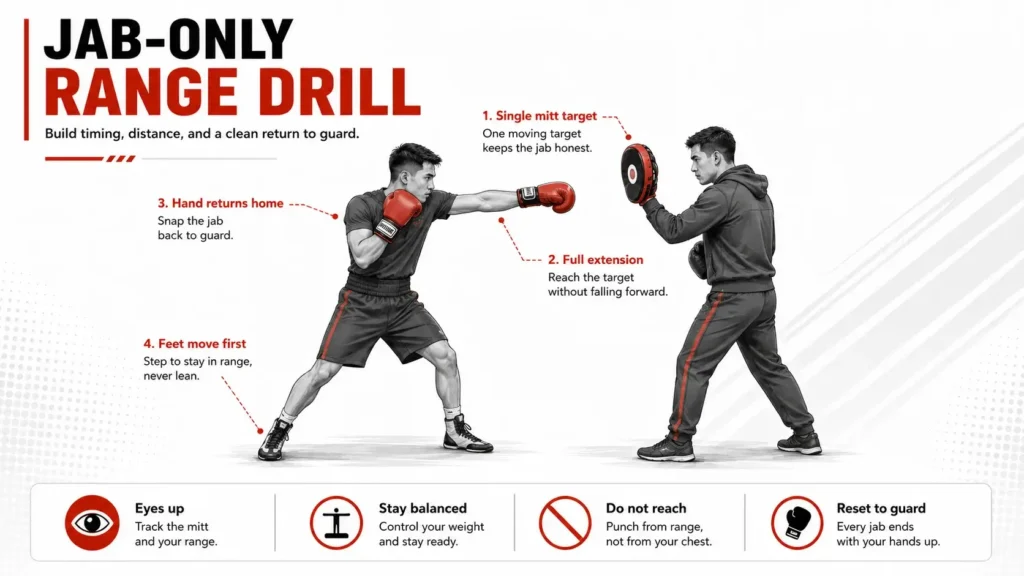
Purpose: Build jab timing, range, guard recovery, and basic footwork.
Setup: The holder wears one mitt or presents one main target. Move forward, backward, and sideways. Show the target at different moments instead of keeping a fixed rhythm.
Boxer action: Jab as the target appears, bring the hand straight back to guard, and adjust the feet to stay in range.
Watch for:
- Reaching with the head over the front knee
- Dropping the rear hand
- Waiting flat-footed for the target
- Pushing the jab instead of snapping it
Keep the first round slow. Speed means little if the boxer loses position.
2. Short Combination and Guard Reset
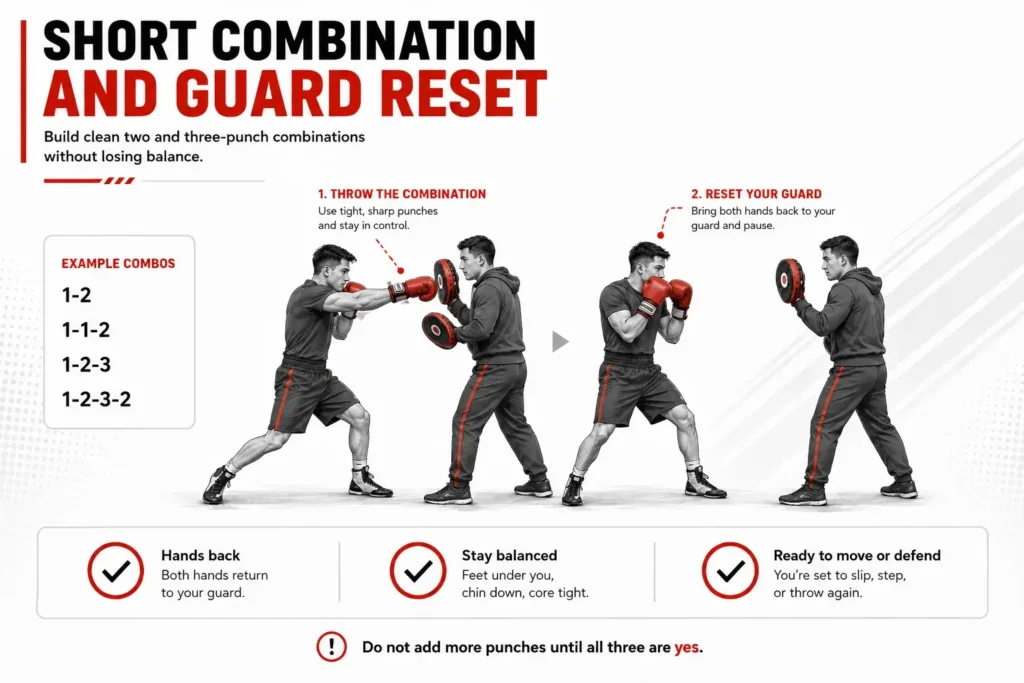
Purpose: Build clean two and three-punch combinations without losing balance.
Start with:
- 1-2
- 1-1-2
- 1-2-3
- 1-2-3-2
Consider simple two or three-punch combinations for beginners and don’t go for complex sequences before balance and control are ready.
After each combination, pause for one beat and check three things:
- Are both hands back?
- Is the boxer balanced?
- Can the boxer move or defend at once?
Do not add more punches until all three answers are yes.
3. 1-2 With an Immediate Defense
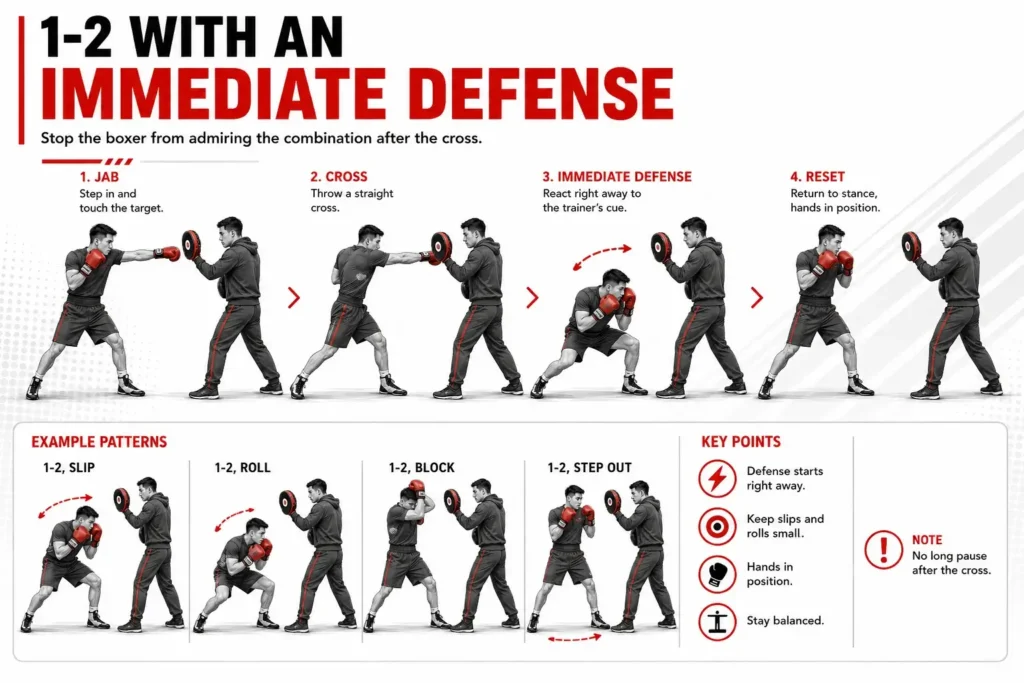
Purpose: Stop the boxer from admiring the combination after the cross.
Setup: Call one of these patterns:
- 1-2, slip
- 1-2, roll
- 1-2, block
- 1-2, step out
- 1-2, slip, 2
- 1-2, roll, 3-2
The defense starts as soon as the cross returns. There should be no long pause.
Keep slips and rolls small. Large movements waste time and can pull the boxer out of position. Go for a balanced base, hands in position, and small movements instead of exaggerated reactions.
4. Body Block and Counter Drill
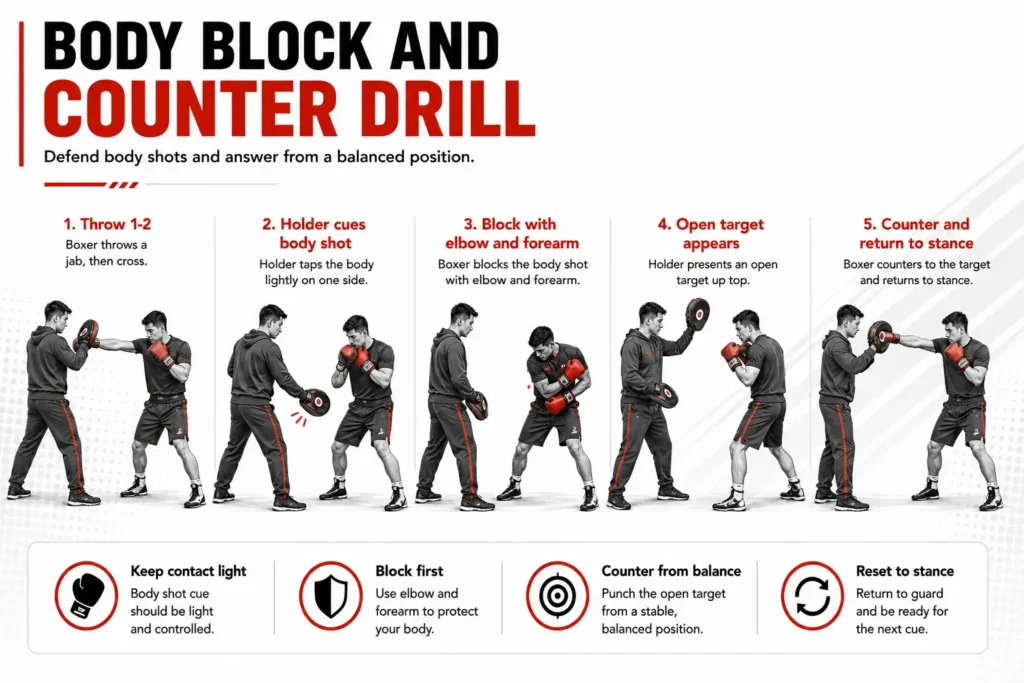
Purpose: Defend body shots and answer from a balanced position.
The holder gives a light, controlled tap toward one side of the body. The boxer blocks with the elbow and forearm, then counters to the open target.
A simple pattern is:
- Boxer throws 1-2.
- Holder gives a light body-shot cue.
- Boxer blocks.
- Holder presents a head or body target on that side.
- Boxer counters and returns to stance.
Keep the contact light. This is a timing drill, not a test of toughness.
5. Rapid Call-Out Drill
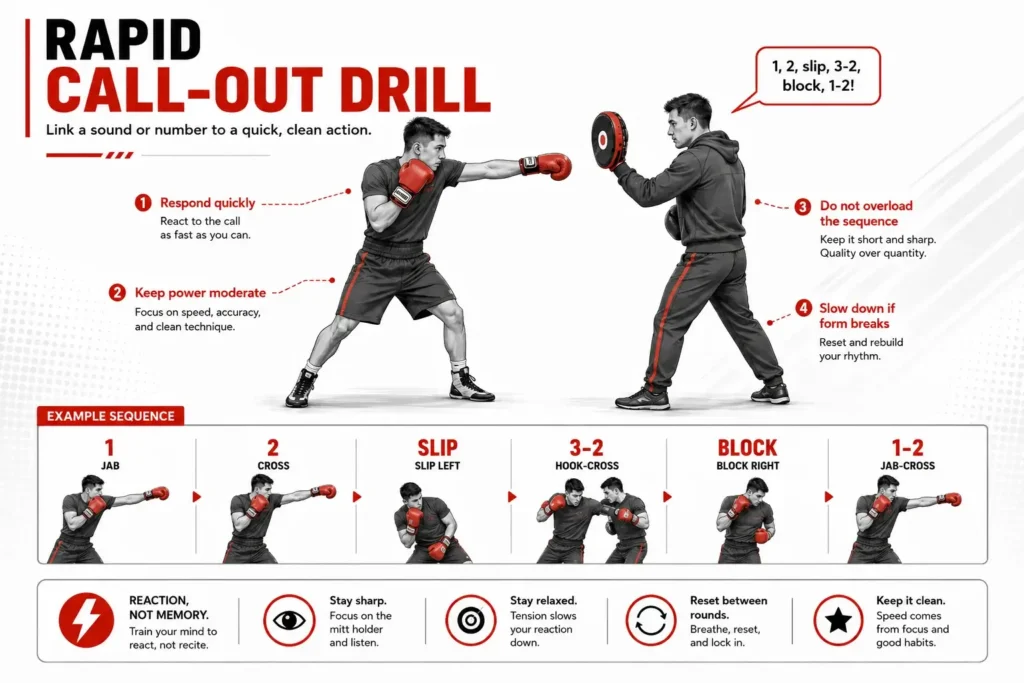
Purpose: Link a sound or number to a quick, clean action.
Setup: Call single punches and short sequences. Mix in defensive calls.
Example:
1, 2, slip, 3-2, block, 1-2
Do not call a long string before the boxer starts. That tests memory more than reaction.
The boxer should respond quickly, but power stays moderate. Stop or slow the drill when the punches lose shape.
6. Silent Visual-Cue Round
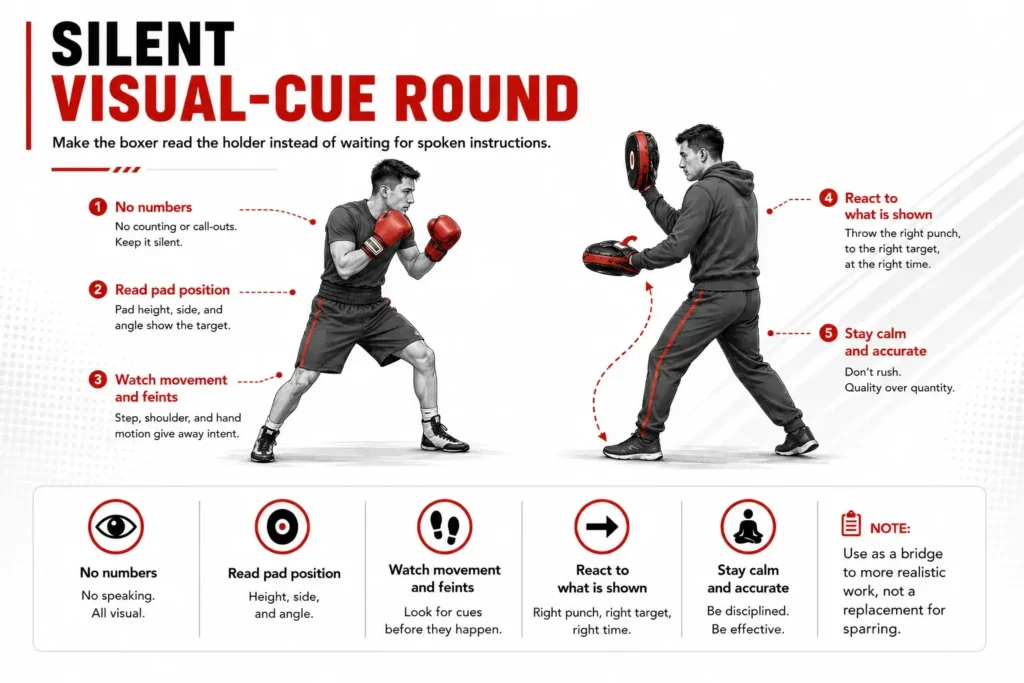
Purpose: Make the boxer read the holder instead of waiting for spoken instructions.
Setup: Use no numbers. Present a pad, change position, step, feint, or show a defensive cue with controlled body movement.
Start with obvious cues. Make them less obvious only when the boxer stays calm and accurate.
The boxer should react to what is actually shown, not guess the next pattern.
Silent rounds can help bridge the gap between called combinations and live movement, but they are not a replacement for partner drills or sparring.
7. Opening Recognition Drill
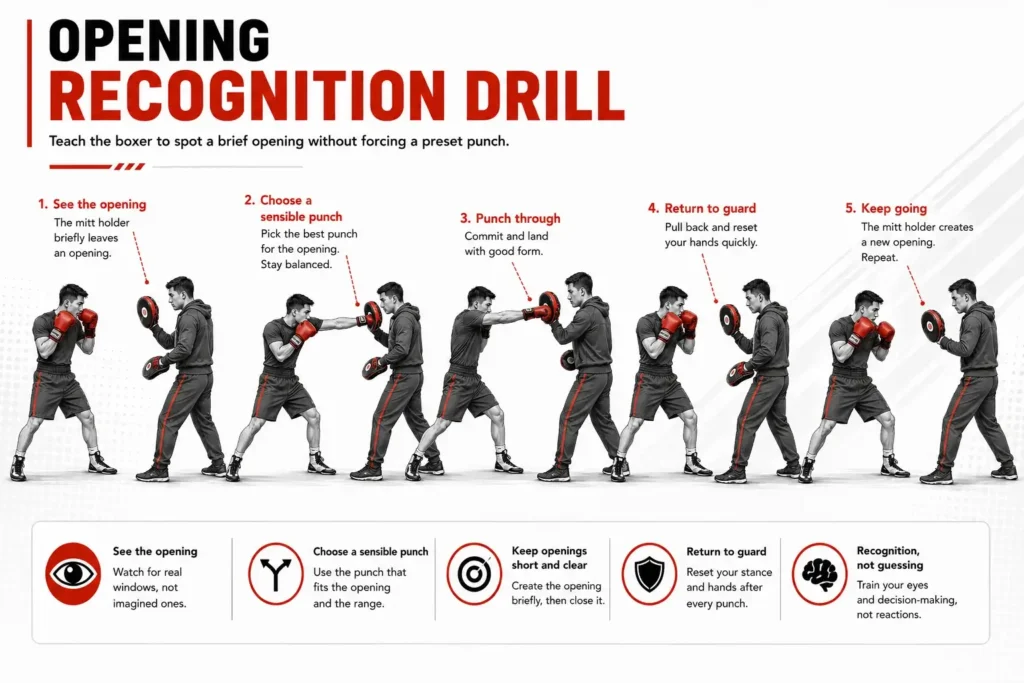
Purpose: Teach the boxer to spot a brief opening without forcing a preset punch.
Setup: During simple padwork, the holder briefly leaves one target open. Examples include a low lead hand, an open body line, or a slow return after a hook.
The boxer chooses a sensible punch and returns to guard.
Keep the opening short but clear at first. Later, vary the timing. Do not repeat the same opening until the boxer starts guessing.
The goal is recognition, not tricking the boxer.
8. Defense-Only Mitt Round
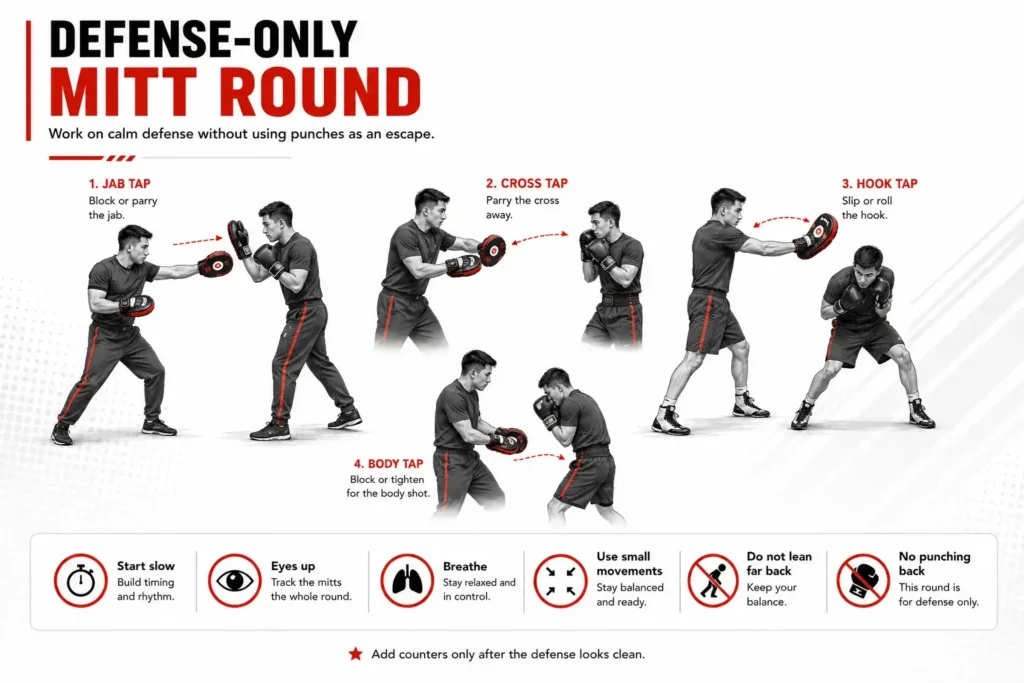
Purpose: Work on calm defense without using punches as an escape.
Setup: The holder throws light, controlled pad taps that represent jabs, crosses, hooks, and body shots. The boxer can block, parry, slip, roll, or step away, but cannot punch back during the round.
Start slow. The holder must stay in control.
The boxer should keep the eyes up, breathe, and use small movements. Do not lean far backward or run in a straight line.
Once this is clean, add a counter after the defense.
9. Pool Noodle Reaction Drill
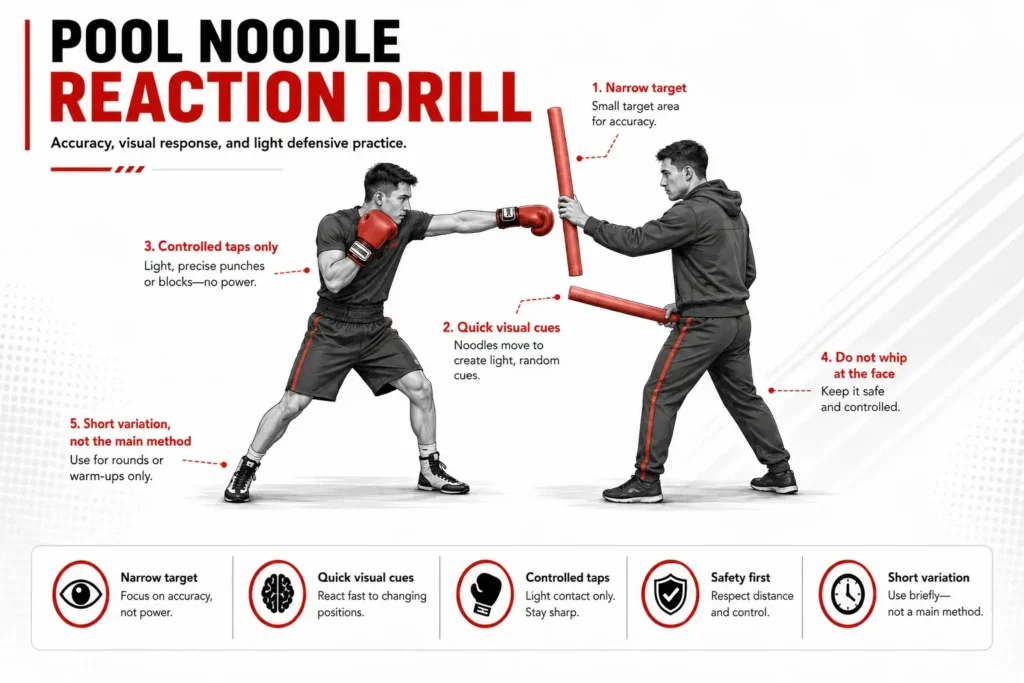
Purpose: Accuracy, visual response, and light defensive practice.
Foam noodles create a narrow target and can give quick defensive cues without the impact of a hard pad. The holder may change the visible length or attack angle.
Use controlled taps. Do not whip the noodle into the face.
The drill works best as a short variation, not the main method for teaching punch mechanics.
10. Single-Shot Power Drill
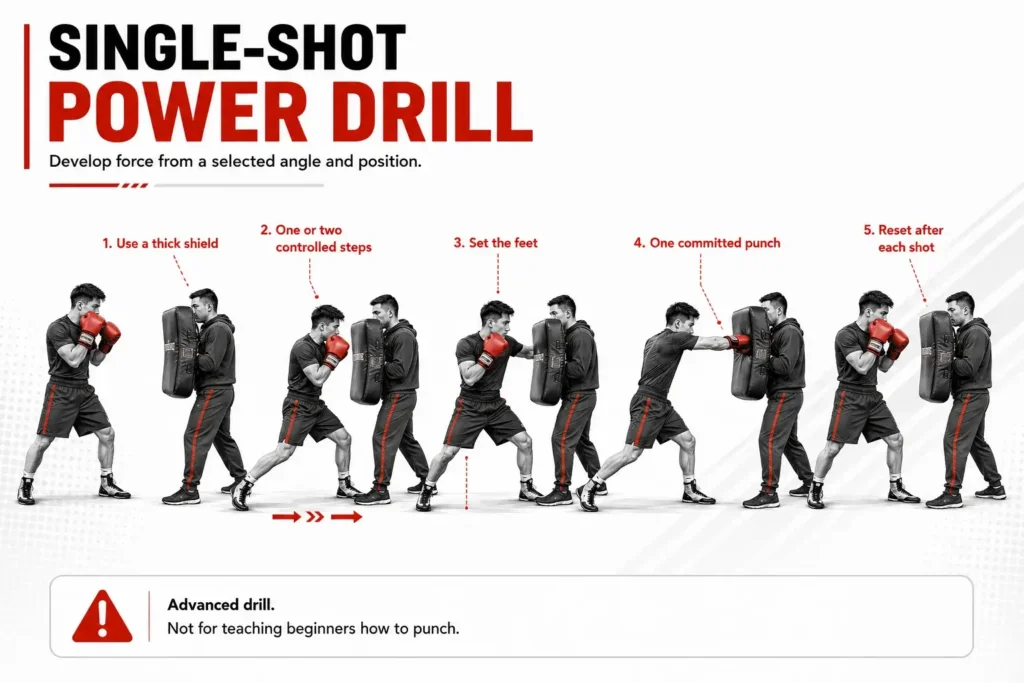
Purpose: Develop force from a selected angle and position.
This is advanced work. Use a thick body shield, punch shield, or suitable heavy pad rather than asking for full-power shots into small mitts.
The boxer takes one or two controlled steps, sets the feet, throws one committed punch, then resets.
Do not use this to teach beginners how to punch. New boxers often tense up, load the hand, and lose balance when told to hit as hard as possible.
Put Footwork into Every Drill
Footwork should not wait until the final round.
The holder can step back after a combination, move sideways after a jab, or change angle after a hook. The boxer must keep the stance, adjust the gap, and finish in position.
Good padwork should involve the feet because effective punching and defense start with position. England Boxing tells coaches to watch the boxer’s feet during padwork, not only the impact on the pads.
Useful Footwork Rules
- Step before reaching
- Keep the feet apart
- Do not cross the legs
- Move as a unit
- Finish balanced
- Change angle after selected combinations
Optional Burnout Round
A burnout round can test technique under fatigue, but it should not be a sloppy punching contest.
Use high-volume, low-power work for 30 to 60 seconds at a time. Keep the combinations short. Add rest or slow the pace when the boxer loses guard, balance, or clean breathing.
Mental fatigue can reduce a boxer’s speed and accuracy when reading attack and defense actions. That is one reason to train clean decisions while tired, but it is also a reason not to overload a beginner until the drill falls apart.
A Practical 30-Minute Mitt Session
This plan includes the warm-up, six rounds, rest periods, and a short cool-down.
| Time | Work |
|---|---|
| 5 minutes | Dynamic warm-up, stance, guard, and light shadowboxing |
| Round 1, 3 minutes | Jab-only range drill |
| 1 minute | Rest and one correction |
| Round 2, 3 minutes | Short combinations and guard reset |
| 1 minute | Rest |
| Round 3, 3 minutes | 1-2 with immediate defense |
| 1 minute | Rest |
| Round 4, 3 minutes | Rapid call-outs |
| 1 minute | Rest |
| Round 5, 3 minutes | Silent visual cues or opening recognition |
| 1 minute | Rest |
| Round 6, 3 minutes | Defense-only work with foot movement |
| 2 minutes | Light shadowboxing and breathing |
Keep the feedback short. Fix one main error between rounds instead of giving five instructions at once.
Research on trained combat athletes found that instructions focused on the result of the punch produced better speed and force than instructions focused only on body movements. It does not mean technical cues are useless. It means a clear cue such as “hit through the center” may work better than a long speech about every joint.
How to Extend It to 60 Minutes
Use the same structure, then add:
- A second round for each major skill
- A tactical round for a certain opponent type
- A partner-pad round
- A controlled pressure round near the ropes
- A short video review break
- A final technical round at low speed
Do not fill the extra time with random combinations. Each added round needs a clear reason.
Common Mitt Work Mistakes
Holder Mistakes
| Mistake | Why It Hurts the Drill | Quick Fix |
|---|---|---|
| Pads too low or too wide | Creates false targets and pulls the boxer out of stance | Hold near real head and body lines |
| Swinging pads into punches | Shortens the punch and can stress the wrists | Present the target and let the punch arrive |
| Calling long combinations | Turns the round into a memory task | Call one to three punches at a time |
| Standing still | Removes range and footwork decisions | Step, angle, and change distance |
| Chasing a loud pad sound | Rewards pad slapping instead of clean contact | Focus on accuracy and position |
| Ignoring mistakes | Repeats poor habits | Stop, fix one issue, and restart slowly |
Puncher Mistakes
| Mistake | Quick Correction |
|---|---|
| Dropping the non-punching hand | “Hand home” |
| Chin lifting | “Chin down” |
| Leaning to reach | “Move your feet” |
| Crossing the feet | “Keep your base” |
| Loading up before the punch | “Throw from guard” |
| Guessing the cue | “See it first” |
| Tensing the shoulders | “Breathe and loosen” |
| Finishing square or off balance | “Finish ready” |
Use Video Without Overcoaching
Record one round from the side and one from the front.
Check:
- Does the hand return to guard?
- Does the boxer lean past the front knee?
- Do the feet cross?
- Does the rear heel turn naturally on the cross?
- Is the holder presenting realistic targets?
- Does either person move before the cue is clear?
Review one or two errors, then repeat the drill. Do not turn every rest period into a long lecture.
How to Move from Mitts to Sparring
Mitt work should be one step in a wider skill plan.
A sensible order is:
- Controlled padwork: Called punches and simple defenses.
- Visual-cue padwork: Less talking, more movement and body cues.
- Partner pads: A faster partner gives more realistic speed and range.
- Technique or conditioned sparring: Limit the available punches or defenses so one skill gets tested.
- Open sparring: Use coach feedback to see whether the trained habit holds up.
You can have a similar progression from coach padwork to partner pads, then technique and conditioned sparring, with open sparring used more carefully when skill learning is the main goal.
Mitt work cannot copy everything a live partner does. A holder does not create the same danger, timing, feints, pressure, or resistance as a sparring partner.
That is why a boxer can be good on pads and still struggle in the ring.
The answer is not to remove mitt work. Make it more realistic and connect it to supervised partner practice.
The Science Behind Mitt Work
Boxing depends on quick visual decisions, not just fast hands.
Studies using boxing-specific cues show that experience changes how athletes respond to attack information. Other work has linked reaction measures with competitive outcomes and found that fatigue can hurt action recognition.
Do not claim that silent rounds, pool noodles, or one number system will automatically improve fight IQ. Treat them as coaching tools.
Keep the tools that improve balance, accuracy, defense, range, and choices in sparring.
Frequently Asked Questions
What Are the Best Mitt Drills for Beginners?
Start with jab-only work, the 1-2, short two or three-punch combinations, and a simple defense after the combination.
Keep the pace low enough for the boxer to return to guard and stay balanced.
How Many Punches Should a Beginner Throw in a Combination?
Usually, two or three. Add longer sequences only when the boxer can maintain form, balance, and defensive readiness.
Should the Mitt Holder Hit Back?
The holder can use light, controlled taps to cue blocks, slips, rolls, and guard recovery.
This should be agreed in advance and kept appropriate for the boxer’s level. It is a teaching tool, not punishment.
How Long Should Mitt Rounds Last?
Match the round to the boxer and the purpose of the drill.
Short rounds work well for fast technical practice. Longer rounds can test sustained work. England Boxing notes that conditioning padwork may use one-minute rounds with 30 seconds of rest, while other training may use timings closer to competition.
Stop or reduce the pace when technique starts to break down.
Are Pool Noodle Drills Useful?
They can provide small targets and light defensive cues.
They are optional. They do not replace correct mitt work, partner drills, or sparring.
Can Mitt Work Replace Sparring?
No. Mitt work gives the coach control over pace, target, and correction. Sparring adds a live partner who resists, feints, changes plans, and creates real consequences.
Use mitts to prepare a skill, then test it in supervised partner work.
Final Word
The best mitt session is the one that leaves the boxer more balanced, more accurate, harder to counter, and better able to make a quick choice.
Start with clean punches. Add defense. Add movement. Remove some verbal help. Then test the same skills in partner work.
And that’s how mitt work starts to carry over to boxing.
Recommended Focus Mitts for Boxing Coaches


References
Ottoboni, G., Russo, G., and Tessari, A. (2015). “What Boxing-Related Stimuli Reveal About Response Behaviour.” Journal of Sports Sciences, 33(10), 1019-1027.
Halperin, I., Chapman, D. W., Martin, D. T., and Abbiss, C. R. (2017). “The Effects of Attentional Focus Instructions on Punching Velocity and Impact Forces Among Trained Combat Athletes.” Journal of Sports Sciences, 35(5), 500-507.
Wu, C. H., Yang, Y., Xu, X., Wang, N., Li, Q., Geng, L., and Bao, S. J. (2025). “Mental Fatigue Impairs Temporal Perceptual Prediction: A Study on Boxing Performance Across Skill Levels.” Sports, 13(5), 154.