
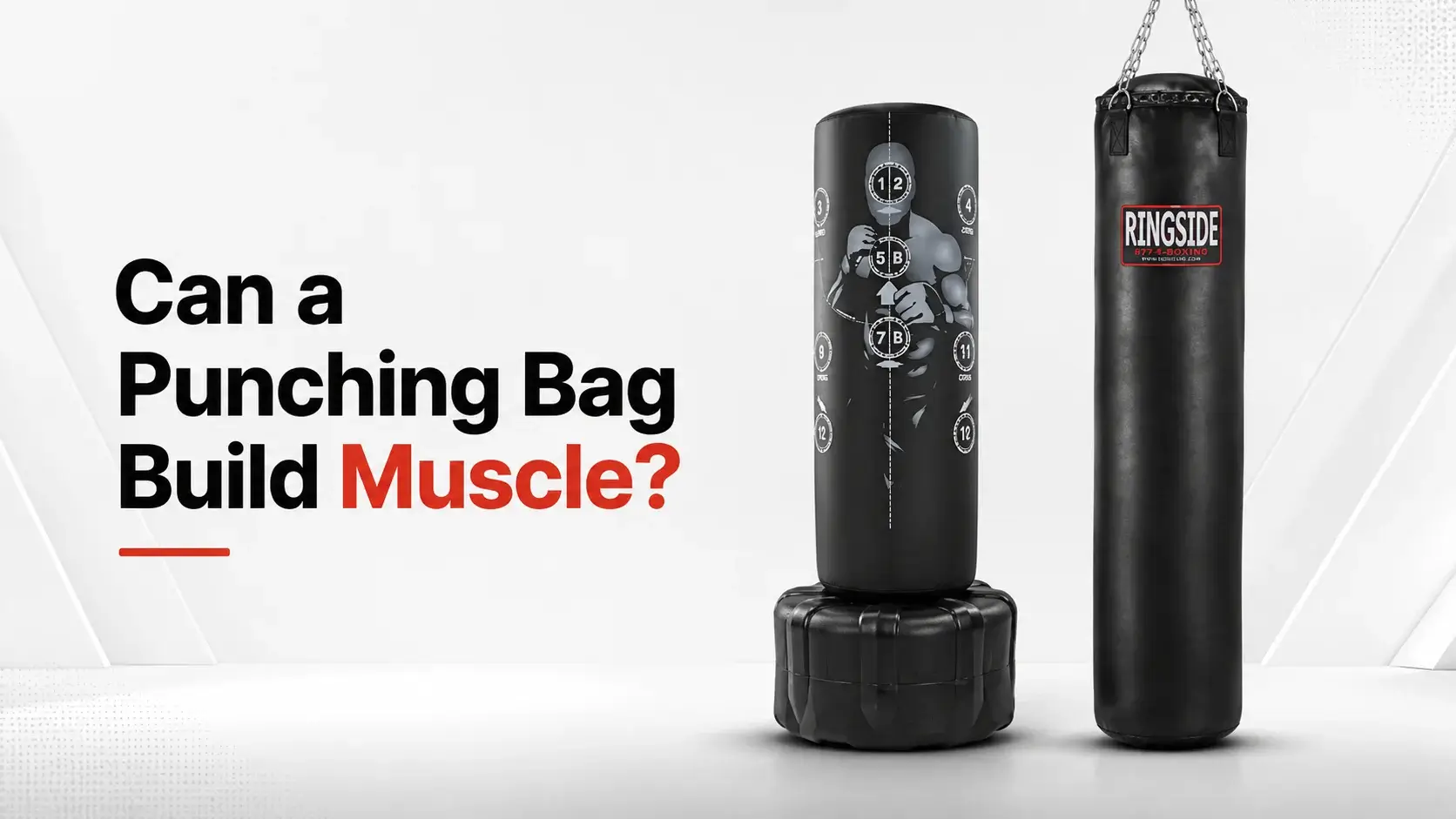
A punching bag can help you build some muscle, especially when you are new to boxing. But it will not build muscle as well as a proper strength training plan.
Bag work is better for muscular endurance, punching force, coordination, fitness, and fat loss. It can make your shoulders, arms, chest, back, core, and legs feel stronger. It may also make your muscles look more defined if you lose body fat.
If your main goal is bigger muscles, use the punching bag alongside strength training. Do not rely on the bag alone.
Table of Contents
Quick Answer
Yes, punching a bag can support a small amount of muscle growth.
The effect is usually stronger in beginners because their bodies are not used to repeated punching. Once the body adapts, further muscle growth becomes harder unless you add another form of resistance.
Most punching bag workouts involve a high number of punches against limited resistance. It trains your muscles to keep working for longer. It does not place the same steady and increasing load on them as presses, rows, squats, pull-ups, and other strength exercises.
For clear muscle growth, resistance training remains the better choice. It has been shown to improve muscle size, strength, endurance, and force production. Higher weekly training volume can also support greater muscle growth.
How Does Punching a Bag Work Your Muscles?
Every proper punch starts from the floor.
You press through your feet, turn your hips, tighten your core, rotate your upper body, and extend your arm. Your other hand stays near your face, your shoulders control the strike, and your back helps return the punching arm to its starting position.
It makes punching a full-body movement, not just an arm exercise.
The bag gives you resistance when your fist makes contact. Your muscles must create force, control your posture, manage the impact, and repeat the action.
Regular bag training can improve:
- Muscular endurance
- Punching force
- Speed
- Core control
- Balance
- Footwork
- Coordination
- Heart and lung fitness
Boxing training places a high demand on the heart, lungs, and working muscles. Timed bag rounds can provide a hard conditioning workout, especially when you keep moving between punches.
Why a Punching Bag Does Not Build Large Muscles Easily
Muscles grow when they are given enough resistance and enough total work.
With strength training, you can slowly add more weight, repetitions, sets, or harder exercise versions. It is known as progressive overload. It simply means making the exercise more difficult as your body gets stronger.
A punching bag has a fixed amount of resistance.
You can:
- Hit harder
- Throw more punches
- Complete more rounds
- Reduce your rest time
- Use harder combinations
- Improve your technique
These changes make the workout harder, but they do not increase resistance as clearly as adding weight to a barbell, dumbbell, cable machine, or resistance band.
Punching also provides less controlled lowering work. During a bench press or curl, your muscles work while lifting the weight and while lowering it. That lowering phase can support muscle growth. Resistance training with enough weekly volume and controlled lowering work is more effective for increasing muscle size.
It does not make bag work useless. It means that the main result is usually better endurance and athletic strength, not large muscles.
Does Muscle Soreness Mean the Bag Is Building Muscle?
No.
Hard bag sessions may leave your shoulders, arms, back, or core feeling sore. It is common when the movement is new or when you suddenly increase your training.
But soreness does not prove that your muscles are growing.
Muscle damage is not a reliable way to measure muscle growth. More pain does not mean a better workout.
Better signs of progress include:
- Cleaner punches
- Better control
- More force
- Longer rounds
- Faster recovery
- Better footwork
- Less fatigue
- Improved strength during other exercises
What Muscles Does a Punching Bag Work?
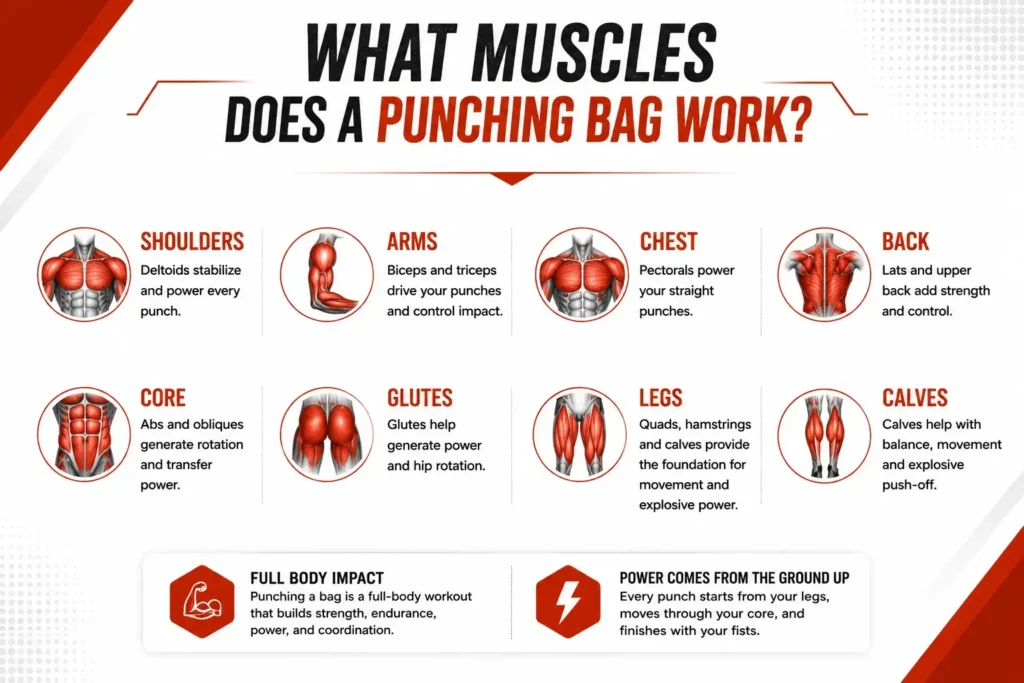
Shoulders
Your front and side shoulder muscles help raise, extend, and control your arms.
Your shoulders also stay active while you hold your hands near your face. This is why beginners often feel shoulder fatigue during their first few bag sessions.
Regular practice can improve shoulder endurance and may add some muscle in beginners.
Triceps
The triceps straighten your elbow during jabs and crosses.
Fast, repeated punches give the triceps plenty of work. Bag training can make them stronger and more conditioned, but pressing exercises usually provide a better muscle-building effect.
Biceps
The biceps help slow the arm down and pull it back after a punch.
They are involved, but they are not the main muscles creating a straight punch. Do not expect bag training to grow your biceps like curls, rows, chin-ups, or pull-ups.
Chest
Your chest helps drive straight punches and bring your arm across your body during hooks.
The chest gets useful work, but the bag does not load it through the same controlled movement as push-ups, dumbbell presses, or bench presses.
Back
Your upper back helps control your shoulder blades and return each hand to your guard.
The back also supports your posture while you throw combinations and move around the bag. Strong back muscles can help you punch, reset, and protect your shoulders.
Core
Your abs, side abs, and deeper core muscles transfer force between your lower and upper body.
Crosses, hooks, slips, rolls, and footwork all need core control. Your core keeps your body stable while your hips and shoulders rotate.
Bag training can make your core stronger. It may also help your abs become more visible when combined with fat loss.
Glutes, Quads, Hamstrings, and Calves
Your legs form the base of every punch.
They help you:
- Shift your body weight
- Turn your hips
- Step forward and backward
- Move around the bag
- Stay balanced
- Push against the floor
You will use your lower body even more when you add kicks or constant footwork.
Still, punching bag workouts will not grow your legs as well as squats, lunges, deadlifts, split squats, and loaded carries.
Forearms, Hands, and Wrists
Your forearms help keep your wrists stable when your punches land.
Your grip, fist position, and wrist angle also affect how safely you hit the bag. Poor alignment can place too much stress on the hands and wrists.
Punching uses muscles across the upper body, trunk, and lower body as one connected movement. Proper force transfer depends on coordination between these areas.
Can Punching a Bag Make Your Arms Bigger?
It can, but the change is usually limited.
A beginner may gain some size in the shoulders and triceps because the body is responding to a new activity. Someone who already trains regularly is less likely to gain much arm size from bag work alone.
For bigger arms, combine punching with exercises such as:
- Push-ups
- Bench presses
- Overhead presses
- Rows
- Pull-ups
- Chin-ups
- Triceps extensions
- Biceps curls
Use the bag for fitness, speed, skill, and muscular endurance. Use strength exercises for size.
Does Punching a Bag Build Chest Muscle?
Punching works your chest, especially during straight punches and hooks.
However, it does not place the chest under enough controlled resistance to replace chest exercises.
For more chest growth, add:
- Push-ups
- Bench presses
- Dumbbell presses
- Chest presses
- Cable or band fly movements
The bag can support your chest training, but it should not be your only chest exercise.
Does Punching a Bag Build Abs?
Punching can strengthen your abs and side abs.
Every hard punch requires you to tighten your core and transfer force from your legs to your upper body. Hooks and crosses also require strong rotation.
But punching will not automatically give you visible abs.
Visible abs depend on two things:
- Enough abdominal muscle
- Low enough body fat
You still need good food habits, direct core training, and enough total activity.
Can a Punching Bag Get You Ripped?
A punching bag can help you look leaner, but it cannot do the whole job.
A defined body comes from having enough muscle and low enough body fat for that muscle to show.
Bag training can raise your heart rate and increase the amount of energy you use. It can support fat loss when you also control how much you eat.
Physical activity and reduced calorie intake work together to create the calorie deficit needed for weight loss. The amount of activity needed differs from one person to another.
Do not trust fixed claims about how many calories one hour of boxing burns. The actual number changes based on:
- Your body size
- Your fitness level
- Workout length
- Punching pace
- Rest time
- Bag type
- Punching force
- Amount of footwork
Looking toned simply means your muscles have some shape and are not covered by too much body fat.
Does Punching a Bag Burn Fat?
Punching a bag can help with fat loss because it keeps your body moving and raises your heart rate.
Fast combinations, footwork, defensive movement, and short rest periods can make a bag workout physically demanding.
Still, the bag does not directly burn fat from your stomach, arms, chest, or any other single area. Your body decides where fat comes off first.
To lose fat, focus on:
- Regular physical activity
- Controlled food portions
- Enough protein
- Mostly filling foods
- Consistent sleep
- A calorie deficit you can maintain
Exercise helps with weight control, but food intake still plays a major role.
Punching Bag Training vs. Strength Training
| Goal | Punching Bag | Strength Training |
|---|---|---|
| Build large muscles | Limited | Best choice |
| Improve muscular endurance | Very good | Good |
| Improve punching technique | Very good | Limited |
| Improve heart and lung fitness | Very good | Depends on the workout |
| Build maximum strength | Limited | Best choice |
| Improve coordination | Very good | Useful |
| Support fat loss | Useful | Useful |
| Increase resistance over time | Harder to measure | Easy to measure |
| Practise boxing combinations | Best choice | Not suitable |
You do not need to choose between them.
Bag work and strength training can fit into the same weekly plan. One develops your boxing skill and conditioning. The other provides direct resistance for muscle and strength.
Adults are advised to combine aerobic activity with muscle-strengthening exercise instead of using one as a full replacement for the other.
Which Punching Bag Is Best for Building Muscle?
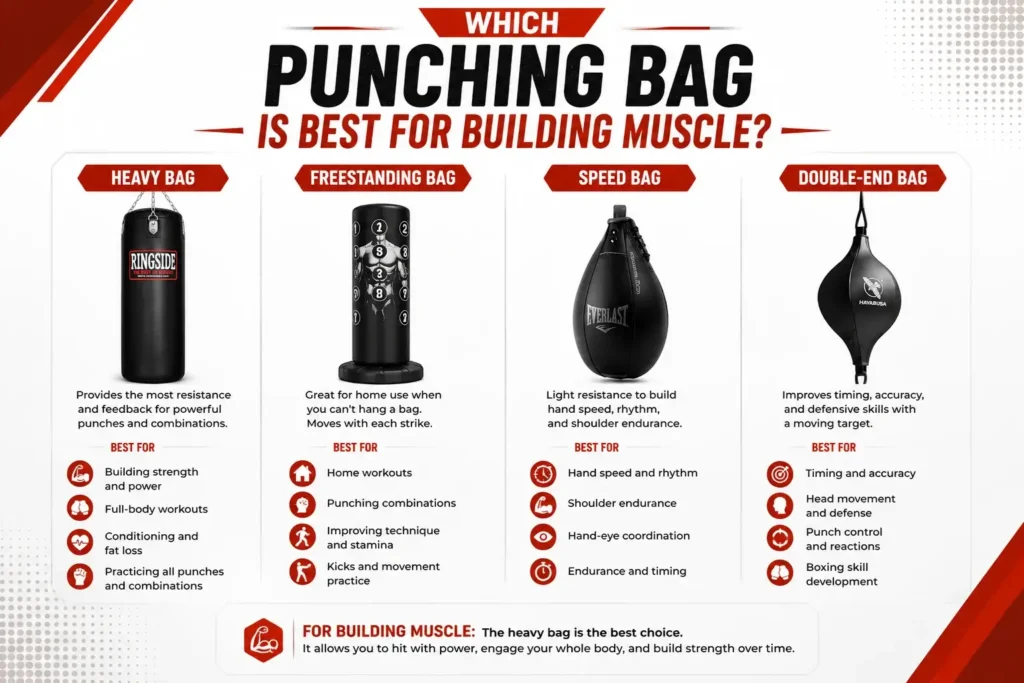
Heavy Bag
A heavy bag is the best common option for hard punches, combinations, full-body movement, and conditioning.
It gives more resistance and feedback than a speed bag. You can practise jabs, crosses, hooks, uppercuts, body punches, and movement.
A heavier bag does not automatically mean more muscle.
The bag should allow you to hit with proper form without swinging wildly or feeling like you are hitting a solid wall.
Freestanding Bag
A freestanding bag is useful when you cannot hang a bag from a ceiling or wall.
It can work well for home training, combinations, movement, and kicks. Its movement depends on the base, height, padding, and spring system.
Some freestanding bags move more than hanging bags, so you may need to reset your position more often.
Speed Bag
A speed bag mainly develops:
- Rhythm
- Timing
- Shoulder endurance
- Hand speed
- Hand-eye coordination
It is not a strong option for increasing muscle size because it provides very little resistance.
Double-End Bag
A double-end bag helps improve:
- Timing
- Accuracy
- Reactions
- Head movement
- Punch control
It is mainly a skill and conditioning tool. It is not designed for major muscle growth.
Is a 100-Pound Punching Bag Better for Muscle?
Not automatically.
A 100-pound bag may move less and provide firmer feedback, but that does not mean it will build more muscle.
Bag weight should suit:
- Your body size
- Your experience
- Your available space
- Your punching force
- The type of training you plan to do
A bag that is too light may swing too much. A bag that is too heavy or firm may punish small mistakes and encourage poor form.
Choose a bag that lets you punch safely, move naturally, and keep control.
How to Use a Punching Bag for Better Muscle Results
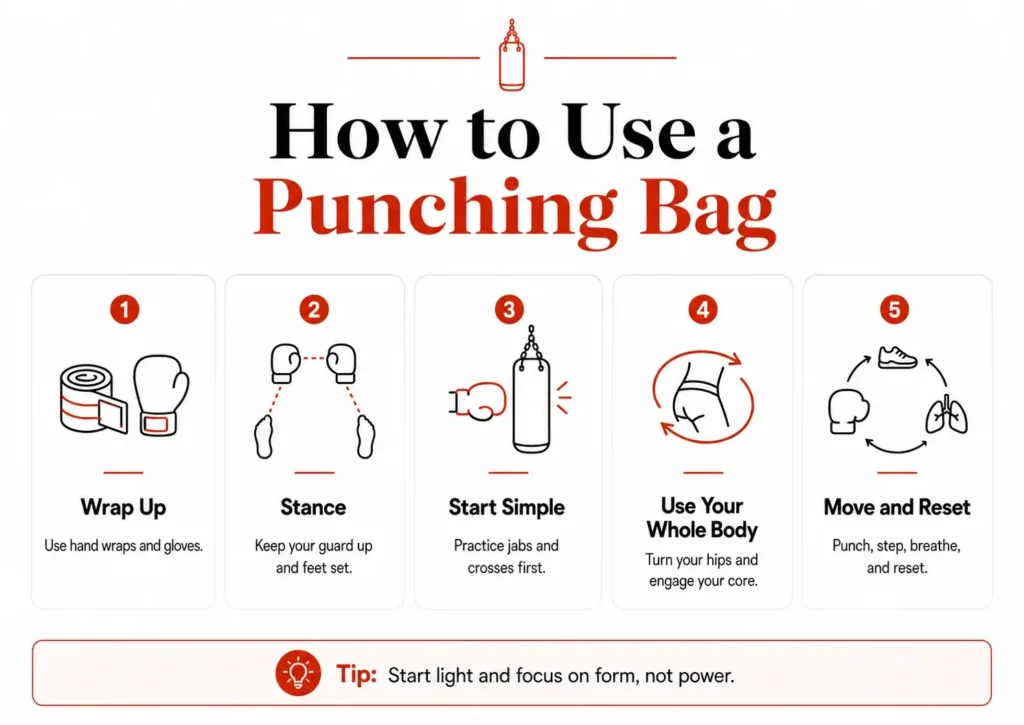
1. Learn Proper Technique First
Power without control can hurt your hands, wrists, elbows, or shoulders.
Keep your wrist straight when the punch lands. Make contact with the main knuckles and return your hand to your face after each punch.
Use your feet, hips, and core instead of throwing punches only with your arms.
Learning proper technique is an important part of reducing hand and wrist injury risk in striking sports.
2. Train in Timed Rounds
Rounds make it easier to control your effort and measure progress.
A beginner can start with:
- 4 to 6 rounds
- 1 to 2 minutes per round
- 60 to 90 seconds of rest
As your fitness improves, you can add a round, make each round longer, or reduce your rest.
Change one thing at a time. Do not increase everything in the same week.
3. Mix Hard Rounds with Fast Rounds
Do not use the same pace for every round.
Use some rounds for hard, controlled punches. Use other rounds for quick combinations, movement, and steady output.
This helps train both force and endurance.
4. Use Your Whole Body
Do not stand still and punch only with your arms.
Turn your hips, move your feet, tighten your core, and return each hand to your guard.
Full-body technique creates more force and spreads the work across more muscles.
5. Add Strength Training
Train the main movement types:
- Squat
- Hip hinge
- Push
- Pull
- Carry
- Brace
- Rotate
You can use weights, resistance bands, machines, or bodyweight exercises.
The equipment matters less than regular training and gradual progress. Current guidance supports training all major muscle groups at least twice per week.
6. Eat Enough Protein
Your body needs protein to repair and build muscle.
Good protein sources include:
- Eggs
- Milk
- Yogurt
- Fish
- Chicken
- Meat
- Beans
- Lentils
- Soy foods
For most active adults, total daily protein matters more than expensive shakes or supplements. A commonly supported range for exercising adults is about 1.4 to 2.0 grams of protein per kilogram of body weight per day.
7. Eat Enough Total Food
If you want to gain muscle, you need enough total energy from food.
You may struggle to add size if you train hard but eat too little. On the other hand, eating far more than you need can add unwanted body fat.
Aim for a small and controlled increase in food intake when muscle gain is the goal.
8. Give Your Body Time to Recover
Your muscles, joints, hands, and wrists need time to recover between hard sessions.
Lack of sleep can reduce strength, force, endurance, and training quality.
Do not keep adding hard rounds when your punches become slow, loose, or painful.
A Simple Punching Bag Workout
Use this workout one to three times per week, based on your fitness level and other training.
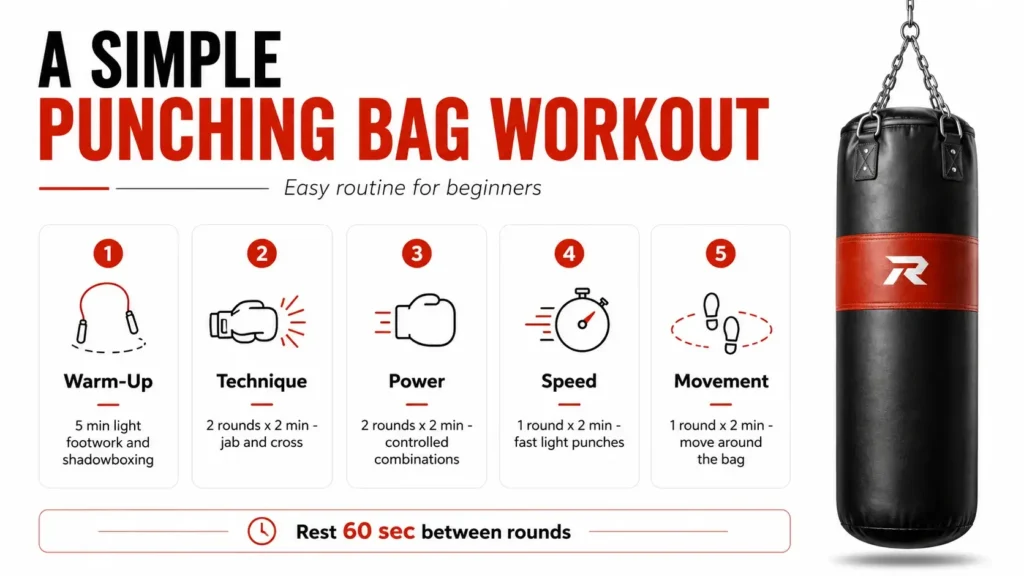
Warm-Up, 5 to 8 Minutes
- Light footwork
- Arm circles
- Shoulder movement
- Easy shadowboxing
- Slow jabs and crosses
Round 1: Technique
Throw light jabs and crosses.
Focus on your stance, wrist position, breathing, and returning each hand to your face.
Round 2: Straight Punches
Use jab-cross combinations.
Turn your hips and push through your feet. Keep the punches clean.
Round 3: Hooks and Body Punches
Work at a controlled pace.
Do not let your wrist bend or your elbow move into a painful position.
Round 4: Hard Combinations
Throw short combinations with strong effort.
Reset after each combination instead of punching nonstop.
Round 5: Speed
Use quick and light combinations.
Keep your shoulders relaxed and breathe with each punch.
Round 6: Movement
Move around the bag, step in and out, and punch from different safe positions.
Work for 2 minutes per round and rest for 60 seconds. Beginners can use shorter rounds.
Optional Strength Finisher
Complete 2 to 3 controlled sets of:
- Push-ups
- Bodyweight squats
- Rows or band rows
- Planks
Stop when your form starts to break down.
A Weekly Plan for Muscle and Boxing Fitness
Monday: Full-body strength training
Tuesday: Punching bag technique and conditioning
Wednesday: Rest or light activity
Thursday: Full-body strength training
Friday: Punching bag force and speed
Saturday: Optional light bag work, mobility, or another strength session
Sunday: Rest
This plan gives your muscles direct resistance work while keeping the fitness and skill benefits of boxing.
Can You Hit the Punching Bag Every Day?
You can perform light technique work often, but hard bag sessions every day are not a good starting point.
Repeated impact can irritate your:
- Hands
- Wrists
- Elbows
- Shoulders
Daily hard sessions may also reduce punch quality because your muscles and joints have not recovered.
Start with two or three bag sessions each week. Add more only when your body is recovering well and your form remains clean.
A trained boxing coach can help you plan higher training volumes safely.
Other Benefits of Hitting a Punching Bag
Better Heart and Lung Fitness
Bag rounds can raise your heart rate quickly.
Regular sessions can improve your ability to work hard, recover between rounds, and continue moving without becoming tired as quickly.
Better Balance and Coordination
Punching while moving requires you to control your feet, hips, upper body, and hands at the same time.
A moving bag also forces you to adjust your position and timing.
Better Boxing Technique
The bag gives you a target and resistance.
It lets you practise jabs, crosses, hooks, uppercuts, combinations, footwork, and defensive movement without hitting another person.
Better Punching Force
A heavy bag lets you practise hitting with more force than shadowboxing.
It also gives you feedback. Poor punches may feel weak, unbalanced, or uncomfortable, while clean punches feel controlled.
Recent heavy-bag training research has found improvements in punching speed, repeated punching ability, and upper-body output when bag intervals were added to regular boxing training.
Stress Relief
Physical activity can reduce anxiety, support sleep, and improve mood.
A punching bag can also give you a focused physical task when you feel tense. It should be used as exercise, not as a replacement for dealing with the cause of ongoing stress.
Punching Bag Safety Tips
- Use hand wraps.
- Wear suitable boxing gloves.
- Check that the bag and its mount are secure.
- Warm up before hard punching.
- Keep your wrist straight.
- Start with light punches.
- Increase force slowly.
- Do not fully lock your elbow.
- Stop if you feel sharp pain.
- Stop if your hand or fingers become numb.
- Get help with your form when needed.
- Allow recovery between hard sessions.
Speak with a qualified medical professional before starting if you have an existing hand, wrist, shoulder, heart, or joint condition.
FAQs
How Long Does It Take to See Results?
You may notice better fitness, coordination, and shoulder endurance within a few weeks of regular practice.
Muscle size and visible definition usually take longer. Results depend on:
Your starting fitness
Training frequency
Session quality
Strength training
Food intake
Protein intake
Sleep
Body-fat level
Do not trust fixed promises about what your body will look like after one, three, or six months.
Can Boxing Replace Weightlifting?
Not when your main goal is muscle size or maximum strength.
Boxing can replace some cardio work and improve muscular endurance. It cannot provide the same measured resistance as a full-strength program.
Will Punching Make Me Lose Muscle?
Punching does not automatically cause muscle loss.
Muscle loss becomes more likely when you train a lot, eat too few calories, consume too little protein, and do no strength training.
Is Hitting the Bag Good for Beginners?
Yes, when you start slowly and learn proper form.
Beginners should focus on stance, guard, straight punches, breathing, and wrist position before trying to hit as hard as possible.
Bringing It All Together
A punching bag can build a small amount of muscle, mainly in beginners. It is much better at improving muscular endurance, fitness, coordination, core control, punching force, and boxing skill.
Use a punching bag to become fitter, faster, and better at striking. Use strength training to add noticeable muscle size and maximum strength.
For the best results, combine two or three weekly bag sessions with at least two full-body strength sessions. Eat enough protein, get enough sleep, and allow your hands, joints, and muscles to recover.
Keep your technique clean and increase the workload slowly.