
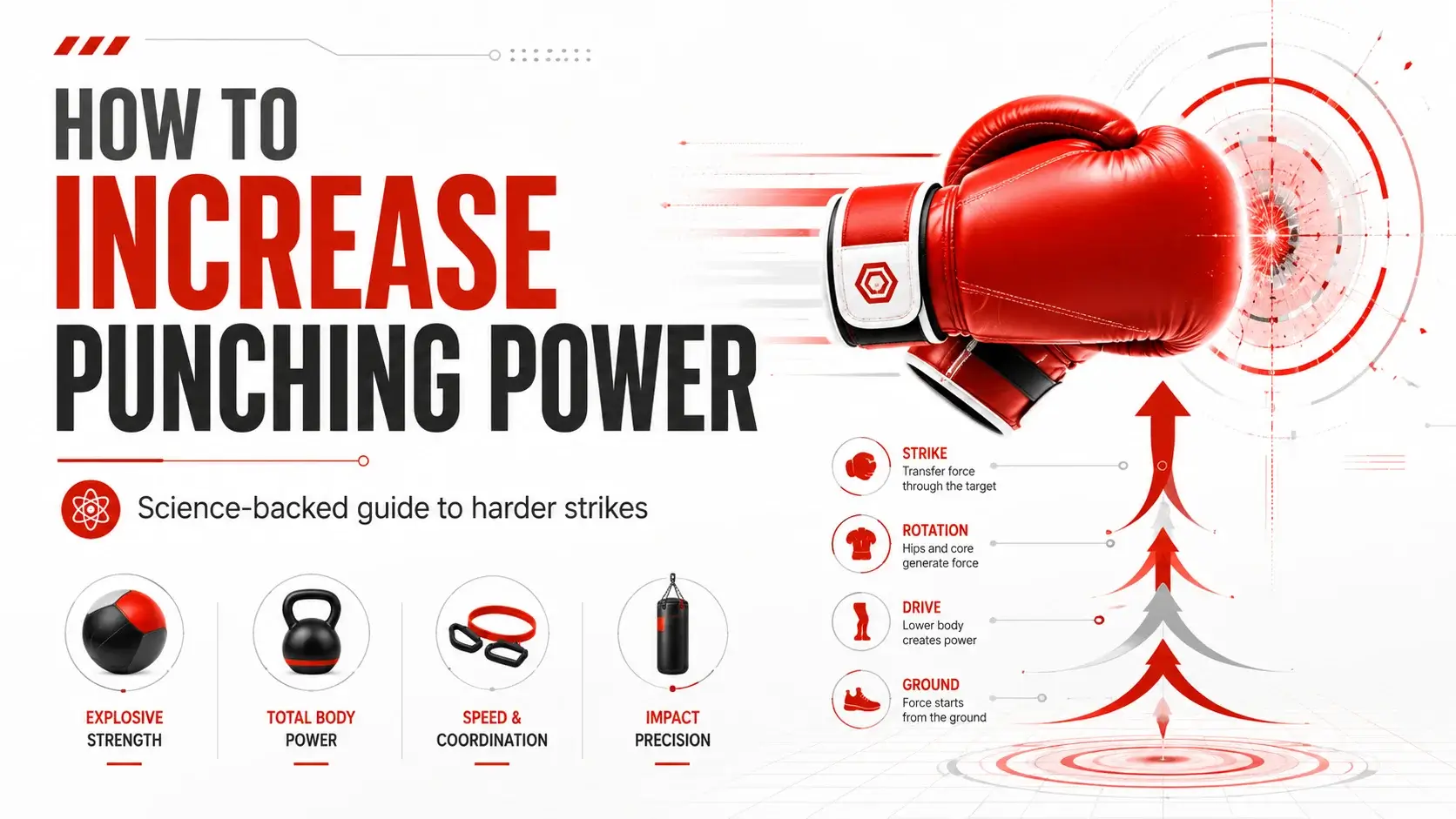
A powerful punch is not created by strong arms alone. It comes from how well your entire body works together to produce and transfer force.
Many fighters spend hours throwing punches but still struggle to create impact because they focus on the fist instead of the movement behind it.
Research on boxing biomechanics shows that factors like punch speed, body coordination, and effective mass all influence how much force reaches the target.
Here, you’ll learn how punching power is built, why technique matters, and which training methods help you develop harder, faster, and more efficient strikes. Let’s start!
Table of Contents
The Kinetic Chain: How Power Travels Through the Body
The Ground Up Sequence: Feet to Fist
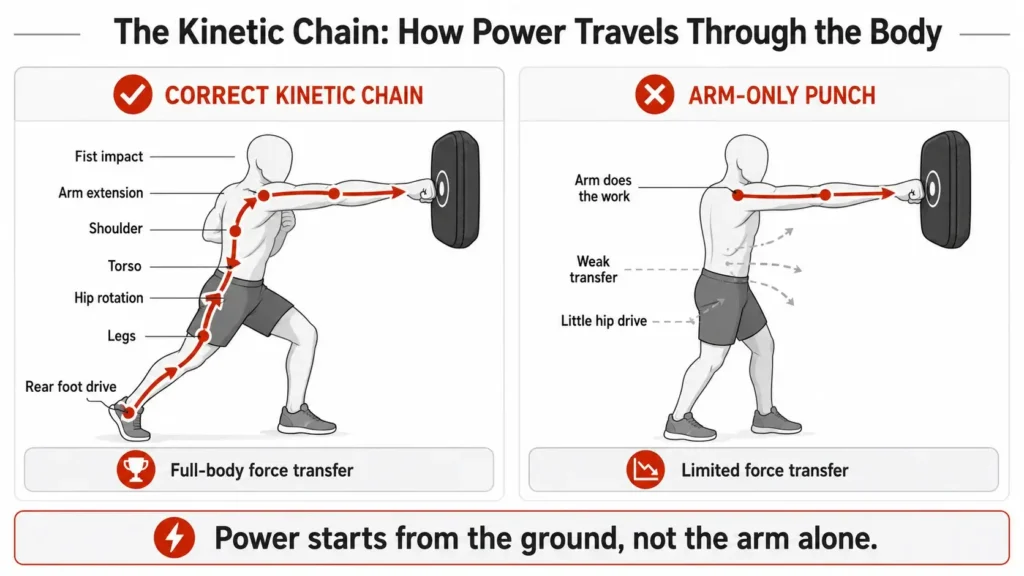
A hard punch starts from the ground. When you throw a powerful cross or hook, the movement begins with pressure from your feet into the floor.
It creates force that moves through the legs, hips, torso, shoulder, arm, and finally the fist. Each part adds speed and helps transfer energy into the target.
The effective force transfer depends on how well these body segments work together, not just on muscle size or strength.
The sequence looks like this:
Rear foot drive → leg extension → hip rotation → torso rotation → shoulder movement → arm extension → fist impact
Effective Mass: Why Technique Beats Arm Strength
Effective mass is the amount of your body mass that contributes to the punch at impact. A beginner often throws an arm punch, meaning only the arm moves with real force behind it. Skilled boxers connect their body better, allowing more mass to move behind the strike.
Think of a whip. The handle starts the movement, but the energy travels through the entire length before reaching the tip. A punch works in a similar way. Your legs and hips create the movement, while your fist delivers the final impact. If one part moves too early or stays too stiff, energy is lost.
The Role of Each Joint in Punch Power
- Ankles and knees: These create the first push against the ground and start the movement.
- Hips: The hips generate rotation and help transfer force from the lower body into the upper body.
- Core and torso: The core connects the lower and upper body. A stable torso helps prevent energy loss during rotation.
- Shoulder and elbow: These guide the final movement and help extend the punch toward the target.
- Wrist and fist: The final link depends on proper alignment and timing. A loose wrist or poor fist position can reduce impact and increase injury risk.
To improve your own mechanics, record your punches from the side and front. Watch if your hips and body move before your arm takes over. Slow practice helps build the correct sequence until it becomes natural.
Technique Fundamentals for Maximum Power
1. Build a Stable, Usable Stance
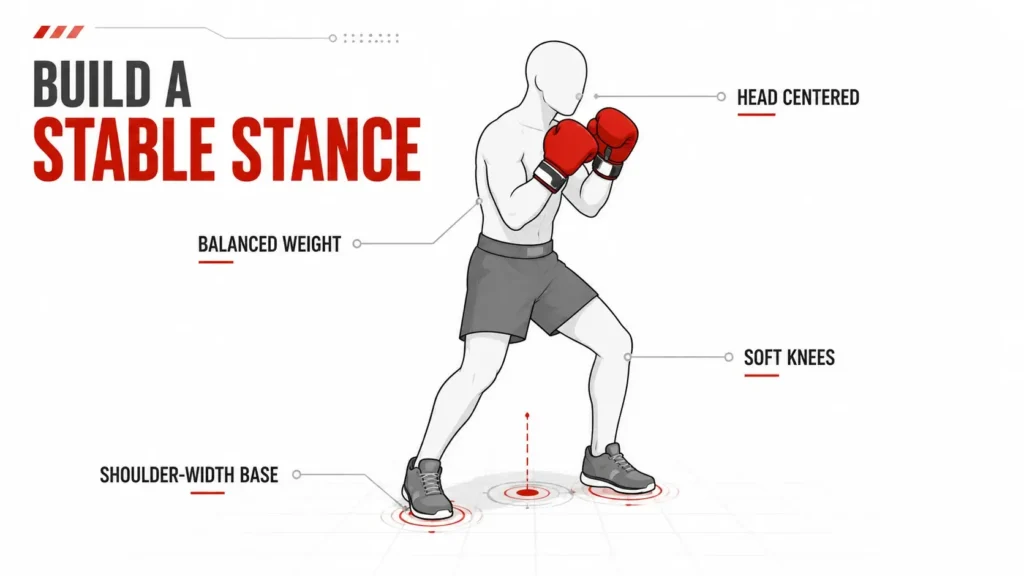
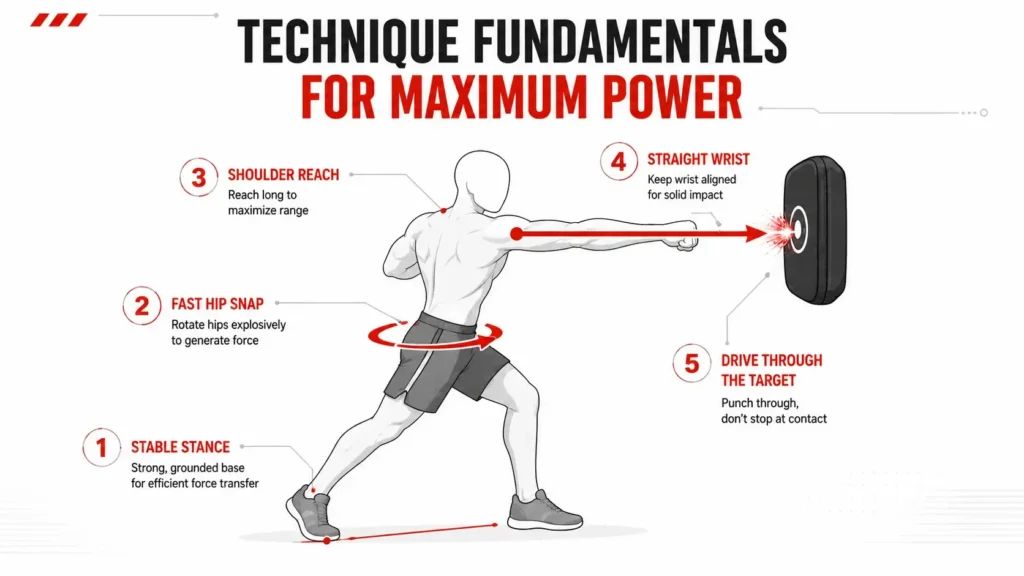
Start with your feet around shoulder-width apart, knees soft, and torso slightly turned away from the target. Your stance should feel stable without locking you in place. A very wide stance may slow your movement, while an overly square stance can reduce the space available for hip rotation.
A fixed 60 percent rear-foot rule does not suit every punch or boxer. Pressure shifts throughout the strike. In one study, elite boxers produced about 61 percent of their ground reaction force through the lead foot at impact during a cross. The better goal is to begin balanced, then move pressure smoothly from the rear side into a firm lead leg without leaning past your base.
Try this transfer drill:
- Set your boxing stance without throwing.
- Push lightly from the rear foot and let your weight move toward the lead leg.
- Keep your head between your feet and return to your starting position.
- Add a small step-and-drag, then repeat the shift.
- Add the cross only after you can move without losing your stance.
Spend one round moving slowly. Speed will not help until you can feel where your weight is going.
2. Use a Fast Hip Turn
The rear hip should turn sharply toward the target as the rear foot presses into the floor. Consider a short snap, not a slow twist. A useful cue is, “Turn your rear pocket toward the target.” Do not force the hip so far around that your stance collapses or your back faces the opponent.
Place your hands behind your head and practise short hip turns from your normal stance. Keep your shoulders loose and let them follow the lower body. Try a coordinated, proximal-to-distal action, but the hips and shoulders do not move in completely separate stages. Their movements overlap, with force passing through the body as the punch gains speed.
3. Keep the Shoulder, Elbow, and Fist on One Line
As the cross travels forward, allow the punching shoulder to move toward the target while the other hand stays at your face. It adds reach and helps protect your chin. Do not stretch so far that your head moves beyond your lead knee or your rear foot loses contact with the floor.
Keep the elbow behind the fist during most of a straight punch. An elbow that swings outward too soon makes the punch easier to read and can send the fist across the target instead of through it. Biomechanical analysis shows that elbow extension makes a major contribution to the cross, while hooks and uppercuts depend more heavily on shoulder movement.
At contact:
- Keep the wrist straight and supported by the forearm.
- Land on a properly closed fist, with the main pressure usually passing through the index and middle knuckles.
- Tighten the hand near impact rather than squeezing hard throughout the punch.
The brief stiffness helps connect the arm to the rest of the body. Staying tense from the start can slow the hand and waste energy. Research on straight punching links impact performance with contact velocity and the body’s ability to form a firm structure at contact.
4. Accelerate Into Contact
The cue “punch through the target” can help fighters who slow down before impact, but it should not mean pushing the arm far past its safe range. Aim just beyond the surface and let the fist reach its highest useful speed near contact. Then return it quickly to guard.
On the heavy bag, watch the result rather than relying only on sound. A solid punch usually moves or compresses the bag without throwing you off balance. A slap may suggest poor contact, but bag filling, gloves, punch angle, and room acoustics also affect the noise.
Film a few crosses from the front and side. Check that your head remains controlled, your hip turns before the arm finishes extending, and you can bring the hand straight back without taking a recovery step. That is a better sign of usable power than simply making the bag swing.
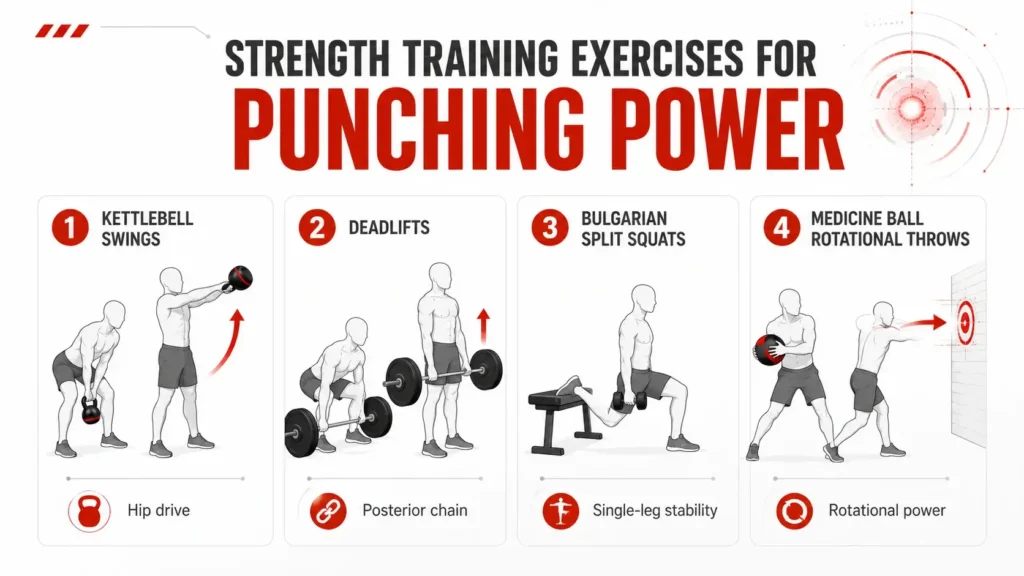
Strength Training Exercises for Punching Power
Strength training supports harder punches by improving how quickly you can produce force and pass it through your body. It supports boxing practice. Strong legs, fast hip action, and an explosive upper body matter only when your punching technique stays clean.
1. Lower-Body Strength
Your legs create the first push against the floor, so lower-body training deserves a central place in your program. Research in trained amateur boxers has linked punch force with lower-body force production, while a 2022 review found that stronger punchers generally showed greater maximal and explosive leg strength.
2. Kettlebell Swings
Kettlebell swings train rapid hip extension. The movement should come from a sharp hip snap, not a deep squat or an arm raise.
Keep your back neutral, push your hips behind you, then drive them forward quickly. The kettlebell should rise because of the hip action. Your arms only guide it.
There is no single kettlebell weight that suits most fighters. A 16 to 24 kg bell may work for an experienced adult, but beginners and lighter athletes may need less. Choose a load that lets you keep the same speed and posture across every repetition.
Suggested Work
3 to 5 sets of 6 to 10 fast repetitions.
3. Deadlifts
Trap-bar and conventional deadlifts train the glutes, hamstrings, back, and grip. These muscles help produce and control force from the ground.
The evidence does not show that deadlifts alone make someone punch harder. However, punch force has been associated with performance in the isometric mid-thigh pull, which tests lower-body maximal force in a position similar to part of a deadlift.
The cited 2022 study did not use a one-repetition maximum squat test. It used countermovement jumps and isometric mid-thigh pulls.
Use a weight you can lift with a stable torso and steady bar path. Grinding through slow, poor-quality repetitions adds fatigue without giving you the fast force production boxing requires.
Suggested Work
3 to 5 sets of 3 to 6 repetitions.
4. Bulgarian Split Squats
Split squats train each leg separately, which can help address side-to-side strength differences. They also improve control when pressure moves between your rear and lead legs.
Keep your front foot flat, lower under control, and push through the floor without letting the knee collapse inward. Studies involving boxers have included Bulgarian split squats within unilateral strength programs, this single exercise does not directly increases punch force. It is best treated as a supporting strength and stability exercise.
Suggested Work
3 sets of 5 to 8 repetitions per leg.
5. Train Rotation with Medicine Ball Throws
Medicine ball throws allow you to apply force quickly without slowing the movement at the end, as you must when lifting a barbell. The programs combining strength work with fast throws and other explosive exercises can improve punching performance.
6. Rotational Scoop Toss
Stand side-on to a solid wall. Load your rear hip, press through the floor, rotate, and throw the ball into the wall. Let your hips and torso move before your arms finish the throw.
It is one of the closest gym exercises to the rotational action of a cross or hook. Do not turn it into a slow side pass.
7. Shot-Put Throw
Hold the ball beside your rear shoulder and throw it forward with one arm. Use your legs and hips rather than pushing only from the chest.
The variation trains force transfer into a straight striking path while allowing the ball to leave your hand freely.
8. Overhead Slam
Raise the ball overhead, then drive it into the floor with speed. Slams train explosive whole-body movement and can add conditioning, but they are less similar to a boxing punch than rotational throws.
Use a ball light enough to move quickly. A fixed 3 to 6 kg range is not right for every athlete. The correct load is the heaviest ball you can throw without slowing noticeably or changing your movement. Use light medicine balls because excessive load can reduce throwing speed.
Suggested Work
3 to 5 sets of 3 to 6 throws per side, with full effort and enough rest to maintain speed.
Here are some useful training tools for building punch power:


Upper-Body Strength with Plyometric Push-Ups
Plyometric push-ups train the chest, shoulders, and triceps to produce force quickly. The aim is not to collect as many repetitions as possible. Each repetition should leave the floor with clear speed.
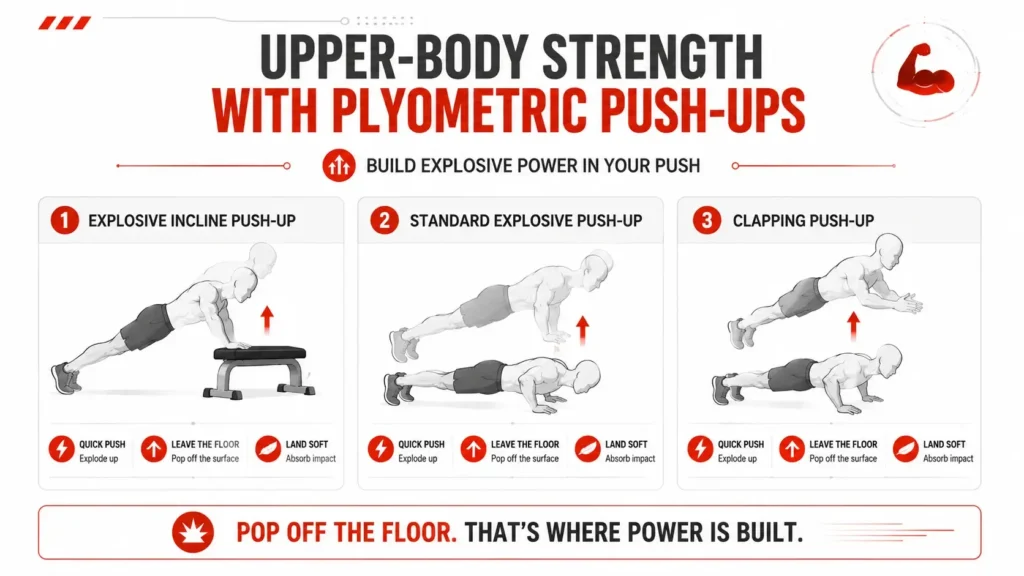
1. Explosive Push-Ups
Lower under control, then push hard enough for both hands to leave the floor. Land softly and reset before the next repetition.
2. Clapping Push-Ups
Add a clap only after you can land with stable shoulders and elbows. The clap does not create the training effect by itself. It simply demands more height and airtime.
3. Drop Push-Ups
Begin with your hands on low blocks, drop to the floor, then push away as quickly as possible. It is an advanced exercise that places greater stress on the wrists, elbows, and shoulders. Use it only after basic explosive push-ups feel controlled.
Keep the floor contact brief, but do not rush a poor landing. Stop the set when your height drops or your elbows begin to flare.
Suggested Work
3 to 5 sets of 3 to 6 quality repetitions.
4. Use Resistance Bands
Bands can add resistance to boxing-shaped movements, but heavy tension may slow the fist and alter the punch path. Elastic resistance has been used successfully in boxing strength programs, though current research supports it as one part of mixed training rather than proof that band shadowboxing alone creates harder punches.
For band-resisted straight punches, anchor the band behind you and use light tension. Keep your stance, elbow path, and hand return the same as they are during normal shadowboxing. Perform short sets rather than long, tiring rounds.
For hooks, resistance should not pull the shoulder into an awkward position. A cable or band can be used for controlled rotational presses, while normal bag and pad work should remain your main place for practising full-speed hooks.
A standard Pallof press is an anti-rotation exercise. You press the band away from your chest while resisting the pull that tries to turn your torso. It helps the trunk stay firm while force moves between the lower and upper body.
Suggested Work
2 to 4 sets of 5 to 8 resisted punches per side, followed by unresisted punches at normal speed.
Use light, medium, and heavy bands for different exercises rather than forcing every movement against the heaviest band. The resistance is right when it challenges you without changing your boxing mechanics.
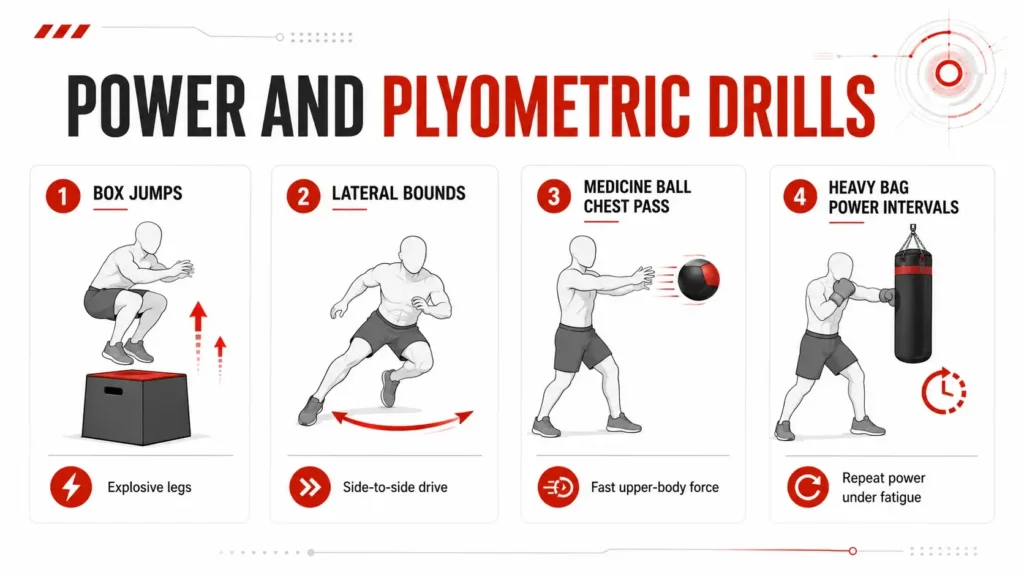
Power and Plyometric Drills
Plyometric drills train your muscles to produce force quickly. For boxers, that can support faster foot pressure, sharper hip action, and a quicker finish at the fist. These exercises work best when repetitions stay fast and controlled. Once jump height, throwing speed, or landing quality drops, the set is finished.
Lower-Body Plyometrics for Punch Initiation
The legs do not throw the punch, but they create the pressure against the floor that starts it. A study of ten male amateur boxers found that lower-body fatigue reduced average punch force by 4.26 percent and lowered ground reaction force.
The results support training lower-body power and fatigue resistance, but the study did not test if box jumps or other plyometric drills prevented that decline.
1. Box Jumps
Box jumps train rapid extension at the ankles, knees, and hips. Use a box that allows you to land softly without pulling your knees high toward your chest.
Start from a shallow dip, jump with full effort, and land with both feet stable. Step down instead of jumping down so the landing does not add needless fatigue.
Do
3 to 5 sets of 3 to 5 jumps.
2. Broad Jumps
Broad jumps train horizontal force production. It can support forward movement and the ability to push into range, though it should not be treated as a direct copy of boxing weight transfer.
Swing your arms, push the floor behind you, and land without falling forward. Reset fully before each repetition.
Do
3 to 4 sets of 3 jumps.
3. Lateral Bounds
Lateral bounds train single-leg push-off strength and control in side-to-side movement. They are useful for boxers who need to change angles without losing their stance.
Push sideways from one leg and land on the other. Hold the landing briefly before the next bound. Do not chase distance at the cost of knee or hip control.
Do
3 sets of 3 to 5 bounds per side.
Jump training has shown direct promise in boxing. In a 2025 trial, amateur boxers who completed five weeks of loaded countermovement jump training improved lower-body power and peak force across several punches.
The study used jumps with dumbbells equal to 10 to 20 percent of body mass, but the authors warned that the findings came from a small group and may not suit athletes without enough basic strength.
Here is suggested equipment for plyometric and bag training:


Upper-Body Plyometrics for Faster Force Production
Upper-body drills train the chest, shoulders, arms, and trunk to produce force without slowing the movement at the end. They support punching, but they do not replace bag work because most throws and push-ups lack the stance, rotation, timing, and target contact of a real punch.
1. Medicine Ball Chest Pass
Hold a light medicine ball at chest level and throw it into a wall or to a partner as fast as possible. Keep your ribs controlled and avoid turning the exercise into a slow press.
The chest pass trains an explosive horizontal push, but it does not fully match a cross because both arms usually work together and little hip rotation is required.
Do
3 to 5 sets of 3 to 6 throws.
2. Overhead Throw
Start with the ball behind or above your head, then throw it forward with full speed. It trains general upper-body and trunk power.
It is not a specific exercise for the final punch snap. A rotational scoop toss or one-arm shot-put throw has a closer movement pattern to boxing.
Use a ball that moves quickly. Research on medicine ball loading shows that lighter balls produce greater release velocity than heavier ones.
3. Plyometric Push-Up Progression
Move through these stages rather than starting with clapping or drop push-ups:
- Explosive incline push-up
- Explosive kneeling push-up
- Full explosive push-up
- Clapping push-up
- Low drop push-up
Move to the next stage when you can perform at least five clean repetitions with a stable trunk, soft landing, and no wrist, elbow, or shoulder pain. A drop push-up is an advanced drill because the landing creates more stress than a standard explosive push-up.
Keep each set short. The goal is clear lift from the floor, not a high repetition count.
Do
3 to 5 sets of 3 to 5 repetitions.
Full-Body Drills That Connect Power with Boxing
1. Rotational Throw with Reset
Load your rear hip, throw a medicine ball into a wall, and return to your stance. Focus on pushing from the floor and letting the hips and torso lead the throw.
Adding a short sprint after the throw can train repeated explosive actions, but it does not make the drill more specific to punching. Use the sprint only when acceleration is also part of the session.
2. Light Band Punches with Footwork
Place a light band around your upper back or waist and practise short punching combinations while stepping. The band should not pull your arm away from its normal path.
Heavy tension may slow the fist, change your balance, and teach you to push each punch. Use a few resisted repetitions, then repeat the same combination without the band at normal speed.
3. Heavy Bag Power Intervals
A useful round consists of:
- 10 seconds of hard, controlled punching
- 20 seconds of rest or light movement
- 6 cycles for one 3-minute round
- 1 minute of rest between rounds
Use short combinations rather than swinging continuously. Stop the power burst when your feet cross, your chin rises, or your punches turn into arm pushes.
The aim is to repeat strong punches as fatigue builds, not to claim that every strike is truly maximal. Research shows that lower-body and trunk fatigue can reduce punch performance, so technique quality should remain the main limit on each interval.
Should You Train Power While Tired?
Do most jump, throw, and explosive push-up work near the start of the session, after warming up but before hard conditioning. Longer rest periods help athletes maintain power across plyometric sets, while continuous work causes output to fall.
Fatigue-specific bag rounds can be added later because boxing requires you to strike effectively when tired. That does not mean placing advanced jumps or drop push-ups at the end of a draining circuit. Under fatigue, poor landings and slow repetitions reduce the purpose of the drill.
Build fresh power first. Then use controlled bag intervals to practise keeping that power during later rounds.
Mistakes That Kill Punching Power
1. Punching With the Arm Alone
A weak punch is often a coordination problem, not an arm-strength problem. Force should pass from the floor through the legs, hips, trunk, and fist. Research links punch force with lower-body strength and effective mass.
Shoulder fatigue alone does not prove arm punching because the deltoids and triceps work in every punch. The clearer sign is that your hips stay still while your arms do most of the work.
Fix
Shadowbox with loose arms. Start each cross by pressing through the rear foot and turning the hip. Let that motion carry the shoulder forward, then add extension.
2. Reaching Past Your Base
Falling forward after contact means your weight has moved beyond your feet. It cuts control and leaves you open to a counter.
Fix
Place tape between your feet. Throw straight punches while keeping your head inside your stance. You should be able to return to guard without taking a recovery step.
3. Showing the Punch Too Early
Pulling the fist back, lifting the elbow, or dipping before you punch gives an opponent extra time to react.
Fix
Fire from your guard. Record yourself from the front and side, then remove movement that happens before the fist travels toward the target.
4. Staying Tense Too Long
Constant tension can slow joint movement and waste energy. Research on fast strikes found muscle activation at the start, brief relaxation during acceleration, and renewed stiffness near contact. It does not mean the arm should go limp. Tension should rise at the right time.
Fix
Keep your shoulders and grip relaxed during shadowboxing, then close the fist firmly before impact. Never hit a bag with an open or partly closed hand.
5. Punching Before Your Feet Are Ready
Power drops when your feet cannot support the strike at contact. They do not need to be frozen, but they must provide a stable base.
Fix
Practise step-and-punch drills slowly. Complete the step, apply pressure through the floor, land the punch, and return to guard without crossing your feet or losing balance.
To protect your hands during heavy bag work, check:

Hayabusa T3 Boxing Gloves
Regular bag and pad training
The T3 features a secure dual-strap closure, wrist support, and layered knuckle padding. It is built for bag work, pad sessions, and regular boxing training.
Check Price
Everlast Elite 180-Inch Hand Wraps
Extra wrist and knuckle coverage
The 180-inch length gives more coverage around the wrist, thumb, and knuckles. The washable material and hook-and-loop closure make them practical for regular training.
Check PriceSport-Specific Considerations
The same rear-hand cross should not look identical in boxing, MMA, and Muay Thai. Each sport changes the stance, safe amount of weight transfer, defensive risks, and conditioning demands.
| Factor | Boxing | MMA | Muay Thai |
|---|---|---|---|
| Bout structure | Professional bouts vary in length and may run up to 12 three-minute rounds under ABC rules. Most bouts are shorter, so 36 minutes should not be treated as the standard for every boxer. | Professional non-title bouts commonly use three five-minute rounds, while championship bouts use five. | A WBC Muay Thai championship bout uses five three-minute rounds with two-minute rest periods. Other organisations may use different formats. |
| Competition gloves | ABC-regulated professional bouts use 8 or 10 oz gloves based on division. Gloves from 10 to 16 oz are common in training, but they are not the standard competition range. | Unified Rules require approved gloves of at least 4 oz. Larger hand sizes may require gloves above 6 oz. The open-finger design also allows grappling. | WBC Muay Thai uses 8 oz gloves through welterweight and 10 oz gloves from super welterweight upward. |
| Typical stance | A boxer can use a more bladed position because kicks and takedowns are illegal. It creates room for hip and shoulder rotation, but the boxer must still remain ready to move and defend punches. | The stance is often less bladed or changes more frequently because the fighter must respond to kicks, level changes, clinches, and takedowns. It should not be described as square in every situation. | Fighters commonly stand more upright with pressure distributed so either leg can check a kick. Stance depth varies by style, opponent, and preferred weapons. Muay Thai rules allow punches, kicks, knees, elbows, and active clinch work. |
| How the cross changes | The boxer can use a longer rear-foot drive, stronger hip turn, and greater shoulder reach when the range and defensive position allow it. Straight punches can transfer a large amount of effective mass when the body is well connected. | The cross is usually more compact. Excessive forward weight transfer can expose the lead leg, hips, or body to kicks and takedowns. The fighter must be able to pull the hand back, lower the level, or defend immediately. | The punch often uses a quick hip snap without a deep forward lean. The fighter needs to recover the stance fast enough to check a kick, throw a knee, or follow with a rear kick. |
| Risk after overcommitting | The main risks are counterpunches, loss of angle, and needing an extra step to regain balance. | A long, heavy cross may be met by a level change, body lock, low kick, or clinch entry. | Leaning too far can make it harder to check kicks and leaves the fighter open to knees, elbows, and clinch control. |
| Punch selection | Jabs, straight rights, hooks, and uppercuts can be developed through high repetition because punching is the only legal striking method. | Straight punches, overhands, and hooks must work beside kicks and grappling entries. An overhand can cover distance or follow a level-change threat, but it should not replace sound straight punching. | Punches often create openings for kicks, knees, or elbows. A cross may finish a boxing combination, but it may also move the guard before a kick lands. |
| Close-range work | Holding and hitting are fouls, and inactive clinches are separated. Short hooks and uppercuts must be thrown before the referee breaks the exchange. | Fighters may punch from the clinch and continue striking after a takedown, subject to legal target rules. Striking and effective grappling are both major scoring factors. | The clinch is an active scoring phase. Position, balance, knees, and elbows often matter more than forcing full boxing combinations at very short range. |
| Conditioning priority | Build a strong aerobic base for recovery, then train short, powerful bursts. Boxing research shows that aerobic metabolism makes a major contribution while the phosphagen system supports brief explosive actions. | Conditioning must cover striking, wrestling exchanges, ground control, and repeated changes of effort across five-minute rounds. | Power must remain available across punching, kicking, clinching, and defensive checks rather than being spent on the hands alone. |
| Main power-training focus | Straight-punch mechanics, repeatable hand speed, bag intervals, and maintaining balance after hard combinations. | Short-range rotation, striking from changing foot positions, and returning to a takedown-safe base after every punch. | Fast hip action, punch-to-kick combinations, single-leg balance, and immediate stance recovery. |
Can Boxers Punch Harder Than MMA Fighters?
Boxing specialists can practise punches from positions built mainly for punching, while MMA and Muay Thai fighters must remain ready for other legal attacks. That changes how much rotation and commitment they can safely use. Glove size alone also does not explain knockout rates, since legal targets, kicks, knees, elbows, takedowns, and ground strikes all affect how fights end.
Punching Power Summary
Punching power comes from several parts working together. No single exercise fixes every weakness, and no muscle works alone. Use the table to match a problem in your punch with a training method that addresses it.
| Power component | Training methods | Main areas trained | Effect on the punch |
|---|---|---|---|
| Ground reaction force and weight transfer | Step-and-drag drill, controlled pivot steps, Bulgarian split squats, loaded jumps | Glutes, quadriceps, calves, hamstrings, foot and ankle muscles | Starts force production and helps more of your body mass contribute to the strike. Studies link lower-body force and strength with punch output, especially during the cross. |
| Hip and torso rotation | Rotational medicine ball throws, landmine rotations, isolated hip turns | Glutes, obliques, spinal rotators, hip rotators | Adds rotational speed and connects lower-body force to the shoulder. Its importance varies by punch, with hooks relying more on rotation than straight punches. |
| Trunk control and force transfer | Pallof presses, side planks, loaded carries, dead bugs | Abdominal wall, obliques, spinal stabilisers, glutes | Helps the trunk stay controlled while force moves between the hips and shoulders. Core training can support striking performance, but it must be combined with technical punch practice. |
| Shoulder movement and arm extension | Explosive push-ups, medicine ball chest passes, light band punches | Pectorals, anterior deltoids, serratus anterior, triceps | Adds hand speed, reach, and force near the end of a straight punch. Elite boxers tend to rely on better whole-body coordination rather than excessive shoulder contribution. |
| Fist alignment and wrist support | Technical bag work, forearm isometrics, grip work, correct wrapping | Forearm flexors and extensors, hand and finger muscles | Provides a stable contact position so force is not lost through uncontrolled wrist movement. Wrist position changes during impact, so alignment should be trained at controlled speeds before full-power bag work. |
| Rate of force development | Kettlebell swings, box jumps, explosive push-ups, medicine ball throws, selected Olympic-lift variations | Lower and upper body working together | Improves how quickly force can be produced. It matters because a punch has little time to reach high speed before contact. Five weeks of loaded jump training improved punch force in a small group of amateur boxers. |
| Effective mass | Heavy bag technique, slow kinetic-chain drills, rotational throws, balance work | Whole body | Measures how much body mass is effectively connected to the fist at impact. Straight punches produce greater effective mass than hooks, while body composition and training experience did not predict it well. |
| Fatigue resistance | Aerobic conditioning, lower-body endurance work, controlled bag intervals | Legs, trunk, shoulders, cardiovascular system | Helps preserve coordination and force as rounds continue. In a small 2025 study, punch force fell by an average of 4.26 percent after a lower-body fatigue circuit. |
Power exercises should usually be completed while you are fresh enough to move quickly. Use bag intervals later in the session to practise holding your form under fatigue. Do not place advanced jumps or high-impact push-ups at the end of a draining circuit simply to make them feel harder.
How to Find Your Punching Power Weakness
Check each statement that regularly applies during bag work, pads, or sparring.
- My arms and shoulders tire while my hips and legs still feel fresh.
- My hips barely turn when I throw a hard cross or hook.
- I fall forward or need an extra step to regain balance.
- I pull my hand back, dip, or lift my elbow before a power punch.
- My punches feel tense and slow.
- My power drops sharply after the first few rounds.
- I lose force when punching while stepping or changing direction.
- My wrist bends or hurts when I hit the heavy bag.
- My punch moves the bag, but I cannot return to guard quickly.
- One side feels much weaker or less coordinated than the other.
Checking three or more boxes does not mean you need more exercises. It usually means your basic sequence needs attention. Return to slow punches, rebuild the movement from the feet upward, and add speed only when you can remain balanced.
Repeat the checklist after four weeks. Use the same bag, gloves, round length, and camera angle so your comparison is useful.
Summing Up
Harder punches come from better force production, timing, and transfer, not from swinging the arm harder. Build strength in the legs and trunk, train explosive movement while fresh, and use the heavy bag to turn those physical gains into boxing skill.
Your best power punch should begin from a stable stance, move through the hips and torso, reach the target with a supported wrist, and return to guard without pulling you off balance. When one part breaks down, force is lost before it reaches the fist.
Start with the weakness shown by your self-assessment. Train it consistently, film your technique, and judge progress by balance, speed, clean contact, and repeatable force across several rounds.
Research References
The recommendations in this guide draw on peer-reviewed boxing and strength-training research. The studies below support the main points about force transfer, lower-body strength, rotational training, effective mass, and fatigue.
- Pinto et al. (2026) Effects of Specific Training Programs on Punch Performance, Sports
- Kacprzak et al. (2025) Biomechanics of Punching: The Impact of Effective Mass and Force Transfer on Strike Performance, Applied Sciences
- Dunn et al. (2022) Relationships Between Punch Impact Force and Upper- and Lower-Body Muscular Strength and Power in Highly Trained Amateur Boxers, Journal of Strength and Conditioning Research
- Stewart et al. (2025) The Role of Lower Limb Kinetics in Boxing Punches and the Impact of Fatigue on Biomechanical Performance, Bioengineering
- Beattie and Ruddock (2022) The Role of Strength on Punch Impact Force in Boxing, Journal of Strength and Conditioning Research