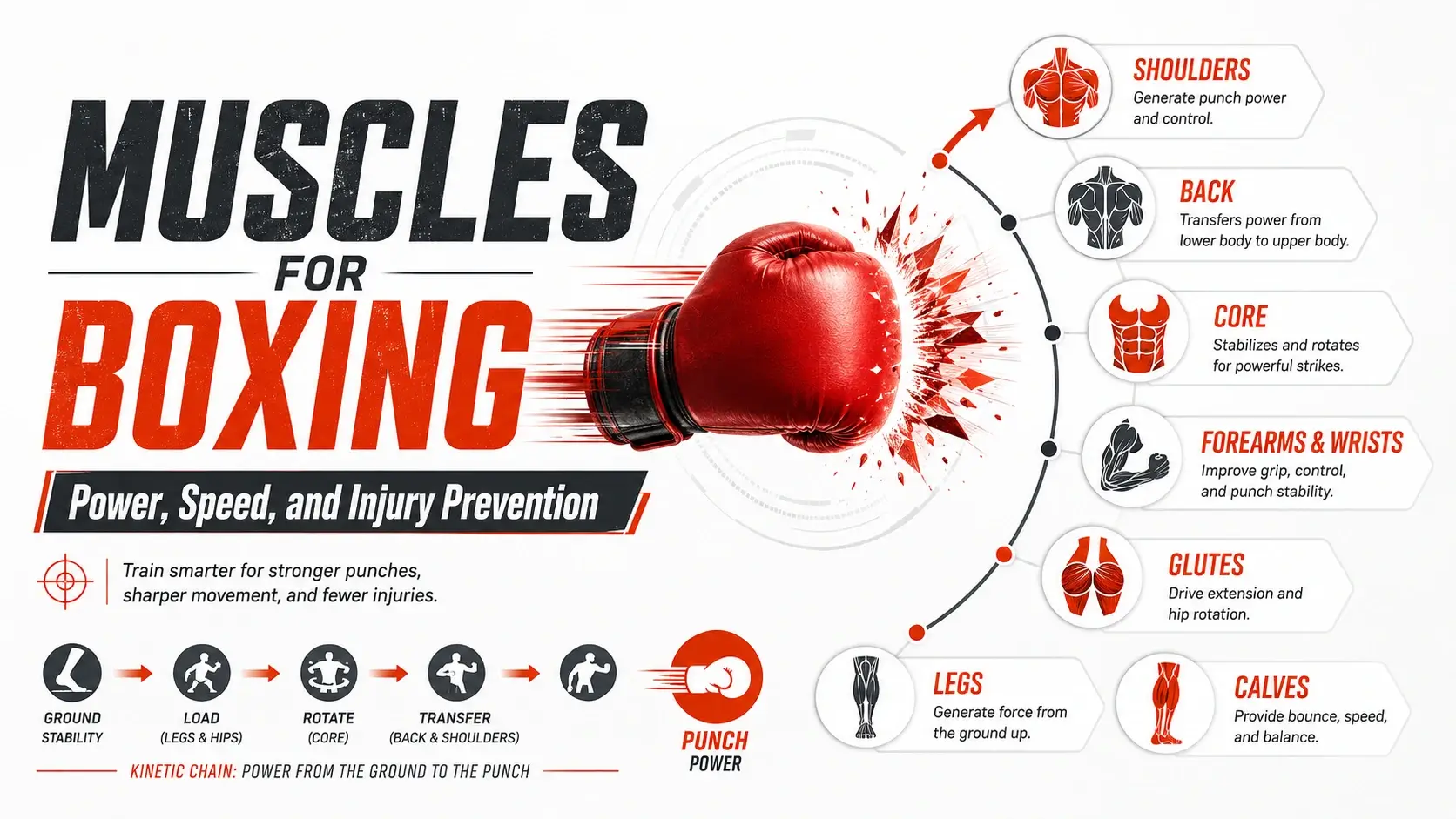
- Boxing is a full-body sport. A strong punch starts from the feet, moves through the legs and hips, passes through the core, and finishes through the upper body.
- The most important muscles to train for boxing are the core, glutes, legs, shoulders, chest, back, triceps, forearms, wrists, calves, and neck.
- Core muscles help with rotation, bracing, balance, and force transfer during crosses, hooks, uppercuts, slips, and pivots.
- The lower body creates the base for punching power. Strong glutes, quads, hamstrings, and calves help with footwork, push-off, balance, and hip rotation.
- The upper body helps finish the punch. Shoulders, chest, triceps, and arms deliver speed and impact, while the back helps pull punches back to guard.
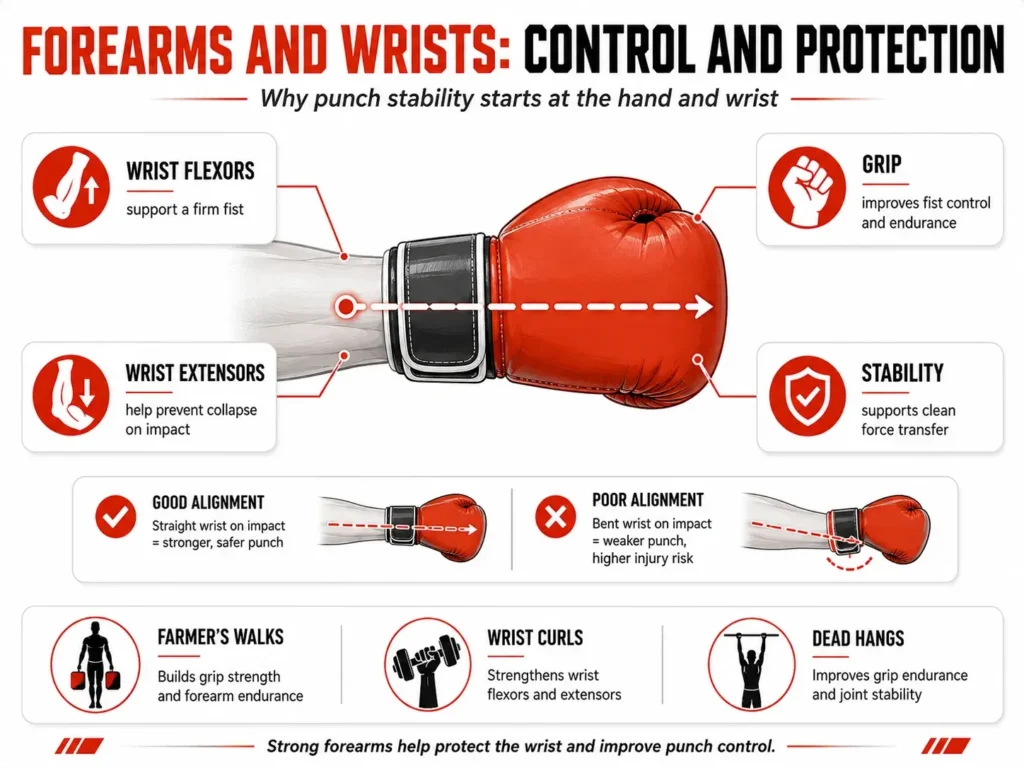
- Forearms, wrists, and grip strength matter because they help keep the fist tight, the wrist stable, and the hand protected on impact.
- A fast punch is about throwing quickly, quick recovery, good posture, and strong antagonist muscles that help slow the punch down safely.
- Boxers should train strength, rotational power, muscular endurance, plyometrics, mobility, and recovery instead of relying only on bag work or conditioning.

Why do some punches feel sharp and heavy, while others look fast but land weak?
For many boxers, the problem is not lack of effort or poor fitness. The issue is often a weak link in the way the body works together.
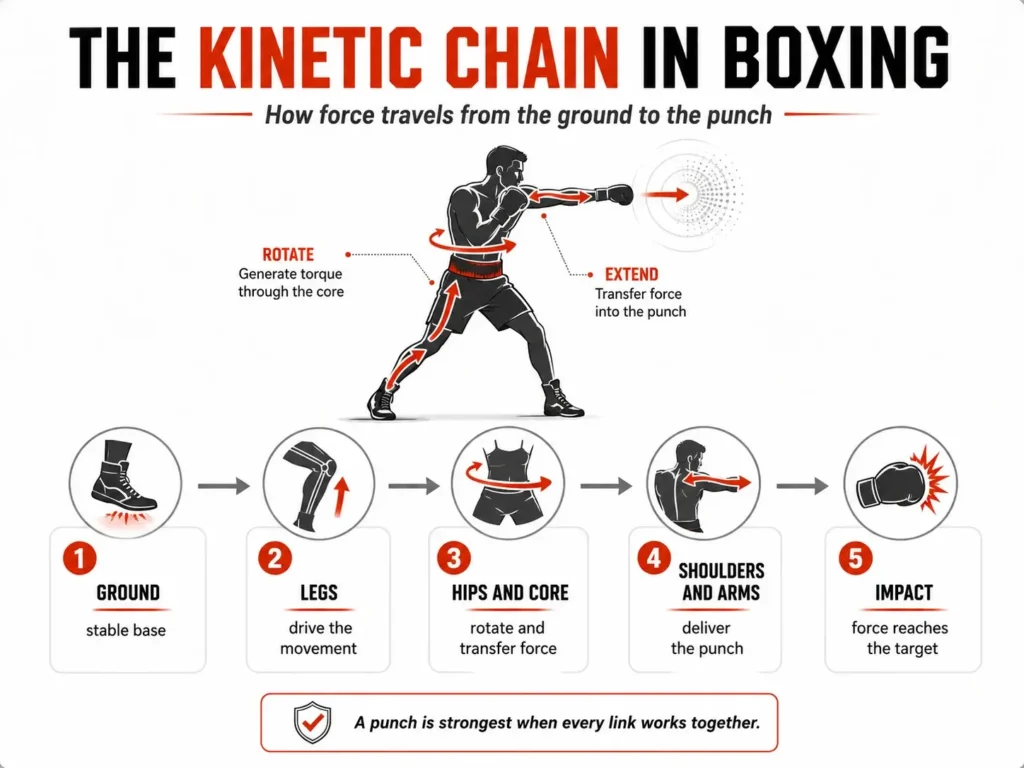
A punch is not just an arm movement. It is a chain reaction that starts at the feet, moves through the legs and hips, transfers through the core, and finishes through the shoulder, arm, and fist.
When one part of that chain is weak, slow, tight, or poorly trained, everything suffers. Power drops. Speed fades. Balance breaks. Fatigue shows up earlier. Injury risk also goes up, especially in the shoulders, wrists, lower back, hips, and knees.
The guide breaks down the main muscles used in boxing and explains how they work during jabs, crosses, hooks, uppercuts, footwork, defense, and endurance work.
More importantly, it shows why each muscle group matters and how better training can help you punch harder, move faster, last longer, and reduce common injury risks.
Let’s start!
Table of Contents
The Core: Rotational Force and Stability
A strong punch does not start in the fist. It starts from the floor, moves through the legs and hips, then passes through the core before it reaches the shoulder, arm, and hand. That is why your core matters so much in boxing. It helps transfer force, control rotation, keep your balance, and protect your spine under pressure.
When you throw a cross or hook, your hips rotate first. Your core then connects that hip rotation to your upper body. If your core is weak or slow, energy leaks before the punch lands. The result is a punch that looks busy but does not hit with real force.
Why the Core Matters in Boxing
The core has three main jobs during boxing. First, it helps rotate the trunk for crosses, hooks, and uppercuts. Second, it keeps your spine stable when you slip, roll, pivot, or absorb contact. Third, it helps you return to position quickly after throwing a punch, so you are not open for counters.
Do not train your core only with sit-ups. Boxing needs rotation, anti-rotation, bracing, and control under movement.
Key Core Muscles Used in Boxing
The rectus abdominis helps with trunk flexion and bracing. It supports movements like crunching forward, but its bigger boxing value is helping you stay tight when you punch or take body contact.
The internal and external obliques are the main muscles behind trunk rotation. They are heavily involved when you turn into a rear cross, whip a lead hook, or rotate back into your guard.
The transverse abdominis is your deep core stabilizer. It is like your natural weight belt. It helps you brace before impact and protects your lower back during fast rotation.
The erector spinae and quadratus lumborum support the lower back. They help control counter-rotation, posture, and spinal stability when punches are thrown with force.

Best Core Exercises for Boxers
Medicine ball rotational throws build punch-specific rotational power. They train the hips, obliques, and trunk to fire together.
Cable wood chops train rotation through different angles, which helps with hooks, crosses, and uppercuts.
Russian twists can build rotational endurance, but keep the movement controlled. Do not rush or twist from the lower back.
Side planks and plank rotations build anti-rotation strength. It helps you stay balanced when punching, slipping, or getting pushed off line.
A medicine ball is one of the best tools here because it lets you train explosive rotation without turning every core workout into slow floor exercises.
Upper Body: Shoulders, Chest, Back, and Arms
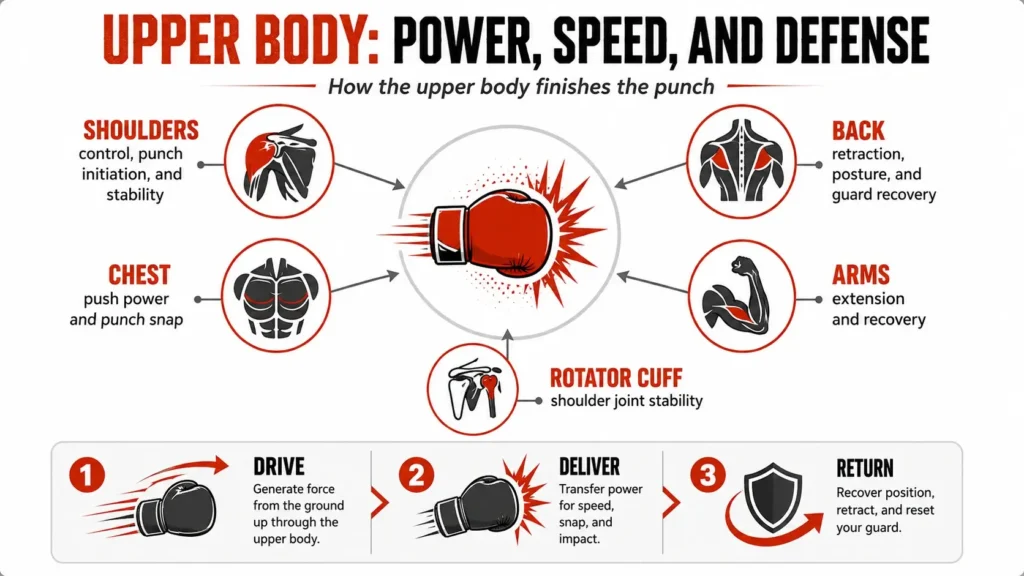
The upper body does not create punching power by itself, but it decides how well that power finishes. Your legs and hips start the force. Your core transfers it. Your shoulders, chest, back, and arms turn it into a fast, sharp punch that can return to guard without leaving you open.
Shoulders
The deltoids do more than make the shoulders look strong. The anterior deltoid helps drive the arm forward in jabs, crosses, and uppercuts. The medial deltoid supports the arm when you hold your guard, punch from angles, or move laterally. The posterior deltoid helps slow the arm down after impact and pull it back safely.
The rotator cuff is just as important. These smaller muscles keep the shoulder joint stable while the arm moves fast. If they are weak, the shoulder can feel loose, irritated, or painful during bag work and sparring.
Useful exercises include overhead presses, lateral raises, face pulls, and band internal and external rotations. Resistance bands work well here because they let you train control without heavy joint stress.
Chest
The pectorals help with the pushing phase of punches, especially the cross and hook. They add snap near the end of the movement, but they should not overpower the shoulders and upper back. Too much chest work without enough back work can pull the posture forward.
Push-ups, dumbbell bench press, and controlled clap push-ups can build pressing strength and punch speed.
Back: Retraction and Guard Recovery
The back is the part many boxers undertrain. The lats help pull punches back quickly and support hook mechanics. The rhomboids and traps keep the shoulder blades stable, which helps posture, guard position, and shoulder health.
Pull-ups, lat pulldowns, rows, and face pulls are strong choices.
Arms: Extension and Recovery
The triceps extend the arm during jabs, crosses, and uppercuts. The biceps help slow the punch down and bring the hand back to guard.
Close-grip bench press, dips, overhead triceps extensions, and controlled curls can all help, as long as they support boxing movement instead of just adding size.
The Groundwork: Legs, Glutes, and Calves
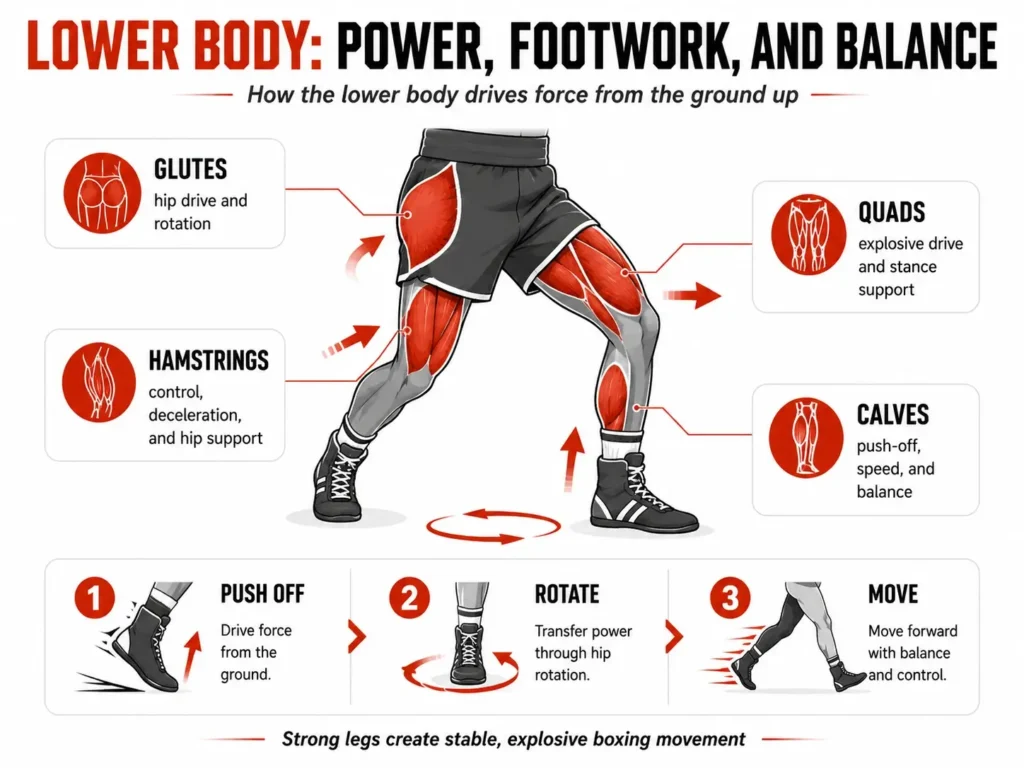
If your punches feel weak, do not look only at your arms. Your feet press into the ground, your legs drive, your hips rotate, and that force travels through the body into the punch.
That is why strong legs are not just for movement. They help you punch harder, pivot faster, hold balance, and recover after throwing or defending. If your lower body is slow, unstable, or poorly trained, your punches will lose force before they reach the target.
Glutes: Hip Drive and Rotation
The glutes are a major part of punching power. The glute max helps with hip extension, which matters when you push off the back foot in a cross or drive into a hook. The glute medius and minimus help keep the hips stable, especially when you pivot, slip, or move side to side.
Quadriceps and Hamstrings: Drive and Control
The quads help extend the knee and create forward drive. They are active when you step in, change levels, lunge, or push out of your stance.
The hamstrings work with the glutes to extend the hip, control the leg, and slow the body down when you stop, pivot, or reset. It matters because boxing is not only about starting fast. It is also about stopping fast without losing position.
Calves: Footwork and Spring
The calves help you push off the balls of your feet. The gastrocnemius and soleus support quick steps, pivots, bounce, and balance. Strong calves also help you stay light without feeling unstable.
Best Lower Body Exercises for Boxers
Squats build leg strength for stance, drive, and balance. Back squats, front squats, and jump squats can all help when used properly.
Deadlifts and Romanian deadlifts train the posterior chain, especially glutes, hamstrings, and lower back support.
Lunges build single-leg strength, which carries over well to footwork and punching from split stances.
Box jumps and broad jumps train explosive push-off.
Calf raises build ankle strength and footwork endurance.
Dumbbells and kettlebells are useful tools here because they let you train strength, control, and power without needing a large gym setup.
Forearms, Wrists, and Grip for Control and Protection
Big punches get most of the attention, but the smaller muscles around the forearms, wrists, and hands do a lot of quiet work. They help keep your fist tight, your wrist lined up, and your punch stable when it lands.
If the wrist bends on impact, force does not transfer cleanly. Instead of driving through the target, the punch can stress the wrist, hand, thumb, or knuckles. That is why forearm and grip training matters for both performance and injury risk.
Key Muscles Involved
The wrist flexors help bend the wrist and support a tight fist. The wrist extensors help keep the wrist from collapsing forward or backward during impact. Both groups need balanced training. If one side is much stronger than the other, the wrist may feel less stable.
Grip muscles support crushing grip, pinch grip, and finger strength. For boxers, this helps with fist formation, glove control, clinch work, and hand endurance during longer rounds.
Best Exercises for Forearms, Wrists, and Grip
Wrist curls and reverse wrist curls train flexion and extension. Use light to moderate dumbbells and keep the movement controlled.
Farmer’s walks build grip, wrist stability, shoulder control, and core bracing. They carry over well because boxing needs the whole body to stay connected.
Plate pinches train thumb and finger strength, which supports hand control.
Dead hangs build grip endurance and shoulder stability.
Kettlebell carries are also useful because they challenge grip, wrist position, and posture at the same time.
Training tip: Keep wrist work controlled. Sharp pain, numbness, or swelling is not normal training discomfort.
Synergy in Motion: The Kinetic Chain and Muscle Balance in Boxing
A strong punch is a chain of movement. The feet press into the floor, the legs drive, the hips rotate, the core transfers force, the shoulder guides the arm, and the fist finishes the punch.
That chain is called the kinetic chain. When it works well, the punch feels sharp and controlled. When one link is weak or late, power leaks. You may still throw fast, but the punch can feel arm-heavy, unstable, or easy to counter.
How the Kinetic Chain Works in a Cross
Take the rear cross. It starts when the back foot pushes into the floor. The calf, quad, hamstring, and glutes help drive the body forward and rotate the hip. The core then transfers that rotation through the trunk. The shoulder, chest, and triceps finish the punch as the hand travels toward the target.
Agonists, Antagonists, and Synergists
The agonist is the main mover. For example, the triceps help extend the arm during a jab or cross.
The antagonist is the opposing muscle. The biceps must relax enough to let the punch extend, then contract to slow the arm down and bring it back to guard.
The synergists assist the main movement. The deltoids, chest, core, and legs all help the punch land with speed and control.
The balance matters because boxing is not just about throwing. It is about throwing, stopping, returning, and staying protected.
Proprioception, Stability, and Breathing
Proprioception means your body knows where it is in space. Boxers need it for balance, pivots, slips, rolls, and fast footwork.
Single-leg balance drills, slow pivots, controlled lunges, and light unstable-surface work can help improve body control.
Breathe out as you punch. It helps you brace the core, stay relaxed, and avoid wasting energy.
Strategic Training Principles for Boxing Muscle Development
A boxer’s physique should be built for performance. The goal is to punch harder, move faster, stay balanced, protect the joints, and keep good technique deep into later rounds. That means your training needs strength, power, endurance, mobility, and recovery working together.
Prioritize Compound Movements
Boxing is a full-body sport, so your strength work should not be built only around small isolation exercises. Squats, deadlifts, lunges, rows, pull-ups, overhead presses, and push-ups train several muscle groups at once. That better matches the way boxing works, where the legs, core, shoulders, back, and arms must connect during every punch and defensive move.
Build Rotational Power
Hooks, crosses, and uppercuts need hip and torso rotation. Medicine ball throws, cable wood chops, landmine rotations, and controlled Russian twists help train that pattern. The key is not just twisting harder. You need the hips and torso to work together while the core stays braced.
Train the Posterior Chain
Many boxers become front-side dominant from punching, push-ups, and guard work. That is why the glutes, hamstrings, upper back, and lower back need direct attention. Romanian deadlifts, hip thrusts, glute bridges, rows, and face pulls help support posture, hip drive, and punch recovery.
Develop Muscular Endurance
A boxer needs strength that lasts. Use circuits, timed rounds, moderate weights, bodyweight work, sled pushes, battle ropes, and high-rep accessory work. It helps maintain punch quality when fatigue starts to affect speed, guard position, and footwork.
Add Plyometrics Carefully
Box jumps, broad jumps, jump squats, clap push-ups, and medicine ball slams train quick force production. Keep the volume controlled. Quality matters more than doing endless reps.
Warm Up, Cool Down, and Recover
Use dynamic warm-ups before training, such as hip openers, shoulder circles, light shadowboxing, skips, and mobility drills. Save longer static stretching for after training.
Here is a quick reference table for help:
| Muscle Group | Main Boxing Role | Useful Exercises |
|---|---|---|
| Core | Rotation, bracing, balance | Planks, wood chops, med ball throws |
| Shoulders | Punch control, guard, stability | Presses, lateral raises, band rotations |
| Chest | Punch extension and snap | Push-ups, dumbbell press |
| Back | Punch recovery, posture, guard support | Rows, pull-ups, face pulls |
| Glutes | Hip drive and rotation | Squats, hip thrusts, lunges |
| Hamstrings | Deceleration and hip support | RDLs, deadlifts |
| Calves | Push-off, footwork, balance | Calf raises, jump rope |
| Forearms and Wrists | Fist control, wrist stability | Farmer’s walks, wrist curls, hangs |
A simple periodized plan can help. Build strength first, add power work next, sharpen endurance closer to competition, then reduce volume before a fight so the body feels fresh.
FAQs
What muscles should you train for boxing?
Train the full body, not just the arms. The most important areas are the legs, glutes, core, shoulders, chest, back, triceps, forearms, wrists, and neck. Your legs and glutes create force, your core transfers it, and your upper body delivers and controls the punch. Balanced training helps with power, speed, defense, and injury prevention.
How to develop fast twitch muscles for boxing?
You do not really “build” fast twitch muscles like a separate body part. You train your body to use fast force better. Use plyometrics, sprint work, medicine ball throws, jump squats, clap push-ups, and short explosive strength sets. Keep the reps crisp. Once speed drops, stop the set. Fast twitch training should feel sharp, not sloppy. Quality beats high reps here.
Are back muscles important for boxing?
Yes, back muscles are very important. The lats help pull punches back quickly, which keeps your defense tight after you throw. The rhomboids and traps support posture, shoulder blade control, and guard position. A weak back can make your shoulders roll forward and make your punches slower to recover.
How to strengthen neck muscles for boxing?
Start with controlled neck isometrics. Press your head gently into your hand from the front, back, and both sides without moving the neck. Add shrugs, band neck work, and light controlled flexion or extension only if you can do them safely. Avoid heavy neck bridges unless a qualified coach has taught you proper form.
Is boxing good for building muscle?
Boxing can build some muscle, especially for beginners, because it uses the shoulders, arms, core, legs, and back. But boxing is better for conditioning, coordination, power, and endurance than pure muscle size. For serious muscle growth, combine boxing with progressive strength training, enough protein, and proper recovery.
Bringing it All Together
Boxing performance comes from how well the whole body works together. Your feet create the base, your legs and glutes drive force, your core transfers power, and your upper body finishes the punch with speed and control.
The best boxers do not only train harder. They train smarter. A strong core, powerful lower body, stable shoulders, active back, strong wrists, and balanced arms all matter. When these areas work together, punches feel sharper, footwork becomes cleaner, and defense becomes easier to control.
Injury prevention should also be part of the plan, not something you think about after pain starts. Rotator cuff work, posterior chain training, grip strength, mobility, and recovery all help keep the body ready for consistent training.
Use this knowledge to review your own program. If your training is mostly bag work and random conditioning, start adding targeted strength, rotation, stability, and recovery work.
For the best results, work with a certified strength coach, boxing coach, or sports medicine professional who can adjust the plan to your body, skill level, and goals.