
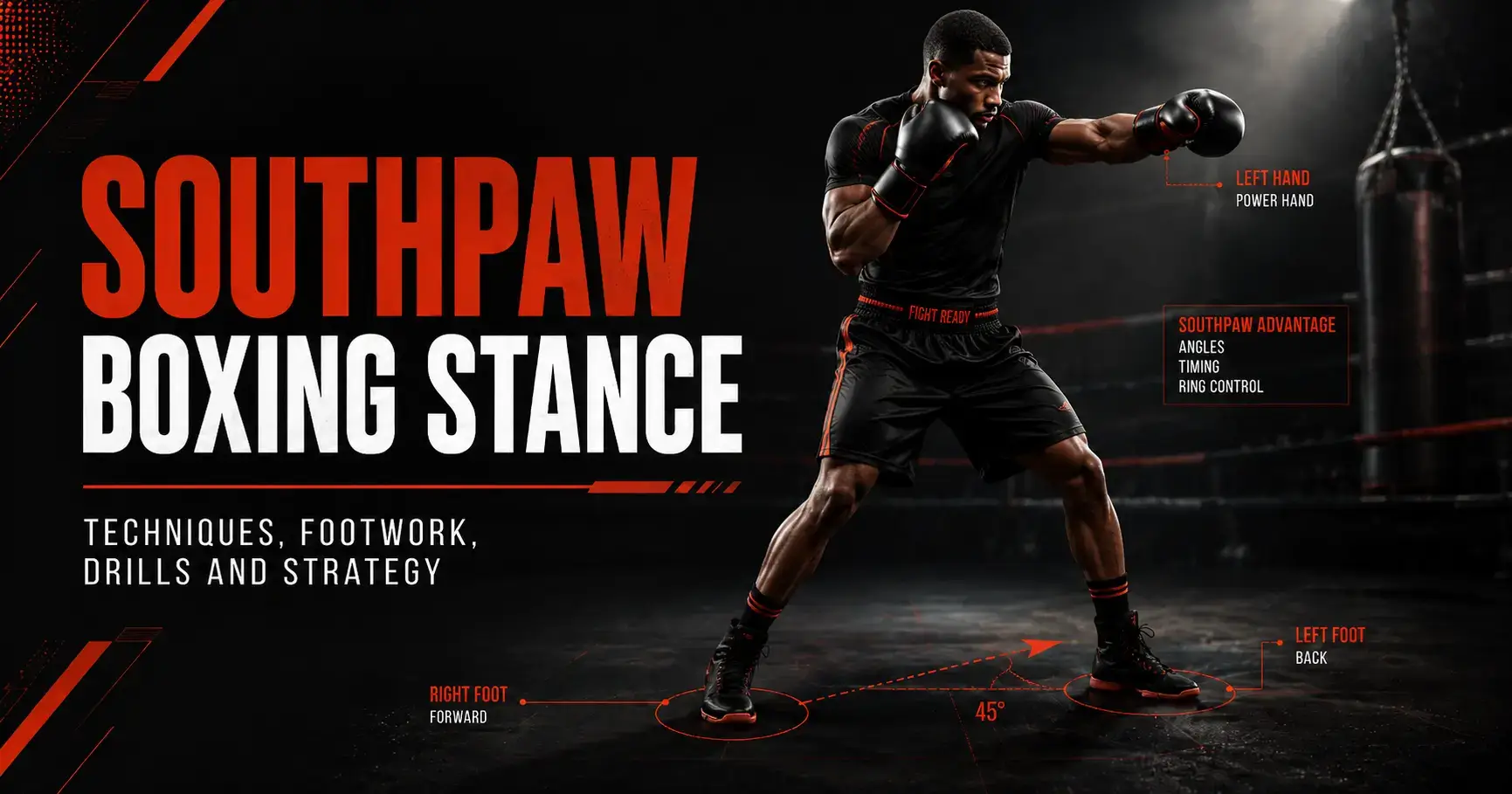
The southpaw stance can be hard to deal with in boxing because it changes the usual angles, timing, and punching lanes. But it only works well when the fighter understands control, foot position, distance, and defensive exits.
Many boxers train in southpaw or prepare to fight one without knowing the small details that decide the exchange, such as lead foot position, rear-left timing, jab control, and how to leave safely after punching.
Here, I will break down the southpaw stance in a clear, practical way. You will learn how the stance works, why it troubles orthodox fighters, which drills to use, what risks to avoid, and how to turn southpaw into a real fight strategy.
Table of Contents
What is a Southpaw in Boxing?
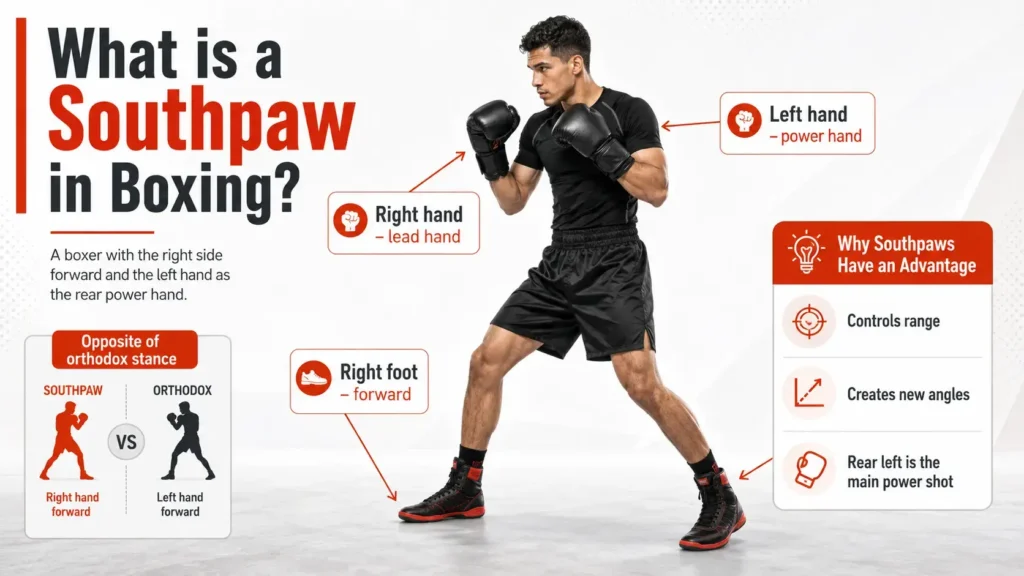
A southpaw in boxing is a fighter who stands with the right hand and right foot forward, while the left hand stays at the rear as the main power hand. It is the opposite of the orthodox stance, where the left side is forward and the right hand is usually the power hand.
At first, the southpaw stance can feel unusual because most boxers spend more time training against orthodox opponents. That is exactly why it can be so effective. A southpaw changes the angles, timing, foot position, and punching lanes that an orthodox fighter is used to seeing.
Defining the Southpaw Stance
In a southpaw stance, the right hand works as the lead hand. It controls range, measures distance, sets up punches, and interrupts the opponent’s rhythm. The left hand sits at the rear, ready to fire as the stronger straight shot, cross, or counter.
The lead right foot also plays a major role. Against an orthodox fighter, the southpaw often wants to place the lead foot outside the opponent’s lead foot. The small foot position can open a cleaner path for the rear left hand and make it harder for the opponent to land their own rear hand.
The word “southpaw” is often associated with left-handed baseball pitchers, but its exact origin is debated. Today, in boxing, it simply refers to a fighter who leads with the right hand and right foot while using the left hand as the rear power hand.
Why the Southpaw Stance is Unique
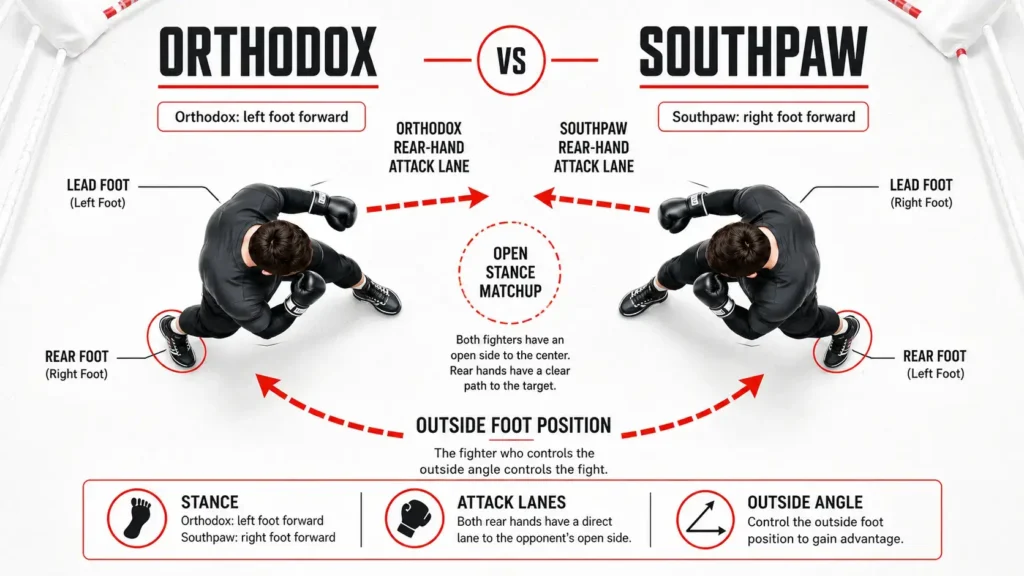
The biggest reason the southpaw stance stands out is the mirror match effect. When a southpaw faces an orthodox fighter, both lead feet and lead hands line up against each other. It creates different punching lanes than a regular orthodox vs orthodox matchup.
For example, the southpaw’s rear left hand often travels straight through the open side of an orthodox fighter’s guard. If the southpaw wins the outside foot position, that left hand becomes even more dangerous because the angle is cleaner and the opponent has less time to react.
That is also why southpaws can disrupt rhythm so well. Orthodox fighters are used to seeing jabs and right hands from familiar angles. A southpaw gives them the opposite look. The jab comes from the right side, the power shot comes from the left side, and the lead-foot battle changes how both fighters move.
Core Characteristics of the Southpaw Stance
| Characteristic | Description | Impact |
|---|---|---|
| Lead Side | Right hand and right foot forward. | The lead right hand controls distance, touches the opponent’s guard, blocks vision, and sets up the rear left. A sharp lead hand can stop an orthodox fighter from stepping in freely. |
| Power Side | Left hand is usually the rear power hand. | The straight left can travel down the open side of an orthodox guard. That makes it one of the most important southpaw weapons, especially after a jab, feint, or outside step. |
| Guard | Right hand works in front, left hand protects the chin and stays ready to fire. | The guard helps block or catch the orthodox jab while keeping the left hand loaded for counters. If the lead hand gets lazy, the southpaw can still be open to right hands. |
| Footwork | Strong focus on outside lead foot position. | Placing the right foot outside the opponent’s left foot can create a better angle for the straight left. It also makes it harder for the orthodox fighter to line up their rear right hand. |
| Matchup Dynamic | The stance creates a mirror image against orthodox fighters. | It can feel uncomfortable for opponents because their normal timing, defense, and combinations do not work the same way. The southpaw can use this to force hesitation and create openings. |
Biomechanical Advantage for Power Shots
The southpaw stance gives the rear left hand a natural path against many orthodox opponents. When the hips, rear shoulder, and left hand rotate together, the punch can travel in a straight line through the center or across the open side of the guard.
It matters because power in boxing is not just about arm strength. It comes from the floor, legs, hips, core, shoulder, and fist working together. A well-positioned southpaw can use foot placement and body rotation to turn the straight left into a fast, direct, and heavy shot.
The point is control. A southpaw who only waits to throw the left hand becomes predictable. A smart southpaw uses the lead hand, feints, small steps, and head movement to make the opponent react first, then lands the left hand when the line is open.
Orthodox vs. Southpaw: The Differences
The main difference orthodox fighters stand with the left side forward, while southpaws stand with the right side forward. That switch changes foot placement, punching lanes, guard position, balance, and the way both fighters read attacks.
In an orthodox stance, the lead left hand is usually used to jab, frame, measure range, and set up the rear right hand. In a southpaw stance, the lead right hand does the same job, while the rear left becomes the main power shot.
| Feature | Orthodox Stance | Southpaw Stance |
|---|---|---|
| Lead Foot | Left foot forward. It helps control range with the jab. | Right foot forward. It creates a mirror match against orthodox fighters. |
| Rear Foot | Right foot back, used to drive the straight right. | Left foot back, used to drive the straight left. |
| Lead Hand | Left hand throws the jab, lead hook, and range checks. | Right hand throws the jab, lead hook, and hand traps. |
| Power Hand | Right hand is the main rear power shot. | Left hand is the main rear power shot. |
| Guard Position | Right hand protects the chin, left hand stays active in front. | Left hand protects the chin, right hand stays active in front. |
| Weight Shift | Slight rear-foot load helps create right-hand power and balance. | Slight rear-foot load helps create left-hand power and balance. |
| Typical Angles | Looks to attack the opponent’s right side. | Looks to attack the opponent’s left side. |
| Natural Openings | Often open to the southpaw straight left. | Often open to the orthodox straight right. |
The Inherent Advantages of the Southpaw Stance
- A southpaw gets different attack lines because the right hand and right foot are forward, while the left hand sits in the rear as the main power shot.
- Against an orthodox fighter, this creates an open stance dynamic. Both lead feet face each other, so the fight often becomes a battle for the outside foot position.
- Expert tip: Keep your right lead foot outside the orthodox fighter’s left lead foot. This helps line up your straight left and makes their right hand harder to land clean.
- The straight left is the main southpaw weapon. When timed well, it can travel directly through the center or across the open side of an orthodox guard.
- Southpaws also disrupt rhythm. Most orthodox fighters see fewer southpaws in training, so the jab, lead hand, foot angle, and rear hand all arrive from less familiar lines.
- Use that awkward feeling on purpose. Feint, step, jab, and make the opponent reset before you throw the left hand.
- The southpaw lead hook is often underrated. From the right lead side, it can catch an orthodox fighter who is watching too much for the straight left.
- Drill the lead hook after the jab, after a slip, and after a small outside step. It gives your attack more layers and stops you from becoming predictable.
Common Disadvantages and Challenges for Southpaws
- Southpaws can struggle to find the right sparring partners. You still need regular rounds with orthodox fighters, but you also need rounds with other southpaws.
- The main defensive danger is the orthodox straight right. If your head stays on the center line or your lead foot is inside too long, that punch becomes a real threat.
- The orthodox left hook is another risk, especially when you pull back with your chin high.
- Generic boxing drills are not always enough. Southpaws need stance-specific work, including outside foot drills, straight-left setups, lead-hand control, and exits after punching.
- Beginners may feel stiff at first. Build the stance slowly through shadowboxing, bag work, partner drills, and controlled sparring until the movement feels natural.
Core Southpaw Techniques: Stance, Guard and Footwork
Proper Southpaw Stance Breakdown
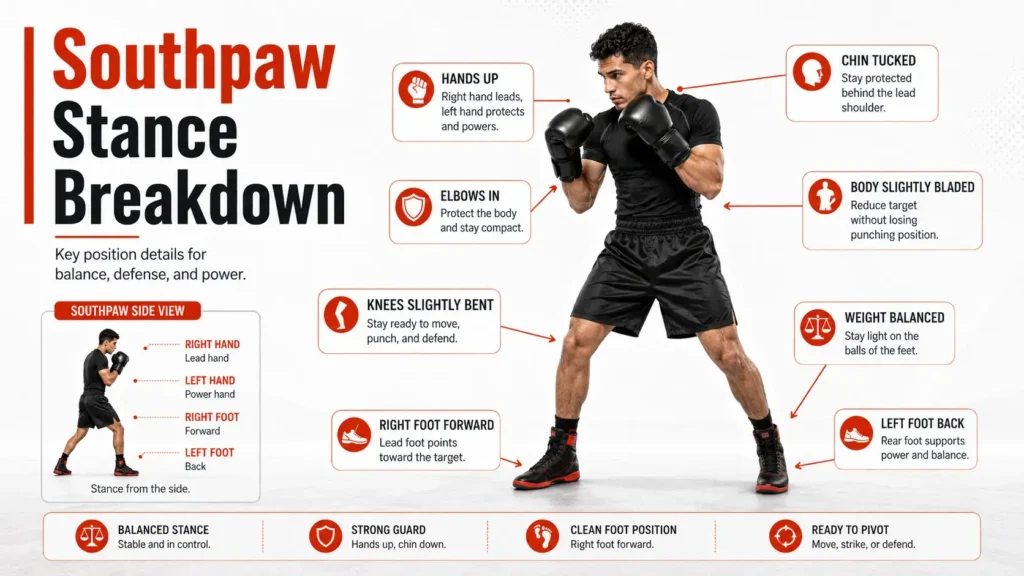
- Start with your right foot forward and your left foot back. Your feet should be about shoulder-width apart, not too narrow and not too wide.
- Keep a heel-toe line between both feet. Your front heel should not sit directly in line with your rear heel, because that makes your balance weak and easy to break.
- Stay light on the balls of your feet. Your weight should feel balanced, with a slight rear-foot load so the straight left can fire with force.
- Bend your knees slightly. Stiff legs slow your reactions and make it harder to step, pivot, or defend.
- Keep your body bladed enough to reduce the target, but not so turned that your rear left hand becomes slow or hard to release.
- Your shoulders should stay relaxed and ready. Tension burns energy and makes your punches easier to read.
Maintaining a Solid Southpaw Guard
- Your left hand is the rear hand, so it should stay close enough to protect your chin and ready enough to throw the straight left.
- Your right hand is the lead hand. Keep it slightly forward to jab, touch the guard, measure range, block vision, and set traps.
- Keep both hands high. A low lead hand may work for advanced fighters, but beginners and intermediate boxers should first build a safe, reliable guard.
- Tuck your elbows in. This protects the ribs and keeps your punches tighter when you attack from close range.
- Keep your chin down behind your lead shoulder. Do not lift your head after throwing the jab or straight left.
- Expert tip: Strong basics matter in every stance. Head movement, a tight guard, good balance, and clean footwork must stay sharp whether you are southpaw or orthodox.
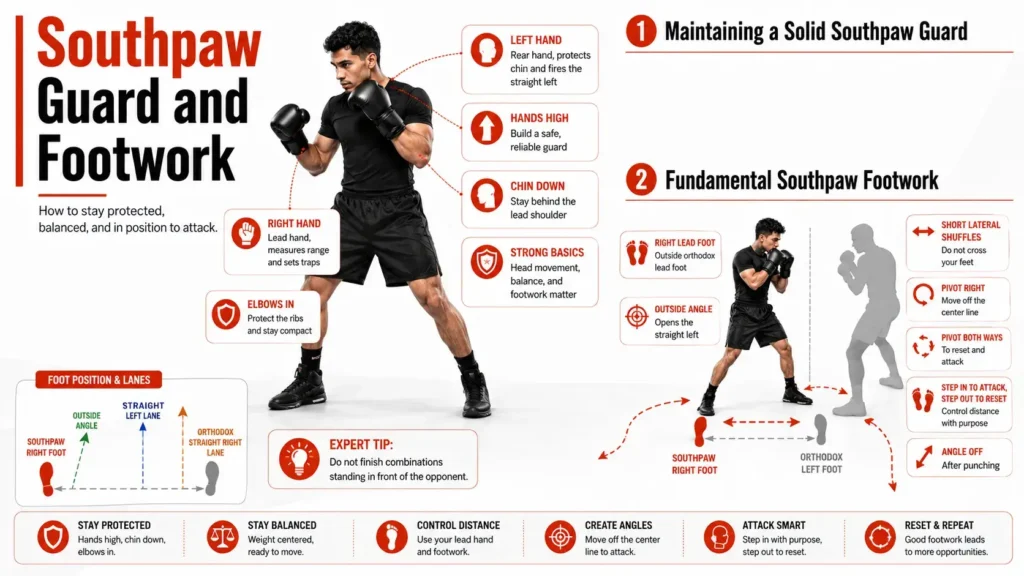
Fundamental Southpaw Footwork
- Lead foot dominance is one of the biggest southpaw skills. Against an orthodox fighter, work to place your right lead foot outside their left lead foot.
- This outside foot position gives your straight left a cleaner line and makes it harder for the opponent to land their straight right.
- Move laterally with short shuffles. Do not cross your feet. Crossed feet can leave you off balance and open to counters.
- Practice moving left and right without letting your stance collapse. Your feet should move as a team, one steps, the other follows.
- Use pivots to get off the center line. A pivot to your right can move you away from the orthodox right hand and open your straight left or lead hook.
- Pivot both ways in training. Clockwise and counter-clockwise pivots help you attack, defend, and reset without running straight back.
- Step in to attack, step out to reset. Distance control is not just about moving away, it is about knowing when you are safe to punch.
- Expert tip: Angle off the center line after you punch. Do not finish combinations standing in front of the opponent.
Footwork Drills
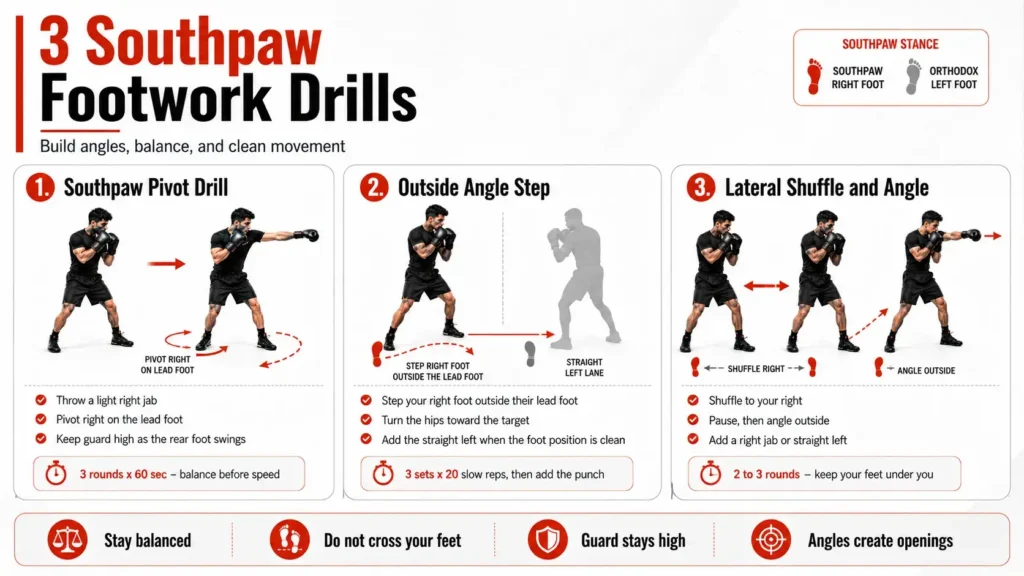
Southpaw Pivot Drill
- Start in your stance, throw a light right jab, then pivot to your right on the lead foot.
- Keep your guard high as your rear foot swings around.
- Repeat for 3 rounds of 60 seconds, focusing on balance before speed.
Outside Angle Step
- Stand across from an orthodox partner or floor marker.
- Step your right foot outside their lead left foot, then turn your hips slightly toward the target.
- Add the straight left once the foot position feels clean.
- Do 3 sets of 20 slow reps, then 3 sets with the punch added.
Lateral Shuffle and Angle
- Shuffle to your right, pause, then take a small angle step outside.
- Add a right jab or straight left after the angle change.
- Repeat for 2 to 3 rounds, keeping your feet under you at all times.
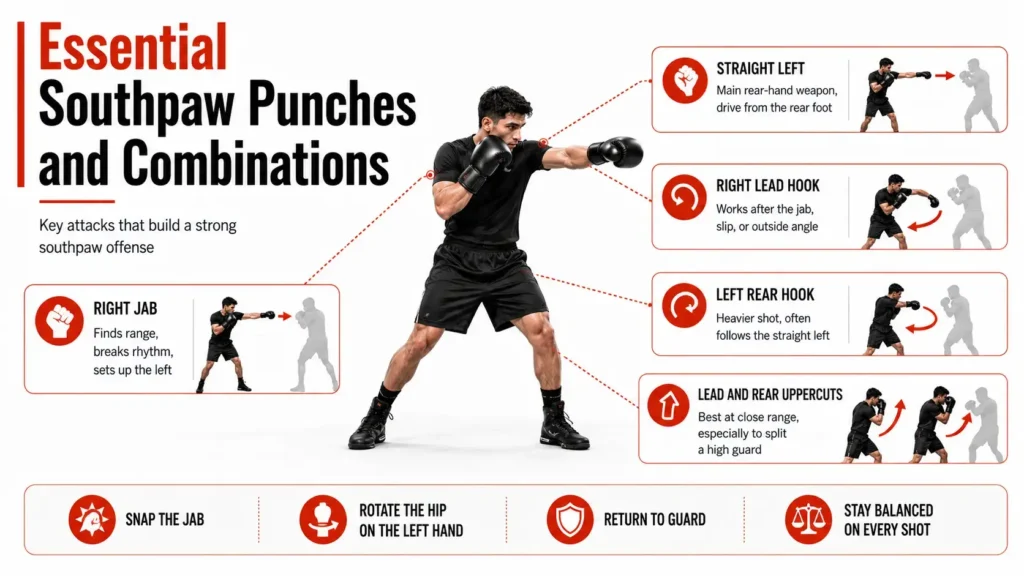
Essential Southpaw Punches and Combinations
Southpaw Jab, Straight Left and Hooks
- The right jab finds range, breaks rhythm, and sets up the rear left. Use a snap jab for speed and a firmer jab when you want to move the opponent.
- The straight left is your main rear-hand weapon. Drive from the rear foot, rotate the hip, turn the shoulder, and bring the hand straight back to guard.
- The right lead hook works well after a jab, slip, or outside angle. It can catch an orthodox fighter who is focused on defending the straight left.
- The left rear hook is heavier but needs good balance. It often works after the straight left or when the opponent shells up.
- Lead and rear uppercuts work best at close range, especially when the opponent leans forward or brings the guard high.
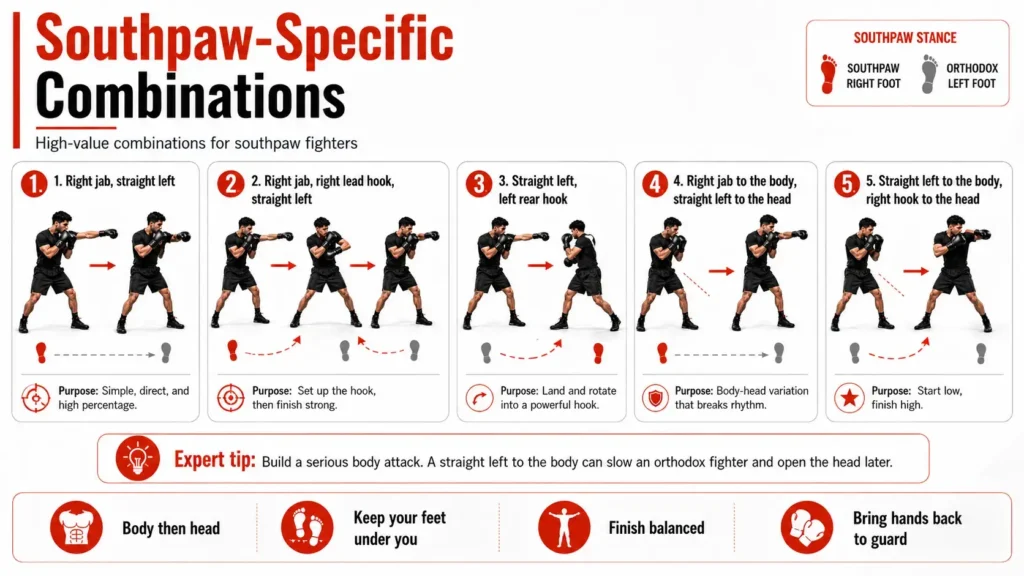
Southpaw-Specific Combinations
- Right jab, straight left.
- Right jab, right lead hook, straight left.
- Straight left, left rear hook.
- Right jab to the body, straight left to the head.
- Straight left to the body, right hook to the head.
- Expert tip: Build a serious body attack. The southpaw straight left to the body can slow an orthodox fighter and make the head shot easier later.
Strategic Game Plan: Fighting an Orthodox Opponent From a Southpaw Stance
Win the Lead Foot Battle
- Your first goal is to control the outside angle. Place your right lead foot outside the orthodox fighter’s left lead foot.
- The small step changes the whole fight. It lines up your straight left, moves your head away from their straight right, and gives you a cleaner punching lane.
- Do not step straight in. Step around their lead foot, turn your hips, then punch. The angle should come before the power.
Attack the Orthodox Openings
- The orthodox fighter’s open side is your main target. Use the right jab to touch, blind, and distract, then fire the straight left down the middle.
- Counter their jab with a small pull, slip, or outside step, then answer with the straight left or right lead hook.
- Mix in body shots. A southpaw straight left to the body can slow their feet and make their guard drop.
Defend the Common Orthodox Attacks
- Be alert for the straight right. Keep your head off the center line after every jab or left hand.
- Parry the orthodox jab with your right hand, but do not reach. If you overreach, you open space for their right hand.
- Watch the left hook when you exit. Keep your chin tucked and leave at an angle, not straight back.
Control the Ring
- Cut the ring by stepping across, not chasing. Make the orthodox fighter move toward your rear left hand.
- Against a brawler, use angles, pivots, and short counters.
- Against an out-boxer, close distance behind the jab and step outside before punching.
- Against a counter-puncher, feint first, draw the reaction, then punch second.
Effective Training Drills for Southpaws
Many southpaws struggle because most boxing drills are taught from an orthodox point of view. The fix is not to train harder with random drills, but to train with a clear southpaw goal every round.
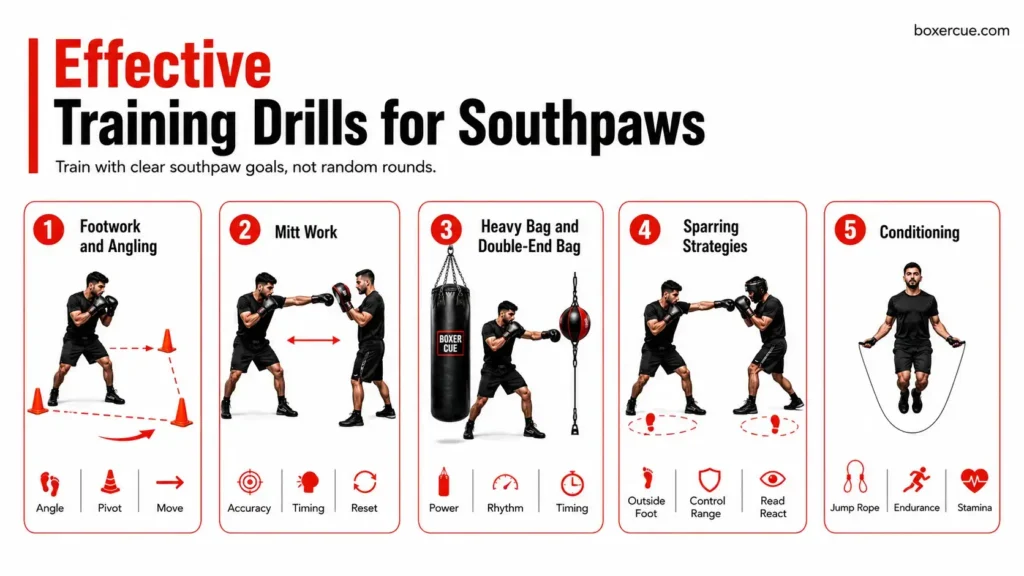
Footwork and Angling Drills
- Set up 4 cones in a square. Start in your southpaw stance, step forward, shuffle right, step back, then shuffle left. Keep your right foot forward the whole time.
- Add a pivot at each cone. Step, turn your lead foot, rotate your hips, then reset your guard.
- Shadowbox for 3 rounds with one rule: your right lead foot must keep finding the outside angle against an imagined orthodox opponent.
- Do not rush this drill. If your feet cross or your stance gets too narrow, slow down and reset.
- Footwork cones or an agility ladder help you build cleaner steps, sharper pivots, and better balance.
Mitt Work and Partner Drills
- Work the right jab, straight left, and right hook on the mitts. These are basic southpaw weapons, but they need timing, not just speed.
- Ask your partner to throw an orthodox jab. Parry with your right hand, step outside, and answer with the straight left.
- Drill defense after every combination. For example: right jab, straight left, pivot right, guard back up.
- Focus mitts or boxing pads are good for accuracy, timing, counters, and defensive reactions.
Heavy Bag and Double-End Bag Drills
- Use the heavy bag to build power in your straight left. Drive from the rear foot, rotate the hip, land clean, then bring the hand back to guard.
- Add the right lead hook after the straight left. This stops you from becoming a one-shot southpaw.
- Use the double-end bag for rhythm. Throw the jab, slip, straight left, then move your feet before the bag returns.
- A heavy bag helps with power, combinations, pressure, and endurance.
Sparring Strategies for Southpaws
- Spar with a clear task. For one round, focus only on keeping outside foot position.
- In another round, focus on countering the orthodox jab with your straight left.
- Spar often with orthodox fighters. That is the best way to test your angles, timing, defense, and lead-hand control.
Conditioning for Southpaw Demands
- Jump rope builds rhythm, foot speed, and light movement.
- Roadwork builds the base you need to keep moving late in rounds.
- A jump rope is simple, low cost, and one of the best tools for boxing rhythm.
Essential Training Gear for Southpaws
Quality gear protects your hands, feet, jaw, and head while you build sharper southpaw habits. When you are drilling outside foot position, pivots, straight lefts, and lead hooks, the right gear helps you train harder without taking careless risks.

- Best For: Bag work, mitt drills, beginner to intermediate training
- Description: A practical training glove for southpaws working on the right jab, straight left, and lead hook. Use 12oz for faster pad work, 14oz for general training, and 16oz for sparring or heavier protection.

- Best For: Heavy bag, mitt work, light sparring
- Description: A solid choice for fighters who want wrist support and hand protection during repeated straight-left drills. Good for southpaws who hit the bag often and need a glove that can handle power work.

- Best For: Knuckle and wrist support
- Description: These wraps help protect the small bones in the hand and support the wrist under gloves. Southpaws throwing hard rear lefts should not skip wraps, especially during bag rounds.

- Best For: Footwork, pivots, ring movement
- Description: A boxing shoe built for grip and quick movement. Useful for southpaws because outside-foot steps, pivots, and angle changes all need stable feet and clean traction.

- Best For: Sparring and contact drills
- Description: A mouthguard is non-negotiable for sparring. Made for contact sports and helps protect the teeth, lips, and jaw when you are working live rounds.

- Best For: Sparring protection
- Description: A face-protector style headgear for controlled sparring. Helps reduce direct impact to the face while you practice defending the orthodox jab, straight right, and left hook.
Gear choice depends on your size, training type, and coach’s rules. Always confirm sparring gear with your coach.
FAQs
Can a right-handed boxer be southpaw?
Yes, a right-handed boxer can fight southpaw. Southpaw usually means the boxer stands with the right hand and right foot forward, while the left hand stays back as the power hand. But stance is not only about which hand you write with. Some right-handed fighters choose southpaw because they like having their stronger hand in front for jabs, hooks, hand fighting, and control.
The key is comfort and results. If a right-handed boxer can move well, defend well, and punch with balance from southpaw, the stance can work.
Do southpaws have an advantage in boxing?
Southpaws can have an advantage because they are less common. Many orthodox fighters are used to facing other orthodox fighters, so a southpaw can disrupt their timing, angles, and defense.
The biggest advantage is the open stance matchup. A southpaw’s rear left hand often has a cleaner path against an orthodox fighter, especially when the southpaw controls the outside lead foot position. But the stance alone does not win fights. A southpaw still needs footwork, defense, timing, and smart punch selection.
Who are some legendary southpaw boxers?
Some legendary southpaw boxers include Manny Pacquiao, Marvelous Marvin Hagler, Pernell Whitaker, Naseem Hamed, Joe Calzaghe, Sergio Martinez, and Vasiliy Lomachenko.
Each used the stance differently. Pacquiao used speed, angles, and volume. Hagler mixed pressure with skill and could switch stances. Whitaker used defense, timing, and footwork. Lomachenko used movement, angles, and lead-hand control.
How do you fight a southpaw boxer?
To fight a southpaw, start by respecting the rear left hand. Do not stand in front of it for too long. Move your lead left foot outside their lead right foot when possible, because this helps line up your straight right and reduces their angle.
Use your jab to control space, but do not jab lazily. A good southpaw will counter a weak jab with the straight left. Feint first, draw reactions, then punch. Circle away from their power hand, keep your guard tight, and watch for the right lead hook when you exit.
Conclusion and Key Takeaways
The southpaw stance gives a boxer real tactical value when it is trained with purpose. The right lead hand can control distance, interrupt rhythm, and set up attacks. The rear left hand can travel through open lanes against orthodox opponents. The lead foot battle can create better angles, safer exits, and cleaner counters. None of this works by accident. It only works when stance, guard, footwork, timing, and discipline come together.
The main lesson is do not treat southpaw as a strange stance. Treat it as a system. Use your jab to control space. Fight for outside foot position. Keep your head off the center line. Build your straight left, lead hook, and body attack. Spar with clear goals, not just hard rounds.
Mastery takes time. You may feel awkward at first, especially if you are new to the stance or switching from orthodox. That is normal. Keep drilling the small details until they feel natural under pressure.
Now take the drills, test them in training, spar intelligently, and turn your southpaw stance into a real boxing advantage!