
Key Takeaways
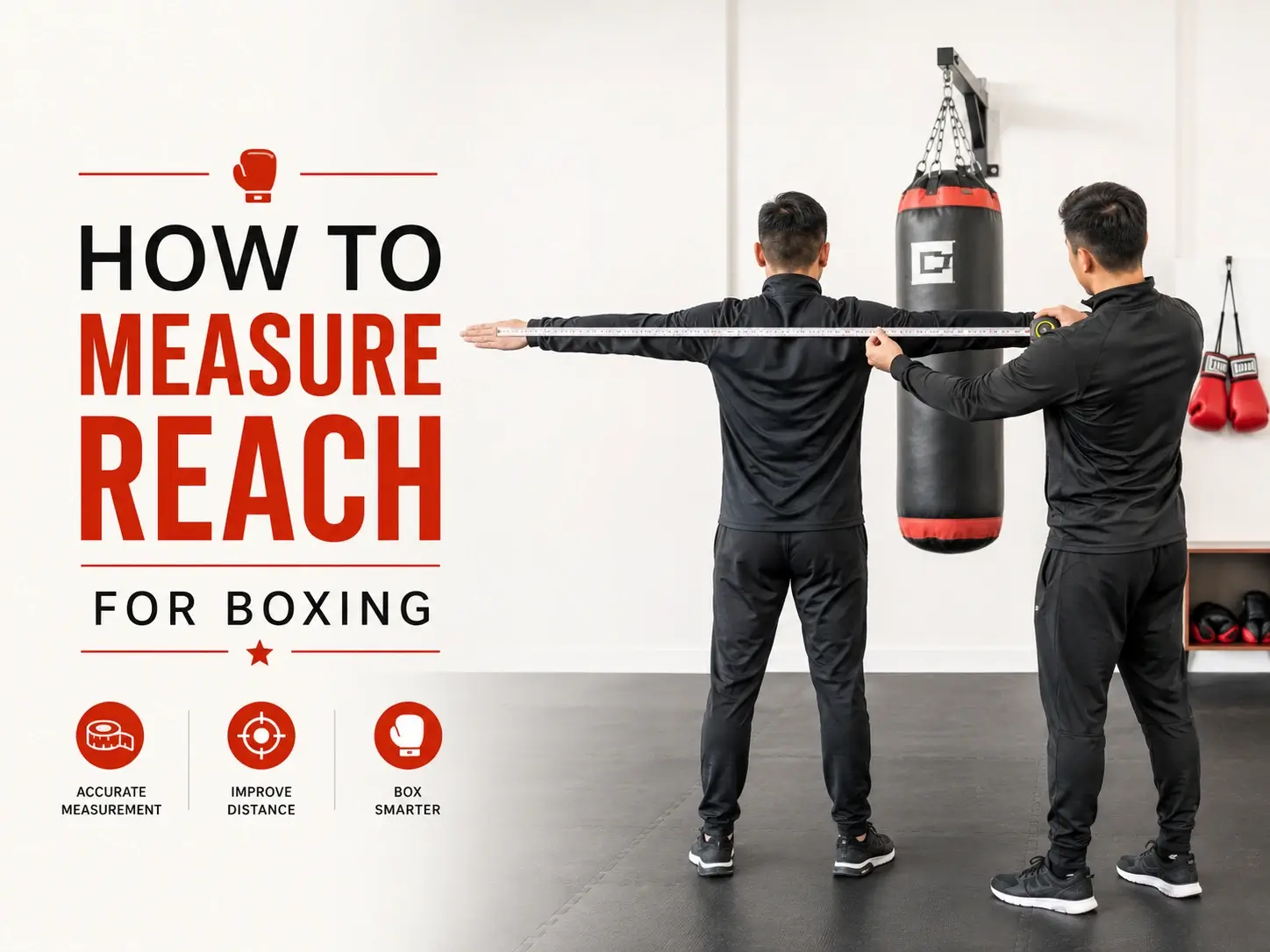
- Boxing reach means your full wingspan, measured from the tip of one middle finger to the tip of the other.
- The most accurate method is the standard wingspan method with a partner, a flat wall, and a tape measure.
- Keep your back straight, arms level with your shoulders, elbows straight, and shoulders relaxed.
- Do not measure from fists, knuckles, or bent fingers. Use the middle fingertips only.
- Measure three times and use the average, because small posture changes can affect the number.
- Your reach is useful, but it does not decide how good you are. Footwork, timing, defense, and form matter more.
Table of Contents
What Boxing Reach Actually Means
Boxing reach means the full span from the tip of one middle finger to the tip of the other when both arms are stretched out at shoulder height. In simple words, it is your wingspan.
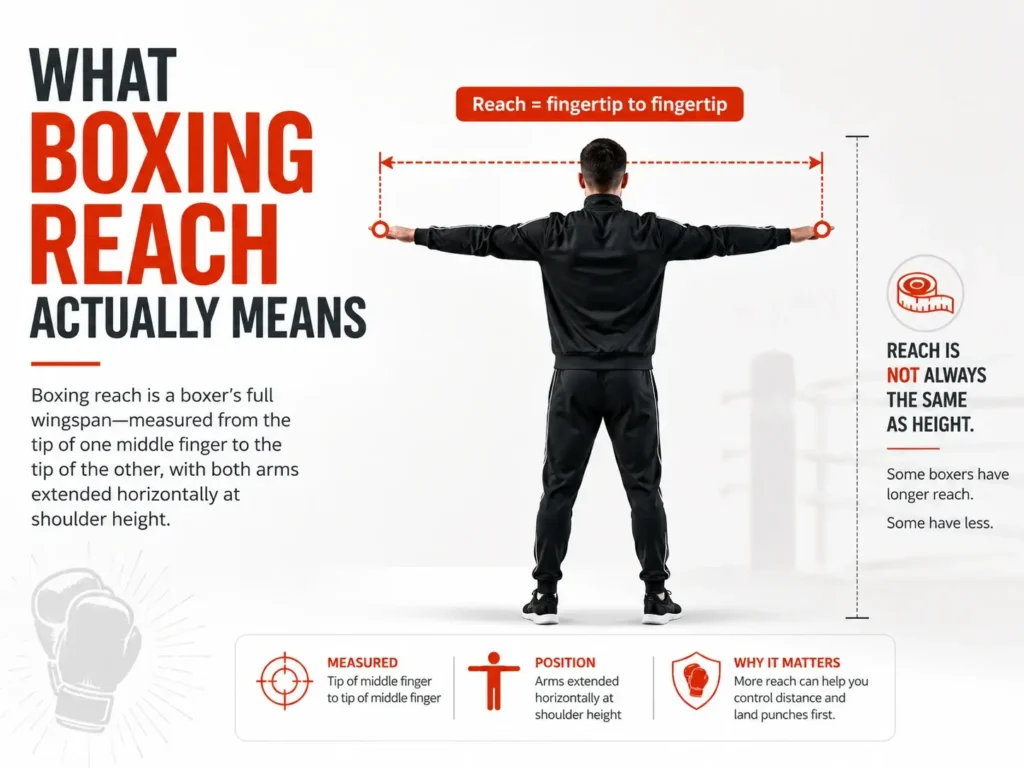
You may think reach is the same as height, but that is not always true. Two boxers can be the same height and still have different reach. One fighter may have longer arms, broader shoulders, or a wider frame, which can change the number.
That is why reach is listed in fighter stats. It gives coaches, fighters, and fans a better idea of how far a boxer can hit from a safe distance.
Why Is Reach Important?
Reach matters because boxing focuses on power and distance.
- A boxer with longer reach can often land a jab before the other person gets close enough to answer back. So, easier to control the pace, keep the opponent outside, and set up straight punches.
- Reach also helps on defense. If you can hit from farther away, you may not need to stand in risky close range as often. Taller or longer-armed fighters often build their style around the jab, footwork, and outside control.
But a long reach will not save a boxer with poor timing, slow feet, weak defense, or bad form. A shorter-reach boxer can still win by closing distance, using angles, slipping punches, attacking the body, and working well inside.
So, reach gives you options. Skill decides how well you use them.
Reach vs. Arm Length
Reach and arm length are related, but they are different.
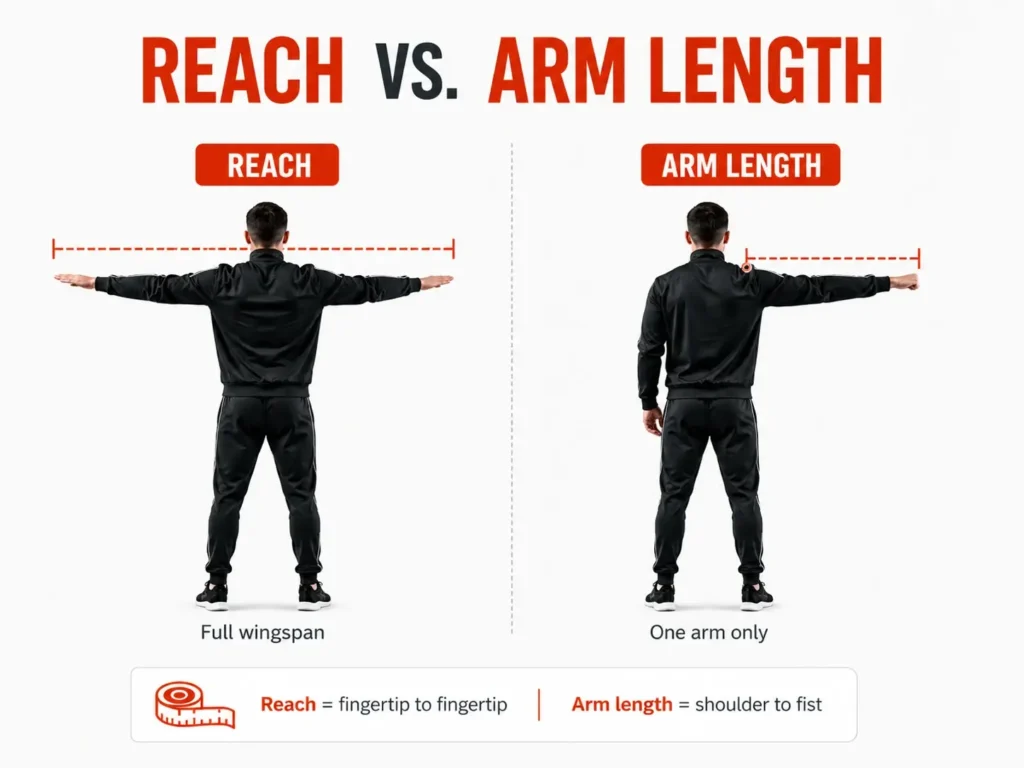
Reach measures across the full body, from fingertip to fingertip. It includes both arms, shoulder width, and body frame.
Arm length usually measures one arm only, often from the shoulder area to the fist or fingertips. It can be useful for technique, but it is not the same stat you usually see before a boxing match.
Another useful term is ape index. It compares your reach with your height. If your reach is longer than your height, you have a positive ape index. If it is shorter, you have a negative one.
For boxing, reach is the number most people care about because it tells you more about your working range in a fight.
How to Measure Reach: Standard Wingspan Method
The best way to measure boxing reach is with a partner. It is faster and usually more accurate because someone else can check your posture while you hold the position.
Step 1: Stand against a flat wall
Take off your shoes and stand on a hard, level floor. Keep your heels, glutes, upper back, and the back of your head lightly touching the wall. Keep your chin neutral. Do not look up, tuck your chin too far down, or lean forward.

Step 2: Raise both arms to shoulder height
Stretch both arms straight out to the sides, like a T shape. Your arms should be level with your shoulders, not angled up or down. Keep your elbows straight, but do not force them backward.
Your shoulders should feel relaxed. Do not shrug, hunch, or pull your shoulders back unnaturally just to make the number bigger.

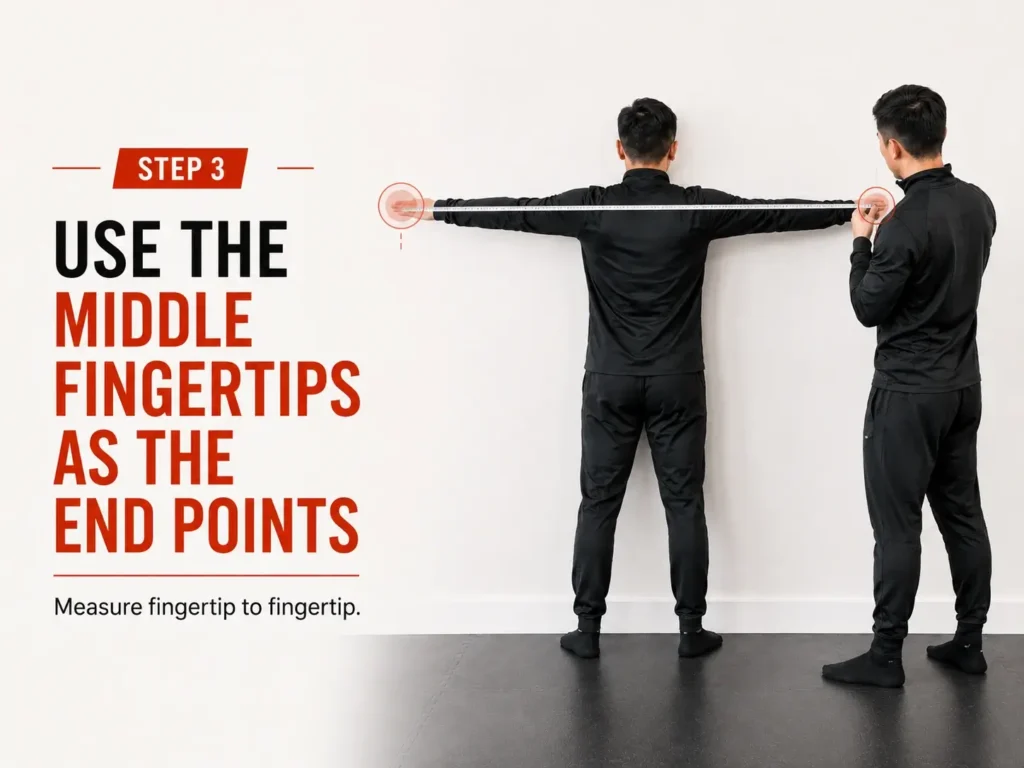
Step 3: Use the middle fingertips as the end points
Your partner should measure from the tip of one middle finger to the tip of the other middle finger. Do not measure from the knuckles, closed fists, or bent fingers. That gives the wrong number because boxing reach is based on full wingspan, not fist width.
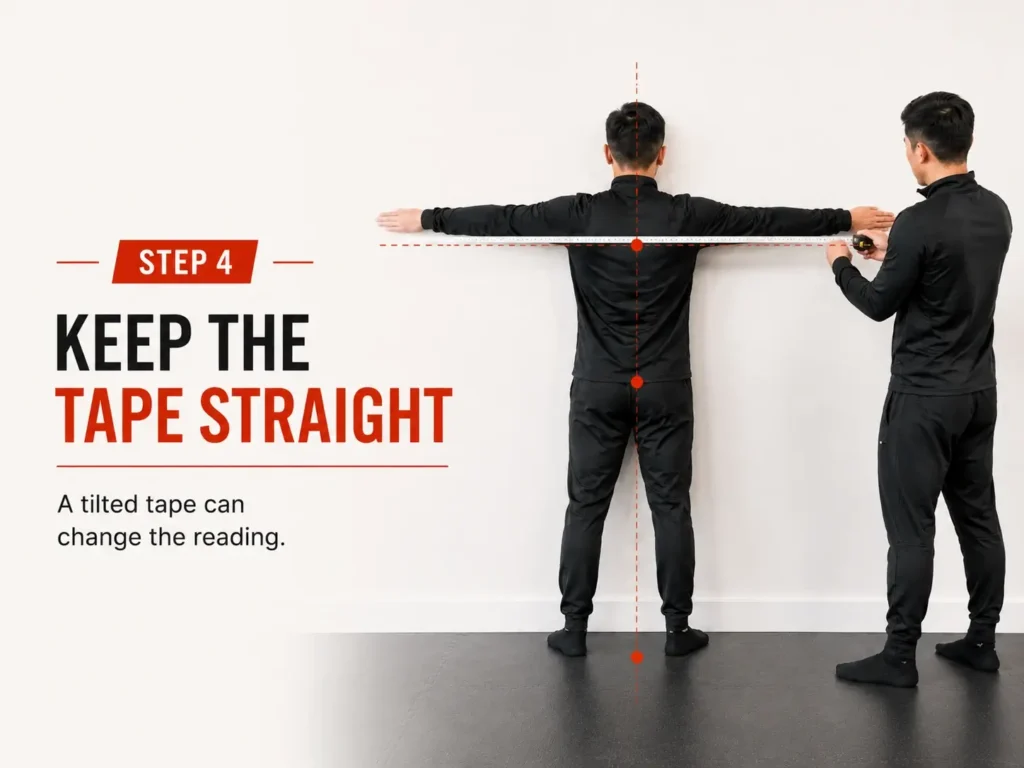
Step 4: Keep the tape straight
The tape should run in a straight line across your body at the same height as your arms. A good check is to make sure it passes around the center of your chest area, not too high, too low, or shifted to one side.
Step 5: Record the number
Read the measurement in inches or centimeters. The average reach is usually around 71 inches. Do not round too much. For best results, reset your posture and measure three times. Then use the average as your final reach.
Can You Measure Reach Alone Through Solo Wall Marks?
Yes, but it is less accurate. Stand against the wall in the same T shape and mark where each middle fingertip lands using removable tape or a pencil mark.
Then step away and measure the distance between the two marks. A mirror can help you check if your arms stayed level. If possible, use the solo method only as a quick estimate, then confirm it later with a partner or coach.

Understanding Your Numbers: What They Mean
Your reach number tells you how much space you can cover when your arms are fully extended. It helps you understand your natural range, but it should not be treated like a final answer to your boxing style.
A 74-inch reach sounds long, but it means something different for a 5’8″ boxer than it does for a 6’3″ boxer.
That is where your ape index helps.
What Is Ape Index?
Ape index compares your reach to your height. It shows whether your arms are longer, equal to, or shorter than your body height.
Use this formula:
Ape Index = Reach ÷ Height
Use the same unit for both numbers. If your height is in inches, your reach should also be in inches. If your height is in centimeters, use centimeters for reach too.
For example, if your reach is 72 inches and your height is 70 inches:
72 ÷ 70 = 1.03
That means your reach is slightly longer than your height.
Positive, Neutral, and Negative Ape Index
- Positive ape index (Above 1.00): Your reach is longer than your height. It can help with jabs, straight punches, and keeping range.
- Neutral ape index (1.00): Your reach and height are almost the same. It usually gives you a balanced base for outside, mid-range, or inside boxing.
- Negative ape index (Below 1.00): Your reach is shorter than your height. It may push you toward pressure, angles, body shots, hooks, and inside work.
How This Helps Your Training
If you have a longer reach for your height, you may want to spend more time building a strong jab, straight punches, and footwork that keeps you at your best distance. You do not need to rush into close range if your reach already gives you space.
If your reach is shorter, do not see it as a problem. It simply means you may need to work harder on closing distance safely. Head movement, step-ins, angles, and body shots become more important.
You can also use your number for small training choices, such as how far you stand from the bag, how much step you need behind your jab, and where your natural punching range begins.
Benchmarking Against Elite Fighters
| Fighter | Height | Reach | Ape Index |
|---|---|---|---|
| Tyson Fury | 81 in / 206 cm | 85 in / 216 cm | 1.05 |
| Deontay Wilder | 79 in / 201 cm | 83 in / 211 cm | 1.05 |
| Anthony Joshua | 78 in / 198 cm | 82 in / 208 cm | 1.05 |
| Oleksandr Usyk | 75 in / 191 cm | 78 in / 198 cm | 1.04 |
| Terence Crawford | 68 in / 173 cm | 74 in / 188 cm | 1.09 |
| Floyd Mayweather Jr. | 68 in / 173 cm | 72 in / 183 cm | 1.06 |
| Canelo Alvarez | 67.5 in / 171 cm | 70.5 in / 179 cm | 1.04 |
| Manny Pacquiao | 65.5 in / 166 cm | 67 in / 170 cm | 1.02 |
| Mike Tyson | 70 in / 178 cm | 71 in / 180 cm | 1.01 |
| Gervonta Davis | 65.5 in / 166 cm | 67.5 in / 171 cm | 1.03 |
A fighter with a high ape index usually has more natural range for their height. It can support a jab-heavy outside style. A fighter closer to 1.00 may still be very effective, but they may rely more on timing, head movement, pressure, and clean entries.
Also, do not compare yourself only to famous fighters. Compare your reach to your own height first. That tells you more about your natural range than raw reach alone.
Demi-Span vs. Shoulder-to-Fist Measurement
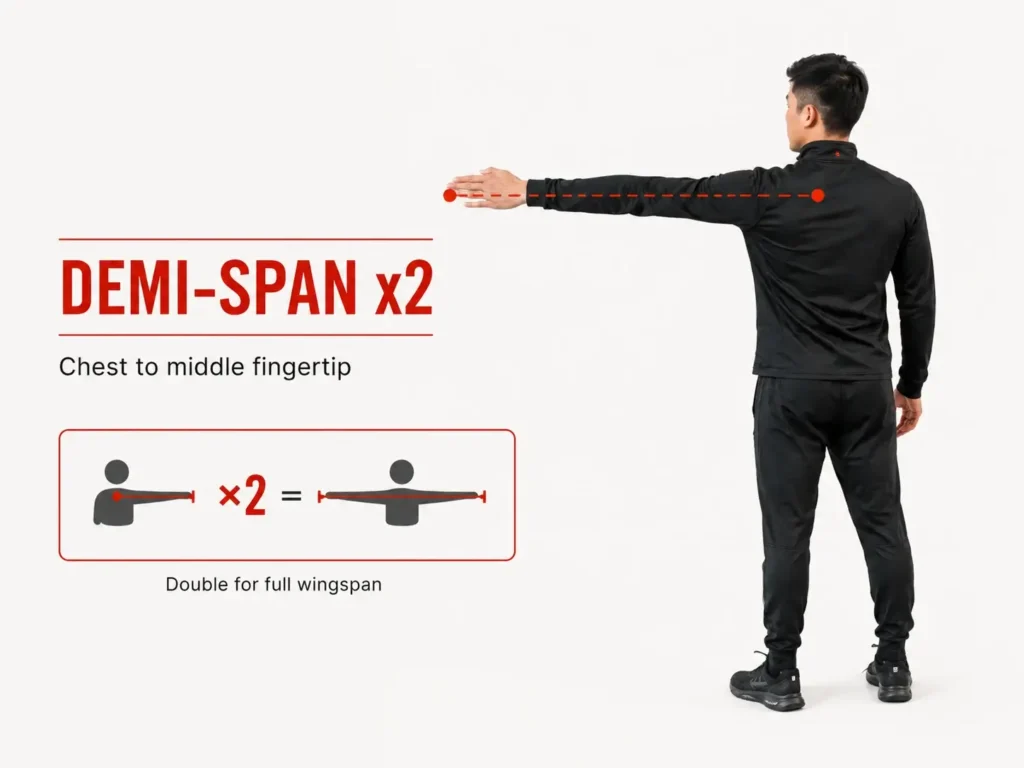
- Demi-span x2: It measures from the center of the chest to the middle fingertip on one side, then doubles the number. It can help when space is limited or when a full fingertip-to-fingertip measurement is hard to do. The downside is that if the first half is off, the final number becomes more off because the error gets doubled.
- Shoulder-to-fist: It measures one arm from the shoulder area to the fist. It can be useful for understanding punching range, arm length, and technique. But it is not the same as boxing reach because it does not include shoulder width or the full wingspan.

For official-style reach comparison, use the full wingspan method. Use demi-span only as a backup, and use shoulder-to-fist as a training note.
Common Measurement Errors and Fixes
- Head coming off the wall: If your head leans forward, your upper back can round and shorten the measurement. Keep the back of your head lightly touching the wall and keep your chin neutral.
- Slouching: A rounded upper back can pull your shoulders out of position. Stand tall before your arms go up. Do not force your chest out, just keep your posture straight and natural.
- Bent elbows: Even a small bend can reduce your reach number. Keep your elbows straight, but do not push them backward or overextend them.
- Arms not level: One arm higher than the other can change the reading. Keep both arms at shoulder height and ask your partner to check from eye level.
- Shoulders pulled back too hard: Squeezing your shoulder blades together can make your reach look shorter. Think about reaching gently toward both side walls instead.
- Measuring from fists or knuckles: It gives the wrong number. Boxing reach should be measured from the tip of one middle finger to the tip of the other.
- Tape angled or sagging: A tilted tape can add or remove distance. Keep the tape straight and level from fingertip to fingertip.
- Measuring after hard training: Your posture may be tired, and your number can come out slightly shorter. For a cleaner result, measure before training and use the same setup each time.
- Only measuring once: One attempt can be off because of posture or tape position. Measure three times, reset your stance each time, and use the average.
What if You Have a Short Reach?
A short reach means you may have to fight in a smarter, closer range.
If your opponent can touch you before you can touch them, staying outside too long is usually a bad idea. You will spend too much time reaching, chasing, or eating jabs on the way in.
Shorter-reach boxers often do better when they close the gap, work from angles, and make the fight uncomfortable for longer-armed opponents. The goal is not to stand in front of them but to get past the end of their punches and work where their long arms are less useful.
How to Make the Most of It
Use your feet first. Step in behind a jab, feint, or head movement instead of walking straight forward. A straight line makes you easy to hit.
Work on slipping and rolling under punches so you can enter safely. Once you are inside, do not admire your work. Throw short combinations, attack the body, and move your head after punching.
Hooks, uppercuts, and body shots are often better tools for a shorter-reach boxer than long, reaching punches. Keep your punches compact and stay balanced.
Short reach only becomes a problem if you fight like a long-range boxer. Build your style around pressure, angles, defense, and clean inside work.
You still need patience. Closing distance takes timing. If you rush, you run into punches. If you enter behind defense and footwork, your shorter reach can become part of a strong pressure style.
FAQs
What is considered a good reach in boxing?
A good reach in boxing depends on your height, weight class, and fighting style. A good reach is usually equal to or longer than your height. Reach is measured fingertip to fingertip, and a reach longer than your height is called a positive ape index.
Is 71 inch reach good?
Yes, a 71-inch reach is good for many boxers, but it depends on your height and weight class.
If you are around 5’8″ to 5’11”, a 71-inch reach is solid and can give you good range for jabs and straight punches. If you are shorter than that, 71 inches may be a very good reach. But if you are a tall fighter, especially in heavier weight classes, 71 inches may be average or even short compared with bigger opponents.
71 inches is around the average reach among many successful champions across weight classes, so it is not a bad number at all.
Is 180cm reach good?
Yes. 180cm reach is about 70.9 inches, so it is basically the same as 71 inches. It is good if you are around 173-180cm tall, and very good if you are shorter than that.
Summing Up
Your boxing reach number can teach you a lot about your natural range. Use the standard wingspan method, record it properly, and compare it with your height for better context.
A longer reach can help with distance control, while a shorter reach can work well with pressure and inside fighting. In the end, reach is only one part of boxing. Footwork, timing, defense, and good coaching matter more.