

Which punching bag do you actually need for your training?
A hanging heavy bag builds power and endurance, but it will not sharpen your reactions like a double-end bag.
A speed bag improves rhythm and coordination, while a maize bag helps with slipping and head movement. Each bag has a clear purpose, and selecting the wrong one can waste space, money, and training time.
The guide explains the main types of punching bags, what each one trains, how much room it needs, and which option makes sense for your goals.
Which Punching Bag Do You Need?
For most beginners, the best first choice is:
- Hanging heavy bag: Best for power, technique, combinations, and conditioning
- Freestanding bag: Best when you cannot drill into a wall or ceiling
- Speed bag: Best for rhythm, hand coordination, and shoulder endurance
- Double-end bag: Best for accuracy, timing, and defensive reactions
- Maize bag: Best for slipping, ducking, and head movement
- Uppercut bag: Best for short hooks and uppercuts
- Teardrop bag: Best for body punches, knees, elbows, and angled strikes
- Aqua bag: Best for a softer impact feel
- Banana bag: Best for Muay Thai, low kicks, knees, and full-body combinations
A standard heavy bag gives a new boxer the broadest range of useful drills. A freestanding model is the practical alternative when permanent mounting is not possible.
Table of Contents
1. Traditional Hanging Heavy Bag
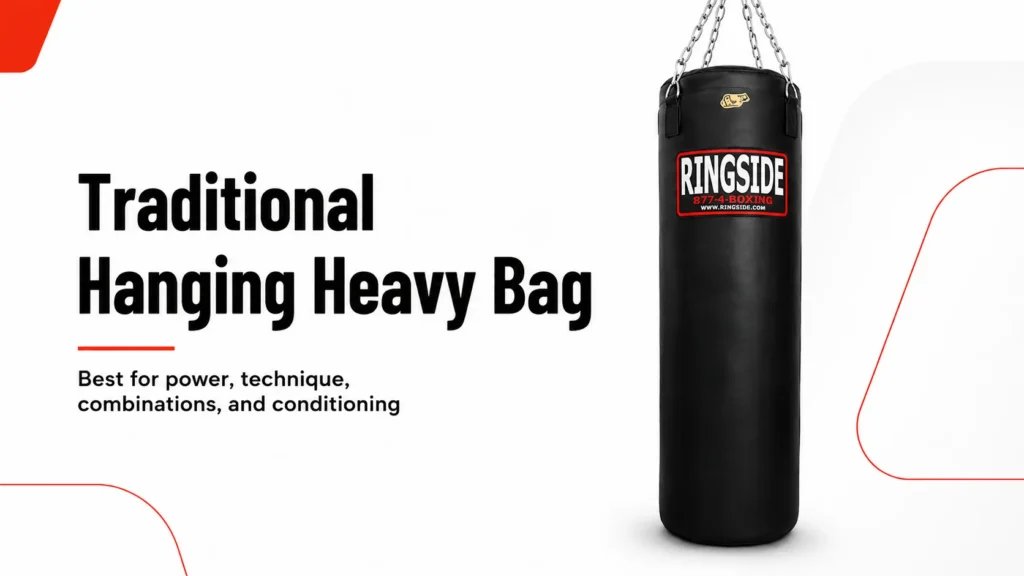
What Is a Hanging Heavy Bag?
This is the long cylindrical bag seen in most boxing gyms. It hangs from a ceiling beam, wall bracket, or heavy bag stand.
Depending on the model, it may contain compressed fabric, foam, rubber, sand pockets, water, or a mix of materials.
The hanging heavy bag is the most useful starting point because it supports basic punches, combinations, body shots, footwork, and conditioning.
What Is It Best For?
A hanging heavy bag is mainly used for:
- Building controlled punching power
- Practising jabs, crosses, hooks, and uppercuts
- Linking punches into combinations
- Improving balance while striking
- Working around a moving target
- Building shoulder, arm, leg, and core endurance
- Training punches, kicks, elbows, and knees on longer models
A heavy bag moves after a hard strike, but it does not react as quickly as a double-end or reflex bag. You still need to move your feet, reset your stance, and control the bag instead of chasing it around the room.
What Weight Should You Choose?
The common starting rule is to choose a heavy bag close to half your body weight. This is only a rough guide, not a fixed rule.
Current manufacturer guidance commonly places bags into these broad ranges:
- 40 to 70 pounds: Light fitness work and new users
- 70 to 100 pounds: Regular boxing and kickboxing training
- 100 to 150 pounds or more: Hard power work, MMA, and Muay Thai
A lighter bag moves more after each punch. That can help with distance and timing, but too much swing can interrupt combination practice.
A heavier bag gives more resistance and remains steadier when hit hard. It also puts more load on the mount and supporting structure.
What Length Should You Choose?
The right length depends on the strikes you plan to practise.
- 3 to 4 feet: Boxing punches and upper-body combinations
- 4 to 5 feet: Boxing with some kicks and knees
- 5 to 6 feet: Muay Thai, MMA, low kicks, and full-body striking
A shorter bag is usually enough for boxing. A long Thai-style bag is better when you need a target for low kicks and knees.
Pros
- Handles hard punches and combinations
- Works for beginners and skilled fighters
- Allows movement around the bag
- Useful for boxing, kickboxing, Muay Thai, and MMA
- Provides better resistance than most freestanding bags
Limits
- Requires a secure structure or large stand
- Sends vibration into walls, beams, or floors
- Needs enough open space for movement and swing
- Does not react quickly enough for serious reflex training
- Poor filling can create hard or uneven areas
Setup Advice
Do not attach a heavy bag to drywall, thin ceiling boards, or an unknown beam.
Use a mount with a stated load rating that covers the filled bag and the extra force created when it swings. Check the bag manufacturer’s instructions and get help from a qualified installer when the structure is uncertain.
Leave enough room to circle the bag without hitting walls, lights, shelves, or furniture.
2. Speed Bag
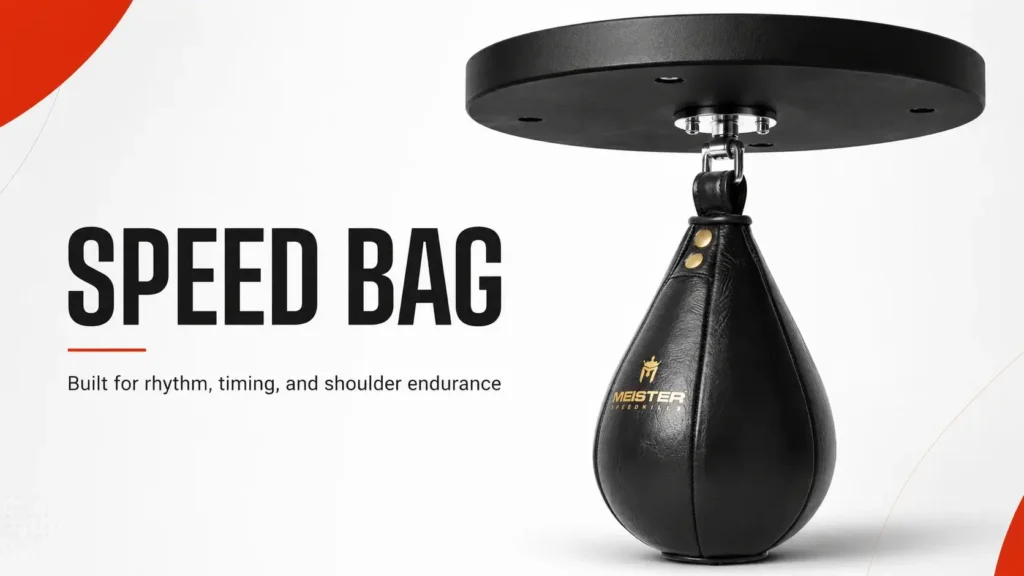
What Is a Speed Bag?
A speed bag is a small, air-filled bag attached to a swivel beneath a solid platform.
When struck, it rebounds against the platform. The boxer maintains a steady pattern by hitting it again as it returns.
The speed bag is not a power tool. It is used for rhythm, repeated hand movement, coordination, and shoulder endurance.
What Does It Improve?
Regular speed bag drills can help you work on:
- Hand-eye coordination
- Punching rhythm
- Timing
- Hand control
- Shoulder endurance
- Keeping your hands raised while tired
- Left- and right-hand coordination
The bag is too small and light for meaningful power practice. It also does not teach full punching technique because the hand motion used on a speed bag differs from a normal jab or cross.
Speed Bag Height
The bag should generally sit slightly above eye level, with the bottom area close enough for you to strike without reaching upward or dropping your elbows.
Adjustable platforms are useful when several people use the same setup. Title standard platforms can be adjusted to suit users of different heights, while some places the bag slightly above eye level.
Beginner Technique
Start slowly.
- Stand square to the bag.
- Keep your elbows raised.
- Make a small circular motion with one hand.
- Strike the rounded lower area of the bag.
- Let it hit the platform three times before striking again.
- Build a steady rhythm before switching hands.
- Add speed only after the timing feels controlled.
Pros
- Requires little floor space
- Builds rhythm and shoulder endurance
- Helps both hands work together
- Suitable for short training rounds
- Available in different sizes for different skill levels
- Larger speed bags generally move more slowly and are easier for beginners. Smaller bags rebound faster and require better timing.
Limits
- Requires a solid platform
- Can create repetitive noise through a shared wall
- Does not build heavy punching power
- Offers little help with body punches or footwork
- Poor swivels can make the rebound inconsistent
3. Double-End Bag
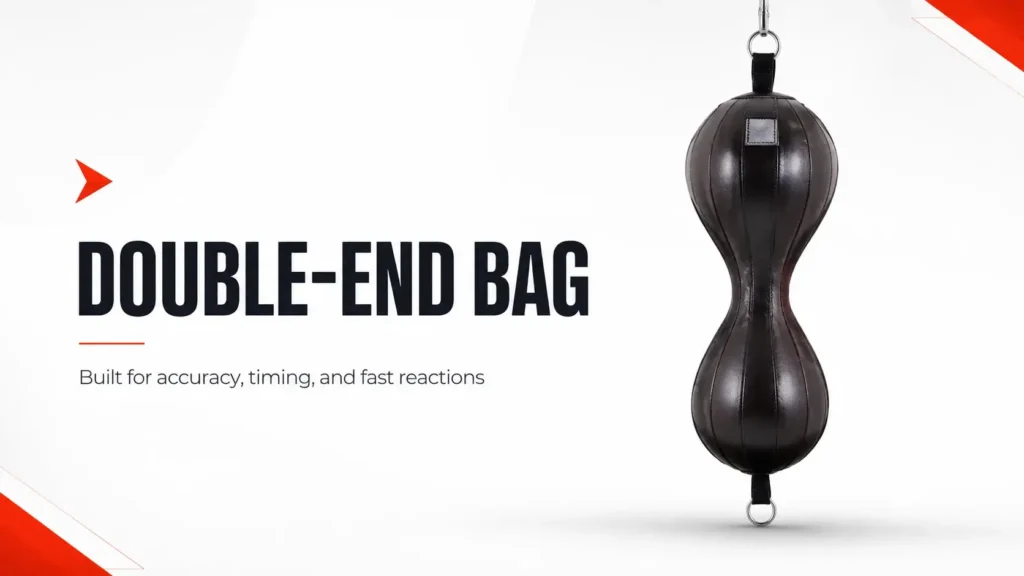
What Is a Double-End Bag?
A double-end bag is a small bag held between two elastic cords. One cord connects above the bag, while the other connects to the floor or a weighted anchor.
After you punch it, the bag snaps away and returns quickly.
That movement forces you to hit with more care. It also makes you react after every combination.
What Does It Train?
The double-end bag is useful for:
- Punch accuracy
- Timing
- Fast reactions
- Distance control
- Short combinations
- Slipping after punching
- Parrying and countering
- Maintaining balance against a moving target
The target is much smaller than a heavy bag. Poorly aimed punches miss, while wide punches leave you out of position.
Is It Only for Skilled Boxers?
No. A beginner can use a double-end bag, but the setup should be forgiving.
Use a larger bag and reduce the cord tension at first. The slower return gives you more time to see the movement and respond.
As your control improves, tighten the cords or switch to a smaller target. It is useful for rhythm, timing, technique, and accuracy across different training levels.
Basic Drill
Try this simple pattern:
- Throw a jab.
- Let the bag return.
- Throw a cross.
- Move your head outside the return line.
- Reset your stance.
- Repeat without rushing.
Do not stand still and slap at the bag. Punch, defend, move, and reset.
Pros
- Takes up little space
- Usually costs less than a full heavy bag setup
- Develops accuracy and defensive habits
- Cord tension can be adjusted
- Useful for boxing and striking practice
Limits
- Requires both an upper and lower anchor
- Can feel frustrating at first
- Does not provide enough resistance for power work
- Poor-quality cords may stretch unevenly
- The bag can move too fast when the tension is excessive
4. Maize Bag or Slip Bag
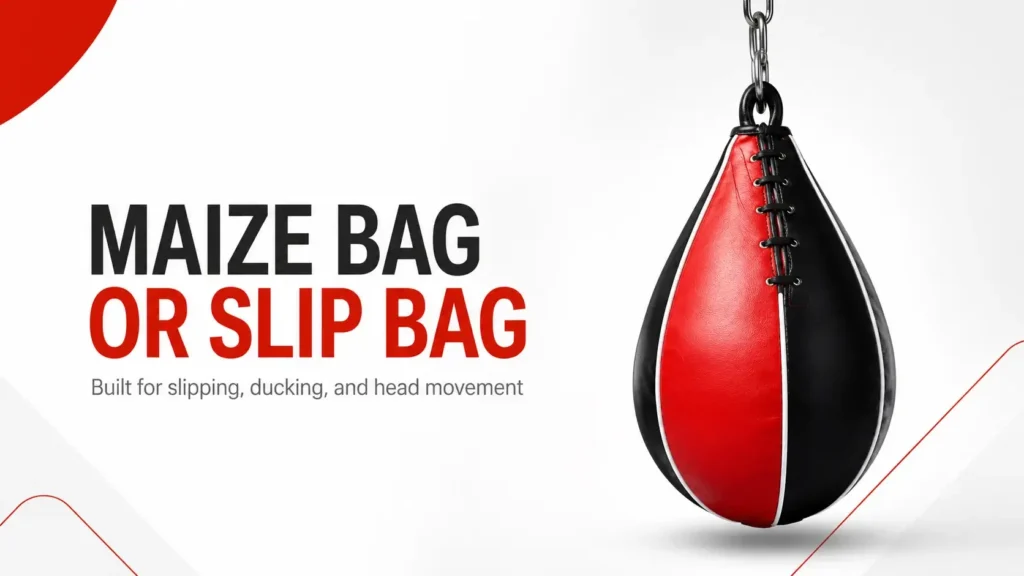
What Is a Maize Bag?
A maize bag is a small hanging bag used mainly for defensive head movement.
Traditional versions were filled with dried corn. Current models may use beads, fabric, or other synthetic filling.
Some maize bags have a short teardrop shape. Others look like a small weighted ball.
What Is It Best For?
The maize bag helps with:
- Slipping left and right
- Ducking under punches
- Bobbing and weaving
- Maintaining balance during head movement
- Moving the head without pulling the body out of position
- Adding counters after a defensive movement
There are both larger maize bags and smaller slipping bags for head-movement practice, and the shape can vary between models.
How to Use It
Start without punching.
- Give the bag a light push.
- Let it swing toward your head.
- Move just far enough to let it pass.
- Return to your stance.
- Slip to the other side on the next swing.
- Add a duck or weave after the movement feels natural.
- Add a short counter only after you can remain balanced.
The goal is not to make large movements. A good slip is small, controlled, and followed by a quick return to position.
Pros
- One of the best tools for repeated head-movement practice
- Requires little space
- Produces less impact noise than a heavy bag
- Helps you stay relaxed while an object moves toward you
- Can be used for close-range defensive drills
Limits
- Does not build punching power
- Requires a ceiling point or hanging frame
- Can teach poor movement if hung at the wrong height
- Large, exaggerated slips may create bad habits
- Not a replacement for coached partner drills
5. Uppercut Bag and Wall Bag
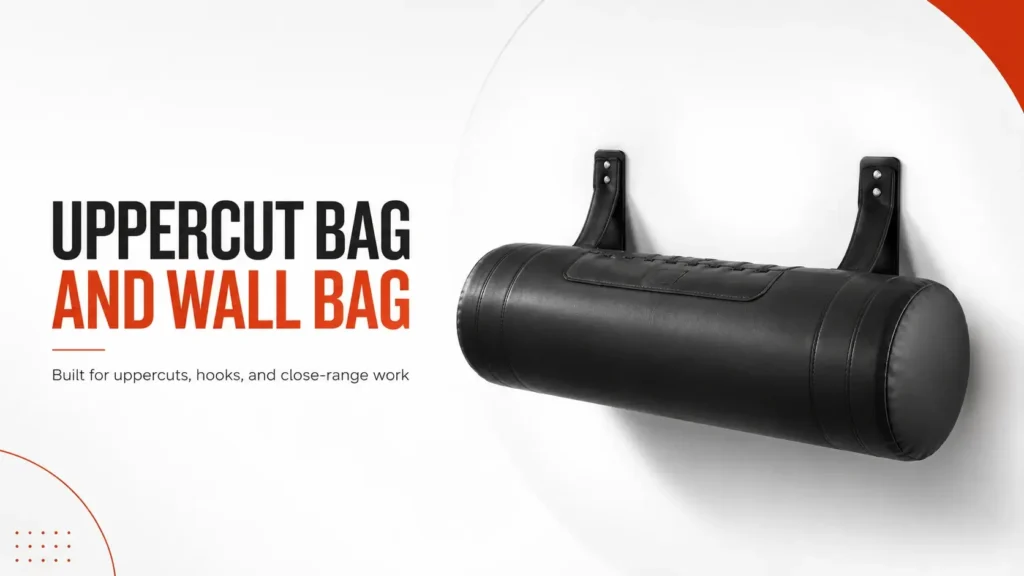
What Is an Uppercut Bag?
An uppercut bag provides a surface that can be struck from below.
Some models are horizontal cylinders suspended from a mount. Others are wall pads with raised or angled striking areas.
Both designs make it easier to practise uppercuts than a straight vertical heavy bag.
What Does It Train?
An uppercut or wall bag works well for:
- Left and right uppercuts
- Short hooks
- Body hooks
- Hook-uppercut combinations
- Close-range punching
- Hip rotation
- Short punches without wide arm movement
Specialty bag makers offer angled and raised surfaces specifically for hooks, uppercuts, body punches, and close-range combinations.
Technique Warning
Do not lift the punch using only your arm.
Bend slightly through the knees, turn the hips, and let the fist rise through the target. Keep the wrist straight and avoid forcing the elbow beyond a comfortable range.
Wall Bag vs. Hanging Uppercut Bag
A wall bag stays fixed. That makes it good for repeated combinations and hard strikes, but it offers no swing or footwork response.
A hanging uppercut bag moves after impact. It lets you work from slightly different positions, though it needs more room and a strong mount.
Pros
- Better uppercut surface than a straight heavy bag
- Useful for body punches and short hooks
- Wall models save floor space
- Supports high-volume combination drills
- Gives clear target areas
Limits
- Less useful for long straight punches
- Wall models offer no movement
- A missed punch may hit the wall or frame
- Poor uppercut form can strain the wrist or elbow
- Good models may cost more than a basic heavy bag
6. Teardrop Bag or Body Bag
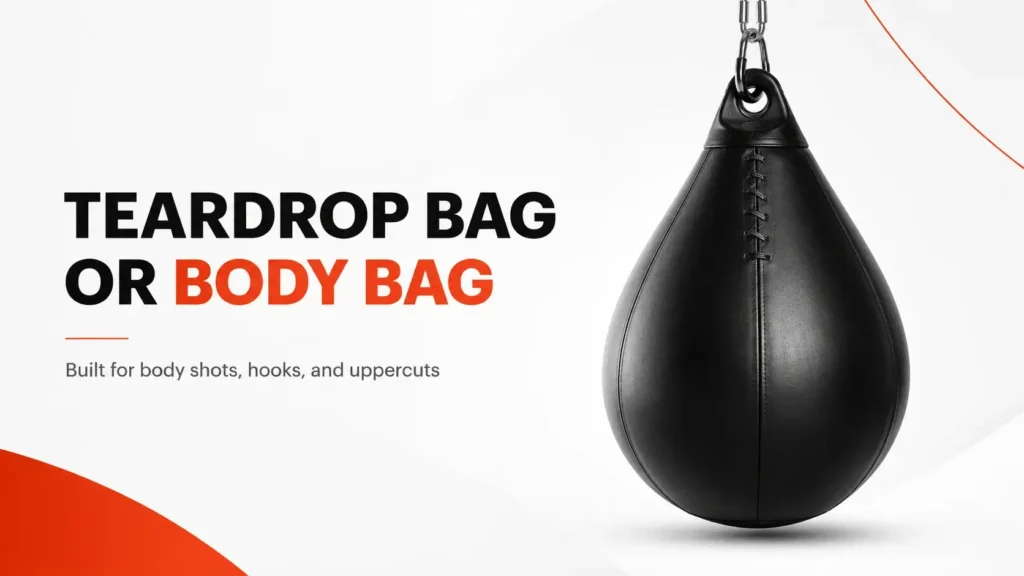
What Is a Teardrop Bag?
A teardrop bag has a wide upper or middle section and a narrower hanging point. Its rounded shape can be attacked from below, from the side, or at an angle.
It is useful for hooks, uppercuts, body punches, knees, and elbows.
The naming can be confusing. Some sellers use the terms teardrop bag, body bag, angle bag, and wrecking ball bag for products with similar shapes. Check the actual size, weight, and hanging position rather than relying only on the product name.
What Does It Train?
A teardrop bag is good for:
- Hooks to the body
- Uppercuts
- Overhand punches
- Knees
- Elbows
- Short combinations
- Head-to-body level changes
- Striking while moving around the target
Its curved surface creates more natural body-shot angles than a straight cylindrical bag.
Pros
- Supports more striking angles than a standard heavy bag
- Useful for boxing, MMA, and Muay Thai
- Good for knees, elbows, hooks, and uppercuts
- Encourages movement around the target
- Can provide solid resistance without a full-length bag
Limits
- Usually less useful for low kicks
- Requires a secure hanging point
- Shape and weight differ widely between brands
- Can swing sharply after side strikes
- Often costs more than a standard cylindrical bag
7. Aqua Bag or Water Bag
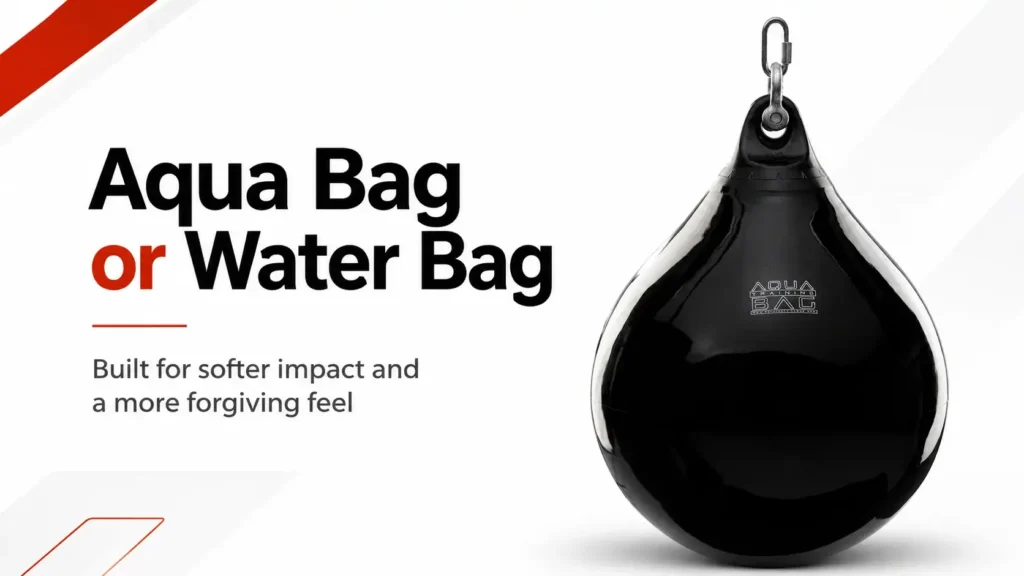
What Is an Aqua Bag?
An aqua bag is filled with water instead of compressed cloth or foam.
Most are made from thick vinyl or a similar flexible material. The water moves and spreads the force of each strike across the bag. It produces a different feel from a tightly packed textile bag.
Does It Protect Your Joints?
A water-filled bag often feels more forgiving because the surface gives under impact and the water spreads the force.
Manufacturers describe this design as having greater shock absorption than traditional dense filling. That may feel better on the knuckles, wrists, elbows, and shoulders, but it does not make poor technique safe.
You still need proper hand wraps, suitable gloves, controlled alignment, and a gradual warm-up.
What Is It Best For?
An aqua bag is useful for:
- Hard punches with a softer contact feel
- Hooks and uppercuts
- Body-shot drills
- Longer sessions for people who dislike very hard bag surfaces
- Boxing and fitness training
- Training spaces where a softer impact sound is preferred
The strike itself may sound softer than a dense fabric bag. The chain, swivel, ceiling mount, or stand can still send noise and vibration through the building.
Pros
- More forgiving contact than many tightly packed bags
- Water is easy to add at home
- Can be emptied before transport
- Rounded models work well for hooks and uppercuts
- Filling does not settle into hard cloth pockets
Limits
- Very heavy after filling
- Requires a mount rated for the full filled weight
- Leaks are possible if the shell or plug is damaged
- Cold temperatures can affect the water and outer material
- Surface texture may feel uncomfortable during bare-knee or elbow work
8. Wrecking Ball Bag
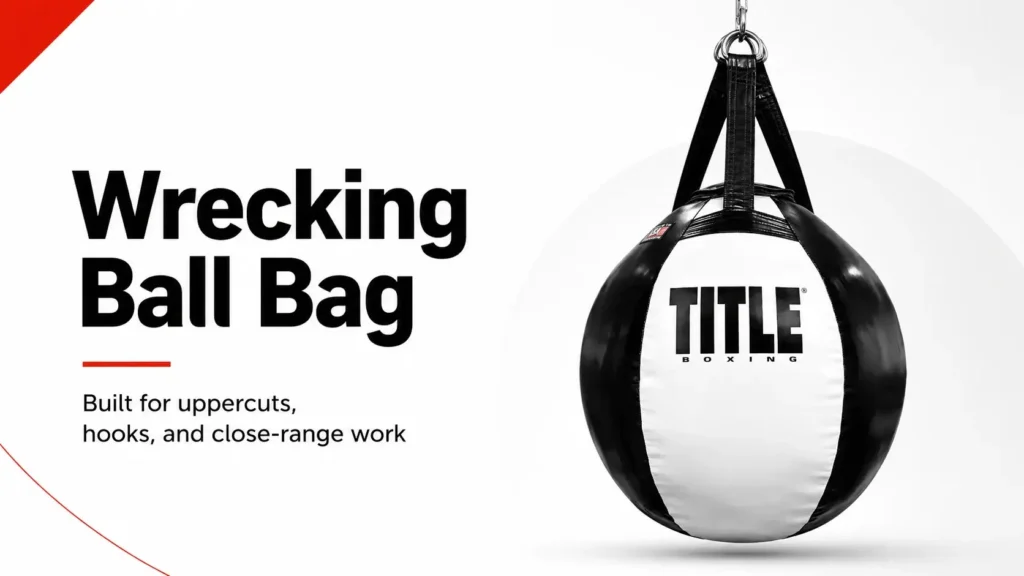
What Is a Wrecking Ball Bag?
A wrecking ball bag is a compact, round or bulb-shaped hanging bag.
It normally has more mass than a small teardrop reflex bag. Its curved lower surface gives you room to throw uppercuts, while the sides support hooks and overhand punches.
What Is It Best For?
Use it for:
- Uppercuts
- Tight hooks
- Overhand punches
- Close-range combinations
- Stepping around the target
- Short angle changes
- Bob-and-weave drills around the bag
It gives you more movement than a fixed wall bag while taking less vertical space than a long heavy bag.
Pros
- Useful in rooms with limited ceiling height
- Provides clear uppercut angles
- Allows movement around the full bag
- Good for short-range boxing
- Takes up less space than a long heavy bag
Limits
- Not useful for low kicks
- Moves more than a fixed uppercut bag
- Dense models can be hard on the hands
- Requires a secure overhead mount
- Short shape provides less room for long combinations
9. Freestanding Punching Bag
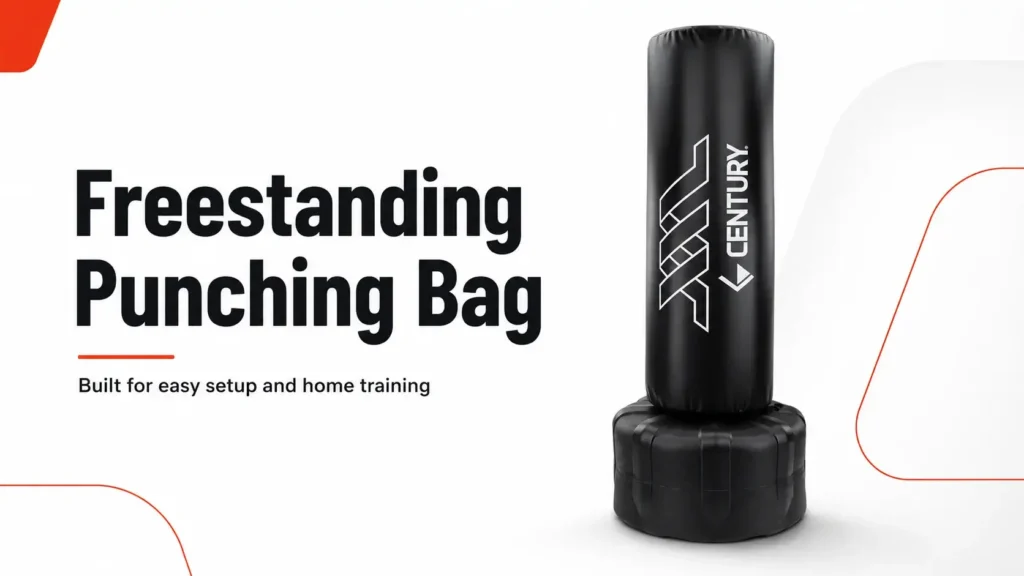
What Is a Freestanding Bag?
A freestanding bag sits on a wide floor base rather than hanging from a wall or ceiling.
The base is usually filled with water, sand, or both. Many models also have a flexible neck that bends or sways after impact.
Who Should Choose One?
A freestanding bag makes sense when:
- You rent your home
- You cannot drill into the structure
- You need to move the bag after training
- Several users need different height settings
- You want a simple home fitness setup
- You train with light to moderate power
Freestanding bags are easier to install and move, but they are generally less stable than hanging bags during hard strikes.
Water vs. Sand in the Base
Water is quick to add and easier to remove. It can slosh, leak, or allow the base to move during hard rounds.
Sand takes longer to add and makes the unit much harder to move. It usually provides better stability because more weight can fit inside the base.
Pros
- No ceiling or wall mount
- Fast initial setup
- Can be moved when empty or partly filled
- Good for rented homes
- Many models support both punches and kicks
- Height may be adjustable
Limits
- Base can slide, rock, or tip
- Takes up more floor space than expected
- Hard kicks can move light models
- Base impact can create noise downstairs
- Does not swing like a hanging bag
- Moving a sand-filled base is difficult
Place a thick rubber mat beneath the base. It can reduce sliding, floor damage, and some vibration.
10. Banana Bag or Muay Thai Heavy Bag
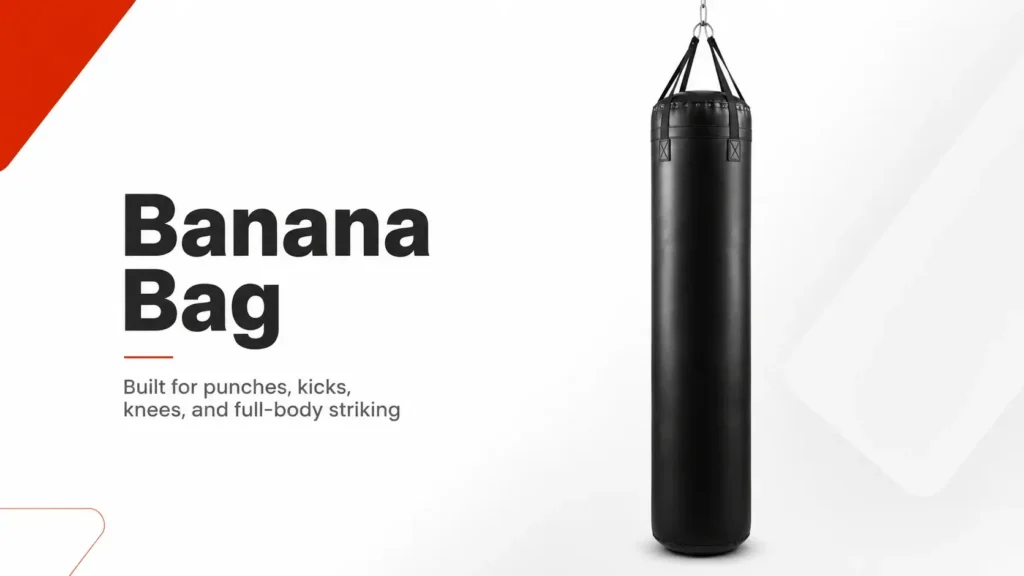
What Is a Banana Bag?
A banana bag is a long, narrow heavy bag that usually hangs close to the floor.
Its length provides a target for punches, body kicks, low kicks, knees, and high kicks.
What Is It Best For?
This is one of the strongest choices for:
- Muay Thai
- Kickboxing
- MMA striking
- Low-kick practice
- Body kicks
- Knees
- Punch-to-kick combinations
Current size guidance places 5 to 6-foot bags in the full-body striking group because they allow low kicks and knees as well as punches.
Limits
A banana bag needs more vertical space and a strong mount. It is also less convenient for pure boxing because you may pay for extra length that you rarely use.
11. Angled Heavy Bag
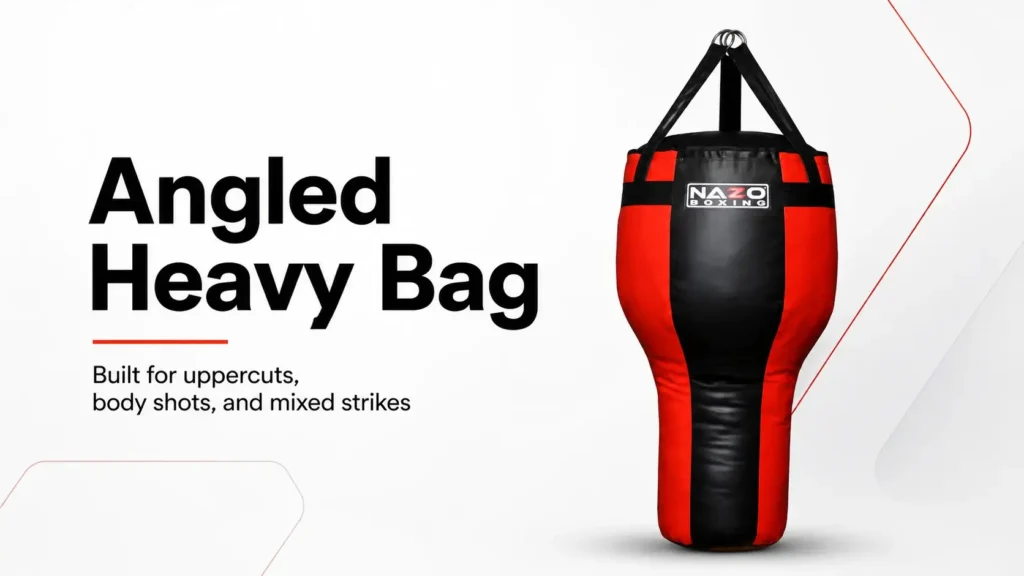
An angled heavy bag is wider near the top and narrower lower down. That change in shape creates surfaces for uppercuts, hooks, body punches, knees, and kicks.
It offers more striking options than a basic straight bag, but it may not move as naturally for simple jab-cross work.
Choose it when uppercuts and body combinations are a major part of your training.
12. Body Opponent Bag
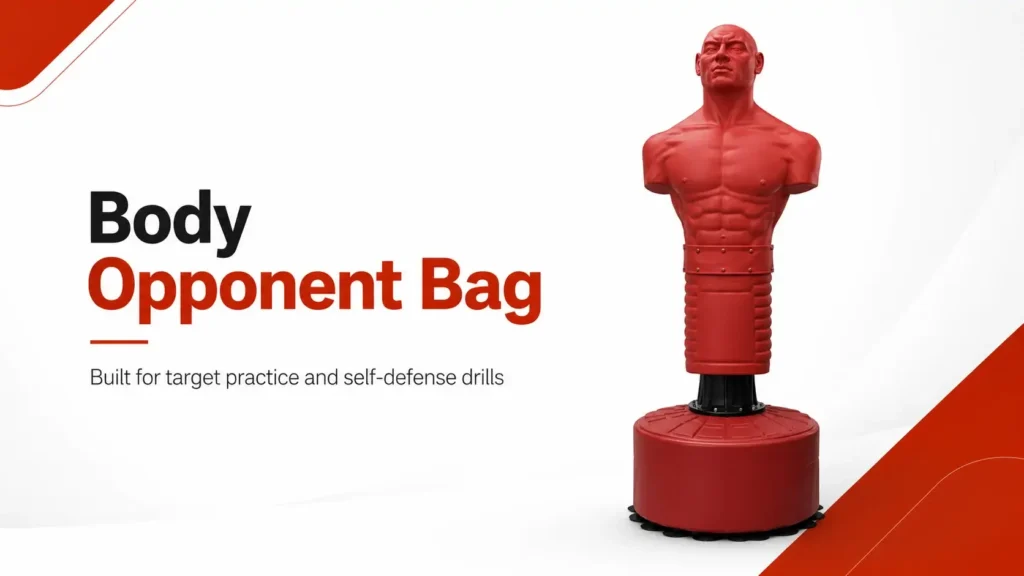
A body opponent bag, often called a BOB, is shaped like a human head and torso. It normally attaches to a freestanding base.
The human form gives you clear targets for the chin, jaw, nose, ribs, chest, and abdomen. That makes it useful for accuracy drills and self-defence practice.
Its main limit is movement. It does not swing or react like a live person, and repeated hard strikes may cause the base to shift.
13. Reflex Bag or Cobra Bag
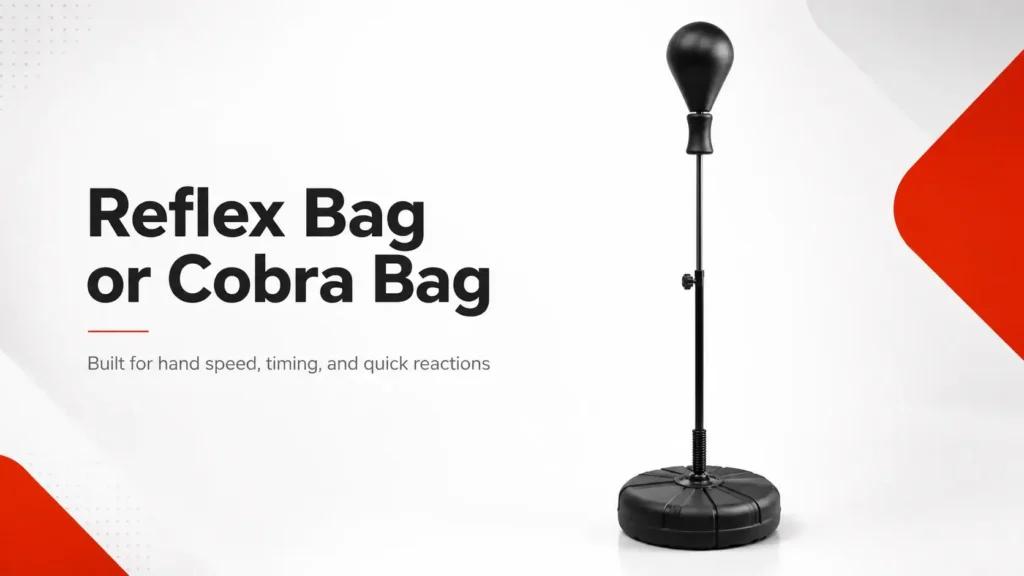
A reflex bag has a small target mounted on a flexible pole or spring.
After it is hit, the target moves away and returns quickly. It is mainly used for hand speed, timing, accuracy, and quick defensive responses.
It is not built for repeated full-power punches.
Freestanding reflex bags are easy to move and require no ceiling mount. Their small target and fast return can feel difficult for a complete beginner, so start slowly and focus on clean contact.
14. Pole Bag
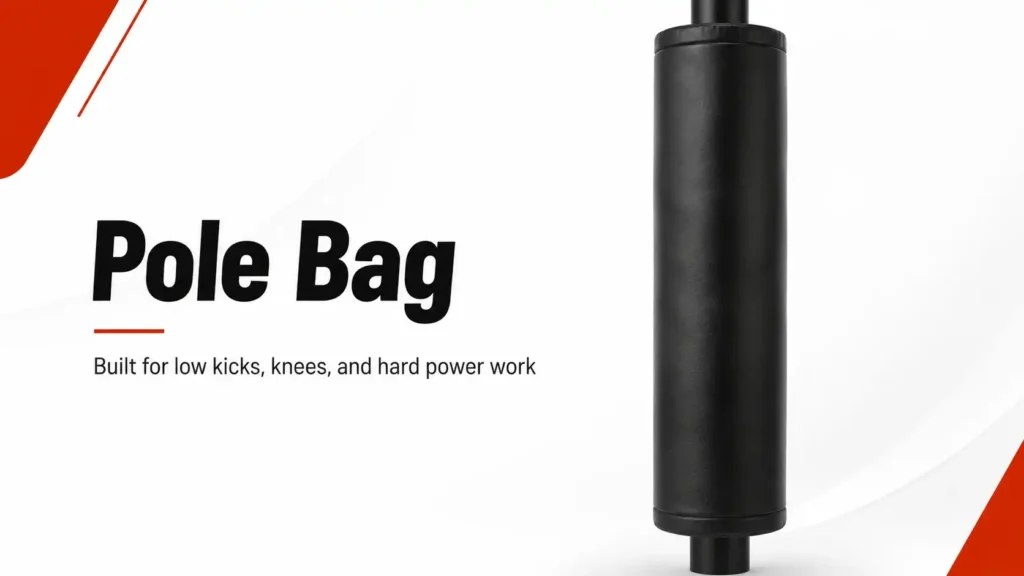
A pole bag is a large, dense bag secured around a permanent vertical post.
It provides strong resistance for punches, knees, and low kicks. Because it is heavy and fixed, it is normally better suited to a commercial gym or a permanent training room.
It is not a practical choice when you need to move equipment or protect rented property.
Let’s Compare the Punching Bags
| Bag type | Best for | Power work | Movement | Space needed | Setup |
|---|---|---|---|---|---|
| Hanging heavy bag | Power, combinations, conditioning | High | Medium | Medium to large | Ceiling, wall, or stand |
| Freestanding bag | Home fitness, basic punches and kicks | Medium | Low | Medium | Weighted floor base |
| Speed bag | Rhythm, coordination, shoulder endurance | Low | Fast rebound | Small | Wall platform or frame |
| Double-end bag | Accuracy, timing, defensive reactions | Low | Very fast | Small | Upper and lower cords |
| Maize bag | Slipping, ducking, head movement | Low | Pendulum swing | Small | Ceiling mount |
| Uppercut or wall bag | Uppercuts, hooks, close-range work | Medium to high | None or low | Small to medium | Wall or ceiling |
| Teardrop bag | Body punches, knees, angled strikes | Medium to high | Medium | Medium | Ceiling or stand |
| Aqua bag | Softer impact feel, hooks, power | High | Medium | Medium | Ceiling or stand |
| Wrecking ball bag | Uppercuts, hooks, angle work | Medium to high | Medium | Small | Ceiling mount |
| Banana bag | Low kicks, knees, full-body striking | High | Low to medium | Large | Strong ceiling mount |
| Body opponent bag | Target accuracy and self-defence drills | Medium | Low | Medium | Weighted base |
| Reflex bag | Hand speed, timing, reactions | Low | Very fast | Small | Weighted base |
| Pole bag | Hard punches, knees, low kicks | Very high | None | Large | Permanent vertical post |
Skill labels are not strict. A beginner can use a double-end, maize, or speed bag when the drill is slowed down and the setup is adjusted properly.
Recommended Punching Bags by Training Goal


How to Choose the Right Punching Bag
1. Start With Your Main Training Goal
Choose the bag according to what you want to improve most.
For punching power:
Choose a hanging heavy bag, aqua bag, or heavy banana bag.
For hand speed and rhythm:
Choose a speed bag.
For accuracy and reactions:
Choose a double-end bag or reflex bag.
For head movement:
Choose a maize bag.
For hooks and uppercuts:
Choose an uppercut, teardrop, angled, or wrecking ball bag.
For Muay Thai or kickboxing:
Choose a long banana bag.
For a rented home:
Choose a freestanding bag.
For target accuracy:
Choose a body opponent bag.
2. Be Honest About Your Space
A hanging heavy bag needs open space around it. The bag swings, and you need room to step in, step out, and move around both sides.
A speed bag, maize bag, wall bag, or double-end bag fits more easily into a small area.
A freestanding bag needs no mounting, but its wide base can use more floor space than a hanging bag.
Measure before buying.
Check the ceiling height, floor area, wall strength, door clearance, lights, shelves, vehicles, and anything else that may enter the bag’s swing path.
3. Check the Full Installed Weight
Do not judge a bag only by its empty shipping weight.
An unfilled heavy bag may become much heavier after fabric, foam, or sand pockets are added. An aqua bag reaches its stated weight only after it is filled. A freestanding base may hold a large amount of sand or water.
Your mount, ceiling, wall, stand, and floor must support the final setup.
4. Think About Noise
Punching bags create two types of noise:
- The sound of the strike
- Vibration passing through the mount or floor
A heavy bag on a metal stand can rattle. A wall-mounted speed bag can send repeated tapping through the wall. A freestanding base can thump against the floor.
Use rubber mats, vibration pads, quality swivels, and secure bolts. Train at reasonable hours when you share walls or floors.
5. Compare the Bag Material and Filling
Leather:
Usually feels good, lasts well when cared for, and costs more.
Synthetic leather or vinyl:
Often costs less and is easier to clean. Quality varies widely.
Fabric filling:
Provides dense resistance but may settle.
Foam layers:
Can soften the outer striking surface.
Sand:
Adds weight but can create hard areas when packed poorly.
Water:
Spreads impact and does not settle like fabric.
Press different areas of a filled bag before buying when possible. Avoid a bag with rock-hard spots, major lumps, damaged seams, or a cover that feels too thin.
6. Count the Extra Costs
The bag price is only part of the setup.
You may also need:
- Ceiling or wall mount
- Swivel
- Spring
- Chains or straps
- Heavy bag stand
- Floor mat
- Base filling
- Hand wraps
- Bag gloves
- Installation help
A low-cost bag can become expensive after mounting. A more expensive freestanding model may cost less overall when it needs no structural work.
Setup and Safety Tips
Use Hand Wraps and Gloves
Do not hit a heavy bag hard with bare hands.
Wraps help support the wrist, knuckles, thumb, and small bones of the hand. 180-inch wraps are common for many adult boxers, while shorter wraps may suit lighter users and younger athletes.
Use proper bag gloves or training gloves with a secure wrist fit. The glove should not slide, fold at the wrist, or leave the knuckles pressed against thin padding.
Warm Up Before Hard Rounds
Begin with light punches, shoulder movement, wrist movement, and controlled footwork.
Do not start the first round at full force.
Increase speed and power after your body is warm and your punches are landing with a straight wrist.
Keep Your Wrist Aligned
The wrist should remain behind the fist at contact.
Do not let it bend inward, outward, or backward. Turn the fist according to the punch, keep the elbow in a safe line, and do not reach beyond your stable stance.
Stop When Something Feels Wrong
Muscle fatigue is expected. Sharp pain, swelling, numbness, tingling, or sudden wrist weakness is not.
Stop the session and assess your technique and equipment. Seek medical advice when pain is severe, follows a clear injury, or does not settle.
Inspect the Bag and Mount
Check these parts regularly:
- Ceiling or wall bolts
- Chains and straps
- Swivel
- Springs
- Stitching
- Bag cover
- Hanging loops
- Freestanding base
- Water plugs and seals
- Speed bag bladder
Stop using the equipment when a mount is loose, a chain is damaged, or the bag is close to tearing.
Keep the Bag Clean
Wipe sweat from the outer cover after training. Use a cleaning method approved for the bag material.
Let gloves and wraps dry fully. Wash reusable wraps regularly. Damp equipment can develop odour and damage sooner.
Final Verdict
A hanging heavy bag is the best first bag for most boxers because it covers power, technique, combinations, footwork, and conditioning.
Choose a freestanding bag when mounting is not possible. Choose a banana bag when kicks and knees are central to your training.
The right setup is the one that supports the skills you are actually trying to improve.